


The Secret Memo That Killed Accommodation
Du Bois Exposes the US Military’s Plan to Export Jim Crow

I. The Damnable Dilemma: Race, Patriotism, and Strategy in WWI
The entry of the United States into World War I presented a profound strategic dilemma for African American leadership. The conflict forced Black intellectuals and activists to choose between emphasizing patriotic loyalty in hopes of post-war reward (the strategy of cooperation) and maintaining persistent agitation against domestic racial injustice (the strategy of protest). This fundamental strategic schism defined the ideological conflict between Emmett J. Scott, representing the governmental administrative approach, and W.E.B. Du Bois, representing the uncompromising voice of the National Association for the Advancement of Colored People (NAACP).
1.1. Contextualizing African American Mobilization: Selective Service and Segregated Units
When Congress declared war in 1917, African Americans embraced military service, being drafted proportionally more often than their white counterparts. Despite comprising only approximately 10% of the total U.S. population, Black men accounted for 13% of the total draft population, with 367,710 serving by the war’s end. This mobilization demonstrated profound patriotism and a widespread communal belief that military service and sacrifice would secure citizenship rights and equality upon return.
However, the military structure rigidly adhered to Jim Crow segregation. Black units, including the newly created Ninety-second and Ninety-third Divisions, were systematically relegated to low-status labor and support roles, preventing many from engaging in the prestigious frontline combat necessary to disprove the pervasive stereotype that African Americans lacked the valor and initiative for armed combat. This systemic limitation placed a constraint on the ability of Black soldiers to achieve the equality they sought through service.
1.2. The Foundations of Conflict: Accommodation versus Protest
The wartime strategies of Scott and Du Bois were rooted in a long-standing ideological battle dating back to the turn of the century. Emmett J. Scott was historically aligned with the Tuskegee tradition of Booker T. Washington, serving as Washington’s closest advisor and advocating for a policy of accommodation that prioritized economic advancement and quiet diplomacy over immediate demands for full political and social rights.
In opposition stood W.E.B. Du Bois, a founder of the Niagara Movement (1905), which explicitly condemned Washington’s accommodationism. The Niagara Movement, dedicated to the uncompromising demand for equal rights, declared its refusal to “allow the impression to remain that the Negro-American assents to inferiority”. The wartime dynamic forced these two philosophies into direct competition for the allegiance of Black America and the attention of the white power structure.
1.3. W.E.B. Du Bois and the “Close Ranks” Gambit
In the summer of 1918, Du Bois made a highly controversial political calculation. In his capacity as editor of The Crisis, the journal of the NAACP, he published the editorial “Close Ranks,” urging African Americans to momentarily “forget our special grievances” and unite “shoulder to shoulder with our own white fellow citizens” in the fight for global democracy. Du Bois argued that the German threat represented “death to the aspirations of Negroes and all darker races for equality, freedom and democracy”.
This abandonment of his lifelong position of militant protest dismayed many of his allies, including William Monroe Trotter, who forcefully condemned Du Bois as “a rank quitter”. The controversy was intensified by the fact that Du Bois had been offered a captaincy in the War Department’s Military Intelligence Division (MID), an opportunity orchestrated by his friend and then-NAACP chairman Joel Spingarn. Though Du Bois later denied a connection, historical analysis strongly suggests he wrote “Close Ranks” to strengthen his case for the commission, effectively “striking a deal” with the military establishment.
The attempt to secure the captaincy was a gamble designed to gain leverage from within the federal administration to ensure fair treatment and officer training for Black troops. However, this opportunity failed to fully materialize; Spingarn was transferred to France, and Du Bois’s commission was never granted. The failure of this political maneuver meant that Du Bois gained no official capital from his temporary accommodationist stance, freeing him politically and ethically to revert to his original militant protest path once irrefutable evidence of governmental deceit came to light.
1.4. Emmett J. Scott: The Special Assistant and the Administrative Strategy
In contrast, Emmett J. Scott represented the official government strategy for handling the “Negro Question” during the war. As Special Assistant to Secretary of War Newton D. Baker, Scott was the highest-ranking African American in the administration. His mandate was clear: to maintain morale, investigate discrimination complaints, and ensure the impartial application of Selective Service regulations.
Scott’s administrative strategy necessitated working within the constraints of the segregated system. His efforts were directed toward concrete, if limited, improvements, such as securing justice in specific cases of discrimination and successfully helping to establish the first officers’ training camp for colored men at Fort Des Moines. Post-war, Scott codified this strategy by publishing Scott’s Official History of the American Negro in the World War (1919), which sought to document the loyal service and achievements of Black soldiers using “official sources”.
Scott’s official role, however, placed him in a difficult position where he was functionally performing damage control for the War Department. He was politically restricted from openly challenging the systemic roots of military racism. Any public acknowledgment of high-level administrative betrayal—such as the deliberate attempt to sabotage Black soldiers’ social standing—would have undermined his entire cooperative strategy and jeopardized his relationship with the white military and political leaders he sought to influence.
The essential conflict between the two leaders’ wartime choices is summarized below:
Table 1: Comparison of WWI Leadership Strategies: Scott vs. Du Bois
W.E.B. Du Bois (The Crisis/NAACP)
Emmett J. Scott (War Department)
Core Ideology
Militant Protest/Integration (Temporarily ‘Close Ranks’)
Administrative Accommodation/Systemic Improvement
Wartime Role
Public intellectual, editor, advocate for officer training, investigator of injustice
Special Assistant to the Secretary of War, official morale liaison
Primary Goal
Use service to demand immediate equal rights and dismantle Jim Crow; expose hypocrisy
Ensure fair treatment within existing segregated structures; document loyal service
Approach to Criticism
Confrontational, exposed injustice openly (e.g., Houston executions)
Collaborative with the administration; produced “Official History”
Response to Pamphlet
Exposed it immediately in The Crisis as documentary proof of government hypocrisy
Published muted recognition of the incident within his historical record, attributing it to “biased Americans”
II. The American Expeditionary Forces (AEF) and the Exportation of Jim Crow
The conflict between American racism and European tolerance set the stage for the creation of the ‘Secret Information’ memorandum. When Black American troops were deployed to France, the rigid racial doctrine of the American military immediately collided with the relatively colorblind social environment of their French allies.
2.1. Systemic Racism in the Military Command
The American Expeditionary Forces (AEF), commanded by General John J. Pershing, rigidly enforced segregation. Black soldiers were subjected to endemic racism, not only from fellow white soldiers but often from their own white officers. Du Bois’s later investigation documented how racist white officers provided poor leadership, sometimes covering up their own failures by falsely blaming or disparaging Black units. Even combat units, such as those in the Ninety-second Division, faced persistent discrimination and skepticism.
2.2. The Reality Overseas: French Acceptance and American Alarm
In France, Black troops encountered a different social dynamic. French citizens and soldiers frequently treated African American service members “with familiarity and indulgence,” often mingling with them socially. This welcome and recognition of dignity stood in stark contrast to the dehumanizing conditions of Jim Crow in the United States.
This integration was not welcomed by white American leadership. White American officers and soldiers were severely alarmed by the breach of racial etiquette, perceiving French tolerance as a direct threat to the established domestic racial order. They attempted to impose Jim Crow standards on foreign soil, putting up “Whites Only” signs on bases and instituting curfews intended to restrict the social autonomy of Black soldiers.
2.3. Defining Intolerable Aspirations
The core motivation driving the U.S. military to intervene in French internal social relations was the protection of the American racial hierarchy upon the soldiers’ eventual return. The official American concern was that “contact with the French will inspire in black Americans aspirations which to them (the whites) appear intolerable”. These “intolerable aspirations” were nothing less than the desire for equal social and political standing—the very rights Du Bois and the NAACP demanded.
The directive openly stated that French “indulgence and this familiarity are matters of grievous concern to the Americans. They consider them an affront to their national policy”. This declaration demonstrates that the AEF viewed the preservation of American Jim Crow not as a regrettable cultural norm, but as a critical strategic priority. The military establishment feared that a Black soldier, returning home having been treated as an equal by an allied nation, would be unwilling to submit once again to the humiliation of segregation. The energy exerted by AEF GHQ to control allied social conduct during a period of intense warfare suggests that maintaining the system of white racial power was considered a necessary condition for domestic stability, prioritized even over allied relations or military unity.
The timeline below highlights the critical sequence of military decisions and political responses during this period:
Table 2: Timeline of Critical WWI Events and Racial Policy Shifts (1917-1919)
May 1917
Selective Service Act passed
Massive mobilization of African Americans into segregated ranks; 13% of draft
July 1918
Du Bois’s “Close Ranks” Editorial
Peak of accommodationist stance; sparked intense internal debate
August 7, 1918
Issuance of ‘Secret Information’ Directive
Official AEF policy decision to enforce Jim Crow on French allies; explicit motivation: preventing “intolerable aspirations”
Dec 1918 – Mar 1919
Du Bois in France
Direct investigation into the traumatic effects of overseas racism on Black troops
May 1919
Pamphlet Published in The Crisis
Strategic exposure of U.S. government racism; cemented Du Bois’s protest stance and fueled post-war militancy
III. Provenance and Motivation of the ‘Secret Information’ Memorandum
The central mandate of this analysis is to identify the source and precise motivations behind the transmission of the document formally titled “Secret Information Concerning Black American Troops” (sometimes referred to as the French Directive).
3.1. Identifying the Source: General Pershing’s Headquarters (AEF GHQ)
The provenance of the controversial memorandum traces directly to the highest command structure of the American military operating in Europe. The document was issued from the headquarters of U.S. General John J. Pershing, the Commander-in-Chief of the American Expeditionary Forces (AEF). The directive was dated August 7, 1918, indicating its status as an official AEF policy transmitted during a critical period of the war.
3.2. The Transmission Mechanism: Colonel J.L.A. Linard
The document was covertly channeled through the French Military Mission stationed with the American Army. While the directive was addressed to French officers, providing them “an exact idea of the position occupied by Negroes in the United States,” the intent was the enforcement of American racial policy.
The memorandum was signed by Colonel J.L.A. Linard of the American Expeditionary Force Headquarters. Colonel Linard, serving as a French liaison, was utilized to deliver American racial mandates under the guise of an advisory document from an allied officer. This mechanism created a bureaucratic shield, attempting to make the imposition of Jim Crow seem like neutral, necessary advice rather than a unilateral, racist policy demand.
3.3. Deconstructing the Document: The Segregation Mandate
The content of the directive is explicit and shocking in its demands for the institutionalization of American segregation within French social life. It begins by asserting that the “American attitude upon the Negro question… does not admit of any discussion,” and that white opinion is “unanimous”.
The document reinforces the foundation of Jim Crow doctrine, claiming that the increasing number of Black Americans necessitated an “impassable gulf” to prevent a “menace of degeneracy” for the white race. It proceeds to issue strict policy requirements for French interaction with Black troops:
- Social Segregation: French officers were strictly warned against allowing any “pronounced degree of intimacy between French officers and black officers.” The directive explicitly instructed: “We must not eat with [the blacks] them, must not deal with them on the same plane as with the white American officers without deeply wounding the latter”.
- Public Dissemination: It mandated that French Military Authorities, through civil authorities, “give information on this subject to the French population residing in the cantonments occupied by American colored troops,” effectively requiring the French civil society to adopt American racial prejudice.
- Defining the Black American Status: The memorandum decreed that the Black American soldier, despite being a citizen, “is regarded by the white American as an inferior being with whom relations of business or service only are possible”.
3.4. Strategic Motivation: The Supremacy of Racial Control
The transmission of this secret information was driven by the overriding political motivation to protect the post-war racial hierarchy in the United States. The explicit fear articulated in the document—that French tolerance would inspire “aspirations which to them (the whites) appear intolerable” —was a clear recognition by the AEF leadership that the exposure of Black soldiers to equality would radically destabilize the status quo back home.
The decision to allocate significant administrative and diplomatic energy to enforcing racial boundaries during a total war represents a profound self-betrayal of military necessity. By demanding that an allied nation adopt American racist policies, AEF GHQ demonstrated that its commitment to preserving white supremacy superseded its commitment to securing military cooperation or upholding the moral objectives of fighting for global democracy. The American war effort was, therefore, not merely a fight against the Central Powers, but simultaneously a campaign to institutionalize American racial segregation on the international stage. This calculated act was designed to avoid “profoundly estranging American opinion,” primarily that of the segregationist South and the powerful white political establishment.
IV. The Turning Point: Du Bois’s Exposure and the Failure of Accommodation
The exposure of the ‘Secret Information’ memorandum by W.E.B. Du Bois constituted a decisive victory for the protest tradition and a critical blow to the credibility of the accommodationist strategy advocated by Emmett J. Scott and his administration allies.
4.1. The Crisis Exposes the Truth: Publication of the Directive
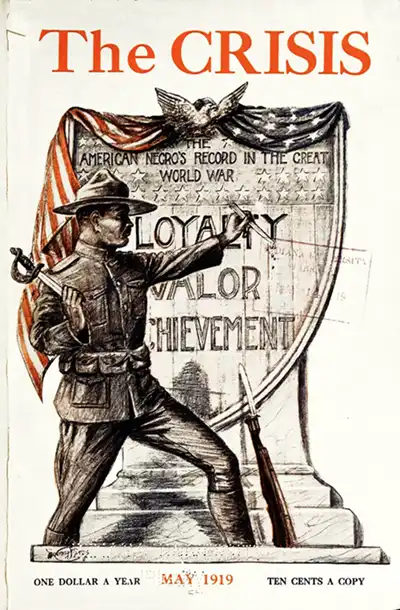
Du Bois, traveling in France in late 1918 and early 1919 as part of the press delegation accompanying President Woodrow Wilson to the Paris Peace Conference , discovered the directive. Recognizing its significance as irrefutable documentary evidence of official governmental malice, he published the full text in the May 1919 issue of The Crisis.
The Crisis, the widely read and highly influential journal of the NAACP, served as a crucial national corrective to the racial stereotypes and silences of the mainstream press. The publication of the memorandum validated every charge the NAACP had ever made regarding governmental hypocrisy. Du Bois leveraged the document to passionately assert that the United States, by actively exporting its Jim Crow policies and attempting to suppress the dignity of its own troops, was “No nation… less fitted for this role” of global moral protagonist.
“We must prevent the rise of any pronounced degree of intimacy between French officers and black officers. We may be courteous and amiable with these last, but we cannot deal with them on the same plane as with the white American officers without deeply wounding the latter.”
MISSION MILITAIRE FRANÇAISE
près l’Armée Américaine.
Le 7 août 1918.
4.2. Scott’s Official Narrative Undermined
For Emmett J. Scott, the document’s public exposure presented an enormous crisis. His entire administrative strategy was predicated on the belief that consistent loyalty and distinguished military service would eventually compel white America to grant Black Americans full citizenship rights. The ‘Secret Information’ proved that even while Black soldiers were fighting and dying, the highest levels of the American military were plotting to negate any social progress they might achieve through their interaction with the French.
Scott’s subsequent historical account, Official History of the American Negro in the World War, could not entirely ignore the incident, but his description was necessarily constrained by his official allegiance. Scott included a reference to the directive, stating that “biased Americans succeeded in having issued” the memo from Pershing’s headquarters. This attribution to vague “biased Americans,” rather than a forceful, immediate condemnation of the AEF leadership, lacked the moral authority and militant force of Du Bois’s public exposé.
The political consequence of the revelation was decisive: the memorandum provided concrete proof that cooperation with the U.S. government led not to reward, but to systemic deceit. This profound betrayal irrevocably damaged the legitimacy of the accommodationist model in the immediate post-war era, providing undeniable validation for the Du Boisian protest strategy.
4.3. Post-War Investigations and Legacy
Du Bois used his time in France and the subsequent publication of the directive to launch a wide-ranging assessment of the treatment of African American soldiers. His investigations confirmed that Black servicemen endured overseas racism that was experienced as physically and emotionally damaging, akin to the “shell shock” recognized in other World War I participants.
Furthermore, investigations by figures like Robert Russa Moton, the head of the Tuskegee Institute, also concluded that the racist rumors circulated during the war—allegations of cowardice or misconduct against Black troops—were “seriously exaggerated”. Du Bois argued that white officers were frequently covering up their own failures by shifting blame onto Black units.
The collective experience—fighting valiantly abroad, experiencing relative freedom in France, discovering irrefutable proof of their government’s active racial conspiracy, and returning home to face renewed segregation and intense racial violence (the Red Summer of 1919)—galvanized a new generation of militant Black leadership. Veterans, especially the Black officer class from Fort Des Moines, returned resolved to continue fighting for equality with “Deeds, not Words,” forming the vanguard of the “New Negro” movement. The exposure of the ‘Secret Information’ memorandum served as the documentary justification for this militant transition.
V. Conclusion and Legacy
The ideological conflict between Emmett J. Scott and W.E.B. Du Bois during World War I centered on whether African American dignity could be achieved through administrative cooperation or required militant confrontation. The transmission of the “Secret Information Concerning Black American Troops” memorandum in August 1918 served as the definitive evidence that conclusively resolved this debate, at least for the post-war era.
The analysis confirms that the memorandum originated from General Pershing’s Headquarters (AEF GHQ) and was transmitted by Colonel J.L.A. Linard through the French Military Mission. The motivation was the explicit enforcement of Jim Crow segregation on French soil, driven by the fear that French social “familiarity and indulgence” would inspire “aspirations which to them (the whites) appear intolerable” in Black soldiers. This action revealed that the U.S. military prioritized the preservation of the domestic racial hierarchy above wartime diplomatic unity or the moral cause of democracy.
Du Bois’s subsequent public exposure of this betrayal in The Crisis in May 1919 permanently discredited the Scott/Washingtonian model of accommodation, proving that the government was not merely negligent toward Black troops but actively malevolent. The shock of this revelation energized the returning veterans and fueled the militancy of the “New Negro” era, solidifying the protest tradition—championed by the NAACP—as the dominant strategy for civil rights advocacy in the subsequent decades. The war, which African Americans had hoped would be a vehicle for integration, ultimately became the crisis that revealed the hypocrisy of American identity and solidified the necessity of relentless struggle against structural racism.
W. E. B. Du Bois and the NAACP
- W.E.B. Du Bois, “Close Ranks” Editorial from The Crisis | BlackPast.org
- DuBois – Close Ranks Excerpt (1918) | Truman Library
- World War I in the Historical Imagination of W. E. B. Du Bois | Cambridge
- W. E. B. Du Bois | The Hutchins Center, Harvard
- W. E. B. Du Bois and The Crisis | UMBC
- The Walter White Project: The NAACP and World War I
- The Crisis – Modernist Journals Project
African American Soldiers in World War I
- Analysis: The Story of a Black Infantry Unit | EBSCO
- Fighting Against the Odds: Black Soldiers in the Second World War | Gilder Lehrman
- African American Soldiers in World War I | Oxford Research Encyclopedias
- “The Damnable Dilemma”: African-American Accommodation and Protest during World War I | Semantic Scholar
- Deeds, Not Words: African American Officers of World War I in the Battle for Racial Equality | University of Mississippi
Emmett J. Scott and Historical Accounts
- Scott’s Official History of the American Negro in the World War | Winthrop
- Scott, Emmett Jay | Texas State Historical Association
- Emmett J. Scott: The American Negro in World War I (Table of Contents) | BYU
- E.J. Scott: The American Negro in the World War, Chapter XXX | BYU
International Perspectives and Racial Policy
- A French Directive | Yale MacMillan Center
- A WWI-Era Memo Asking French Officers to Practice Jim Crow With Black American Troops | Slate
- French Military Mission Stationed with the American Army (Aug 7, 1918) | VIU


