
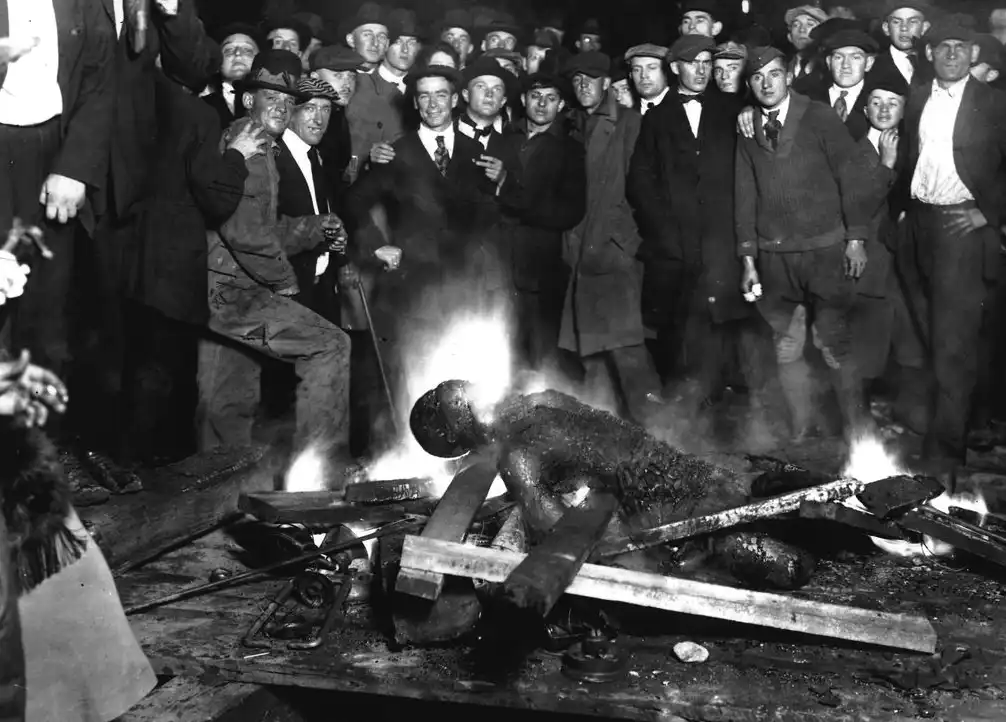

1919 – The Red Summer
How Race Massacres and Defiant Black Veterans Forged the Civil Rights Movement

I. Introduction: Defining the Scope and Significance of the 1919 Bloodshed
The period known historically as the “Red Summer” of 1919 stands as a pivotal and brutal climax in the history of American racial violence. This era was characterized not by a single, isolated event, but by a coordinated series of white supremacist terrorist attacks, race riots, lynchings, and murders targeting African Americans across the United States. The moniker “Red Summer” was consciously applied by James Weldon Johnson, the influential field secretary for the National Association for the Advancement of Colored People (NAACP), specifically to acknowledge and highlight the intense bloodshed that stained the nation. By naming this diffuse violence, Johnson framed the crisis as a cohesive national political and civil rights emergency, rather than a collection of random local disturbances.
The geographic scope of the violence was immense, encompassing more than three dozen cities and one major rural county in Arkansas. Major urban centers that experienced significant conflict included Chicago, Illinois; Washington, D.C.; and Omaha, Nebraska. However, the highest recorded fatality count occurred in the rural area of Phillips County, Arkansas, surrounding the town of Elaine.
The central argument established through an analysis of the Red Summer is that the violence was not simply an emotional reaction to demographic shifts, but rather a structured, often coordinated, national effort aimed at violently suppressing burgeoning African American economic autonomy and political agency. This effort was frequently led by returning white servicemen and incited by local media. Crucially, the campaign failed to intimidate African Americans into submission, instead catalyzing a critical shift in the civil rights struggle toward organized self-defense and landmark federal litigation. The report proceeds by examining the socio-economic friction, the role of Black and white veterans, the specific dynamics of the urban and rural massacres, and the transformative legal aftermath resulting from the violence.
II. The Structural Foundations of Conflict: Post-War America as a Powder Keg
The year 1919 existed at the violent intersection of profound socio-economic dislocation following World War I and deep-seated racial prejudice. The structural causes of the Red Summer provided the necessary fuel for widespread conflict.
The Velocity of the Great Migration and Urban Strain
One of the most significant demographic shifts driving the conflict was the accelerated pace of the Great Migration. World War I intensified the movement of African Americans from the economically restricted, legally discriminatory Jim Crow South to the industrial North and Midwest. By the summer of 1919, roughly 500,000 African Americans had resettled in northern cities. This mass influx placed immense strain on urban resources, immediately intensifying competition for housing and, most critically, for industrial jobs.
The arrival of Black newcomers was met with deep resentment by many existing residents. Northern white workers, many of whom were newly arrived immigrants themselves, felt threatened by this competition for scarce resources. This palpable tension was readily exploited by nativist and white supremacist narratives, which falsely attributed economic woes to the Black population.
Economic Instability and the Radical Scapegoat
The immediate postwar economic environment was characterized by disruptive instability, high inflation, and extensive labor unrest, including numerous strikes. This economic anxiety created a volatile environment where resentment over competition was easily deflected onto racial minorities.
Black laborers often suffered from a negative reputation within the white working community because they were frequently used as low-wage strike breakers, or “scabs,” by factory owners seeking to maintain operations during strikes. This use as replacement labor strategically deepened the racial fissure between Black and white workers, preventing the formation of class solidarity and focusing white working-class rage squarely on race rather than on capital.
Adding complexity, the immediate post-war era coincided with the First Red Scare, fueled by paranoia following the 1917 Russian Revolution. This fear of revolutionary socialism was systematically racialized. Evidence suggests that many white officials and public figures, without substantive proof, suspected organized Black workers who showed collective agency of being “pawns of Bolsheviks and anarchists”. This critical connection means that the structural fear of Communism was intentionally weaponized to legitimize white supremacist violence. By framing Black political and economic organizing—such as unionizing—as seditious and anti-American, authorities provided a political justification for violence that extended well beyond simple racial animus, enabling perpetrators to view their assaults as patriotic acts of counter-subversion.
The Paradox of the Returning Veteran
The end of World War I brought home millions of servicemen, both white and Black, whose expectations clashed violently with reality.
White servicemen returned home expecting to reclaim their vacated positions. They experienced profound resentment when they found that these jobs had been occupied, particularly by African Americans, thus escalating tensions in workplaces and neighborhoods across the country.
Conversely, African American veterans returned from fighting for democracy abroad with a powerful and uncompromising determination to demand full citizenship rights at home. W.E.B. Du Bois famously articulated this shift in mindset, encouraging them to “return fighting” for their dignity. These Black soldiers viewed the United States, which had accepted their sacrifice but denied them equality, as a “disgraceful place full of bigotry”. This determination to fight for domestic democracy directly challenged the existing racial hierarchy and was viewed by white supremacists as an immediate, existential threat to the social order, making Black veterans a primary target of the ensuing violence.
III. The Ideology of Resistance: Armed Self-Defense and Organized Agency
A core analytical conclusion regarding the Red Summer is that the violence failed to achieve its primary objective: intimidating the African American population into submission. Instead, the widespread systemic failure of state protection compelled a historic shift toward organized, aggressive self-defense, which became a foundational element of later civil rights activism.
The Shift from Submission to Confrontation
The collective experience of 1919 forged a “greater sense of shared purpose, identity and pride” among African Americans. The outcome was an emergence from the bloodshed with an enhanced resolve to fight back—not just through political appeals, but through direct action, in the courts, and at the ballot box. Black populations across the country fought back aggressively against intimidation in ways that represented a significant departure from earlier responses to racial violence.
Black Veterans as Defense Leaders
African American veterans were instrumental in organizing and leading these defense efforts. News reports confirmed that Black veterans stood “on the front lines” to defend their homes and communities from the white attacks. The determination of these soldiers was directly tied to the new, non-negotiable demand for respect. Tragically, this stance also made them targets; Randall Neal, a 22-year-old Black veteran, was counted among the first victims of the Red Summer violence in Washington, D.C..
Strategic Militarization and the Failure of State Protection
The necessity of armed self-defense was made starkly clear by the active or passive complicity of law enforcement. In Washington, D.C., following sustained attacks and the complete lack of effective police or military intervention, the Black community opted to secure protection themselves, purchasing guns and ammunition.
This required action demonstrates a catastrophic practical collapse of the state’s monopoly on legitimate violence. When law enforcement and established military troops were either unwilling to intervene or, in some cases, were suspected of actively joining the white mobs , Black citizens were left with no recourse but to organize and defend their neighborhoods. This act of defensive militarization represented a profound assertion of civil rights and fundamentally changed the dynamics of racial conflict by confirming to Black communities that survival depended on self-reliance. A 1919 report confirmed that the persistence of unpunished lynching contributed to a mob mentality among white men, which, in turn, fueled the new commitment to self-defense among Black men emboldened by their military service.
IV. Urban Massacres: Media Incitement and Official Complicity
Analysis of the urban riots, particularly those in Chicago and Washington, D.C., reveals that local institutions—specifically the media and local law enforcement—often functioned as integral extensions of the white mob.
The Chicago Riot (July 27 – August 3, 1919)
The violence in Chicago, which lasted for seven days, was sparked by a racially segregated incident on the lakefront. On July 27, 1919, a Black teenager named Eugene Williams drowned after he was struck by a rock thrown by a white man at a segregated beach. The official response to this tragedy escalated the incident into a massive riot. The violence was widespread, resulting in 38 deaths (23 Black and 15 white) and over 500 injuries. Despite African American residents fighting back, the majority of the casualties and property damage were inflicted upon Black Chicagoans.
The Washington, D.C. Riot (July 19–23, 1919)
The Washington, D.C., violence began after a series of inflammatory articles in local media deliberately incited white hostility. These publications falsely accused Black men of assaults, whipping up racial fervor. The attacks were notably led by white servicemen.
The connection between the press and the violence was acutely operational. After the first night of attacks, The Washington Post published a headline, “Mobilization for Tonight,” which explicitly called for all servicemen to gather on Pennsylvania Avenue. This action goes beyond passive reporting; the media outlet functioned as a coordinating mechanism for the white mob, legitimizing and organizing the attacks. When white cavalry and marines were finally deployed, their role was ambiguous—it was genuinely unclear whether these troops were there for “fighting the mob or joining it”. This institutional ambiguity validated the Black community’s decision to arm themselves for self-defense.
To better illustrate the disproportionate nature of the conflict and the immediate causes, a summary of major urban incidents is necessary:
Comparative Casualties and Triggers of Major Urban Riots (Red Summer 1919)
City/Location
Primary Dates
Specific Trigger Event
Casualties (Black/White)
Unique Assailant Factor
Chicago, IL
July 27 – Aug 3
Drowning of Eugene Williams at segregated beach
23 Black, 15 White (38 Total)
Widespread gang violence, inadequate police response.
Washington, D.C.
July 19–23
Inflammatory newspaper reports of false assaults
15 Total (Approx.)
White servicemen (military personnel) leading attacks; media incitement.
Omaha, NE
Sept 28–29
Lynching of Will Brown
Unknown (Significant property damage)
Federal Troops called, high intensity mob ac
V. The Elaine Cataclysm: Economic Control and Mass Murder
While the urban riots were destructive, the Elaine Massacre in rural Phillips County, Arkansas, stands out as the single deadliest incident and provides the clearest evidence of violence directed explicitly at suppressing African American economic and legal organizing.
The Progressive Farmers and Household Union of America (PFHUA)
The cataclysm was directly triggered by a meeting of the Progressive Farmers and Household Union of America (PFHUA), a union of African American tenant farmers and sharecroppers organized by Robert L. Hill. The union had specific goals that constituted a direct challenge to the white economic power structure maintaining the exploitative sharecropping system.
The PFHUA organized collective resistance by having Black women stop working in white domestic positions and demanding higher wages for cotton pickers. These demands challenged both the social order and the profitability of white landlords. Most critically, the union had retained lawyers at the state capital and planned to file lawsuits against landlords for shares allegedly withheld from tenant farmers.
This intention to use the judicial system to reclaim stolen profits transformed the situation from a labor dispute into a direct legal threat against white property and privilege. The violence, sparked by the fatal shooting of a white man (likely a guard or security agent) who attacked the union meeting, was instantly disproportionate.
Pre-emptive Counter-Insurgency
The subsequent massacre was not a spontaneous riot but a targeted, massive counter-insurgency designed to eradicate any possibility of Black economic self-determination through collective action and judicial process. Hundreds of whites poured into the area, attacking African Americans on sight. Estimates suggest that between 100 and 240 Black people were killed, compared to five white fatalities, making Elaine arguably the deadliest racial conflict in U.S. history. This level of lethal force was required, in the minds of the perpetrators, to defend the foundational economic structure of the rural South.
The specific, organized nature of the resistance and the extreme nature of the white response are detailed below:
Goals and Threat Assessment of the Progressive Farmers and Household Union
Union Goal/Action
Threat to White Power Structure Dates
Mechanism of Resistance
Demand higher wages for cotton pickers.
Challenges the profitability and economic control of white landlords.
Collective bargaining/labor organizing.
Black women stopped working in white domestic positions.
Disrupts the social and domestic order maintained by racial hierarchy.
Economic boycott/Withdrawal of labor.
Hired lawyers to sue landlords for withheld shares
Directly challenges the legality and permanence of the exploitative sharecropping system.
Judicial process and civil rights advocacy.
The Initial Judicial Travesty
Following the massacre, the focus of the legal system was immediately placed on prosecuting the surviving Black union members. All-White juries quickly convicted the “Elaine Twelve” and sentenced them to death or long prison terms, often in trials dominated by mob intimidation. The Arkansas Gazette applauded these proceedings, celebrating them as a “trumph of the ‘rule of law’,” merely because the defendants had been convicted by a court and not summarily lynched by the mob beforehand. This outcome demonstrated the state judiciary’s complicity in legitimizing the massacre by punishing the victims and protecting the perpetrators.
VI. Judicial Aftermath: The Landmark Legacy of Moore v. Dempsey
The legal fight that followed the Elaine Massacre, orchestrated primarily by the NAACP, became the single most consequential judicial challenge derived from the Red Summer, fundamentally transforming the relationship between federal and state courts regarding due process.
Appeals and Due Process Violations
The NAACP pursued appeals vigorously on behalf of the convicted men. The State Supreme Court eventually overturned the convictions of the six “Moore” defendants (part of the Elaine Twelve), finding that the systematic exclusion of Black citizens from the juries violated the Fourteenth Amendment’s Due Process Clause and the Civil Rights Act of 1875.
Moore v. Dempsey (1923): The Challenge to Mob Rule
The case proceeded through habeas corpus appeals and eventually reached the U.S. Supreme Court. The core legal question addressed in Moore v. Dempsey (1923) was whether a federal court could intervene when a state conviction, though seemingly procedural, was rendered inherently unfair due to the overwhelming presence of mob dominance and fear.
The Supreme Court’s landmark ruling in Moore v. Dempsey established that federal district courts were authorized to hold hearings to determine the validity of state convictions when the prisoner alleged that his trial had been dominated by mob rule. This was a transformative moment in American constitutional law. Prior to this, federal courts were highly deferential to state judicial findings.
The ruling, building on Justice Oliver Wendell Holmes, Jr.’s influential earlier dissent, initiated a “long transition toward a more searching review of state criminal proceedings”. It established that the Due Process Clause of the Fourteenth Amendment demanded substance over mere form, ensuring that a trial, especially for racial and religious minorities facing hostility, must be “more than an empty shell”. This verdict created a substantive constitutional check on state judicial fairness, particularly protecting minorities from convictions driven by overwhelming public sentiment and intimidation.
Final Resolution
The ruling mandated further judicial action, but when the cases were remanded to the state court, the lower courts failed to retry the men within the two years required by Arkansas law. Consequently, the defense successfully gained the release of the remaining defendants in 1923, nearly four years after the massacre.
The timeline demonstrates the protracted legal battle that defined the aftermath of the Elaine Massacre:
Timeline of Legal Proceedings Related to the Elaine Massacre
Sept 30, 1919
Progressive Farmers Union meeting attacked.
Immediate trigger for the massacre.
Late 1919
All-White juries convict “Elaine Twelve.”
Example of mob-dominated trial and immediate failure of state due process.
1921
Arkansas Supreme Court overturns convictions.
Found violations of the 14th Amendment due to exclusion of Black people from juries.
1923
U.S. Supreme Court rules in Moore v. Dempsey.
Established federal habeas corpus jurisdiction in cases of mob intimidation in state trials; monumental shift in federal judicial review.
1923
Final release of all remaining defendants.
Ultimate victory for the NAACP and legal activism.
VII. Institutional Failure and Historical Consequence
The Red Summer revealed not only the pervasive power of white supremacy but also the profound institutional failure of the federal government to intervene against systemic racial terrorism.
Federal Abdication and Executive Silence
During the height of the violence, President Woodrow Wilson was deeply involved in peace negotiations in Paris, though he received news of the brewing labor unrest and domestic troubles. However, analysis shows that Wilson had “very little to say” regarding the numerous incidents of racial violence.
Wilson consistently maintained that racial violence was a matter for local authorities, actively resisting appeals from various groups for a congressional investigation into the widespread violence. This failure of executive leadership meant that any potential federal response was stifled, a situation exacerbated when Wilson suffered a stroke shortly after the summer concluded.
The refusal of the federal executive to use national authority to investigate, prosecute, or even publicly condemn the violence had critical structural implications. By consistently delegating impunity to local white power structures, Wilson reinforced the Jim Crow assumption that the federal government would not meaningfully challenge systemic racial violence. This policy of non-interference indirectly legitimized the actions of the mobs and prolonged the Nadir of American race relations by signaling to both victims and perpetrators that the federal system would not assure basic civil protections for African Americans.
The Enduring Legacy of the Red Summer
The traumatic events of 1919 served as a stark, undeniable lesson for African American communities: they could not rely on state or federal authorities for physical protection or judicial fairness. The systemic betrayal resulted not in the submission hoped for by the white mobs, but in a renewed and sophisticated resolve.
The outcome was a channeling of this resistance into organized, strategic areas—armed self-defense, the courts, and political organizing. The violence directly contributed to a “new commitment to self-defense” among Black men, particularly veterans, recognizing that military service abroad did not secure civil rights at home.
The NAACP’s strategic legal success in the Moore v. Dempsey case proved the viability of using the federal judiciary to challenge state-sanctioned injustice. By securing the ruling that the Constitution mandated genuine due process against mob rule, the NAACP established a critical blueprint for the legal strategy that would ultimately define the modern Civil Rights Movement. Thus, the Red Summer, while a period of extraordinary suffering, simultaneously marked a crucial watershed where Black resistance pivoted definitively from appeal and accommodation to organized defense and aggressive legal challenge.
VIII. Conclusions
The Red Summer of 1919 was not a spontaneous period of civil unrest but a calculated convergence of post-war economic anxiety, racialized political paranoia (the Red Scare), and the militant determination of white supremacy to repel the nascent political and economic autonomy of African Americans, especially returning veterans. The defining characteristics of this period were:
- Structural Engineering of Violence: The violence was structurally fueled by exploiting economic competition arising from the Great Migration and strategically justifying white terrorist acts by conflating Black organization with Bolshevism, thereby framing violence as necessary national defense.
- Institutional Complicity: Local institutions, most explicitly major media outlets like The Washington Post, actively functioned to incite and coordinate attacks, while state and local law enforcement either joined the mobs or stood aside, compelling Black communities to organize for armed self-defense.
- Targeted Economic Suppression: The Elaine Massacre demonstrated that the deadliest violence was directed specifically at organized Black efforts to achieve economic parity and legal redress against exploitative systems like sharecropping.
- Judicial Transformation: The ensuing legal battle culminating in Moore v. Dempsey transformed the landscape of federal judicial review. The Supreme Court leveraged the injustice of the Red Summer trials to establish a powerful precedent, enabling federal intervention against state criminal proceedings tainted by racial intimidation, thereby providing a critical future mechanism for protecting minority rights under the Fourteenth Amendment.
Ultimately, the Red Summer of 1919 confirmed the depth of institutional racism in the United States, yet simultaneously catalyzed the transition from the old politics of protest to the modern politics of aggressive litigation and self-determination, cementing its place as a crucial foundation for the Civil Rights Movement decades later.
Summary: The Red Summer of 1919 marked a nationwide eruption of racial violence in the United States, as white mobs attacked Black communities in more than three dozen cities and counties. Sparked by postwar tensions, racial resentment, and Black veterans’ growing demands for equality, the violence exposed the deep racial divides of early twentieth-century America. From Washington, D.C. to Elaine, Arkansas, African Americans organized in self-defense and faced brutal repression, yet their resistance helped lay the groundwork for later civil rights struggles. Key events, such as the Elaine massacre and the resulting Moore v. Dempsey Supreme Court decision, reshaped federal oversight of civil rights violations in state courts. The Red Summer remains a pivotal moment in U.S. history—where both racial terror and Black resistance defined the nation’s uneasy transition after World War I.
Overviews & Historical Context
- Red Summer – Wikipedia
- The Mob Violence of the Red Summer – JSTOR Daily
- Red Summer | National WWI Museum and Memorial
- Red Summer of ’19 – Woodrow Wilson Presidential Library and Museum
- Red Summer of 1919 – Equal Justice Initiative
- Racial Violence and the Red Summer – National Archives


