
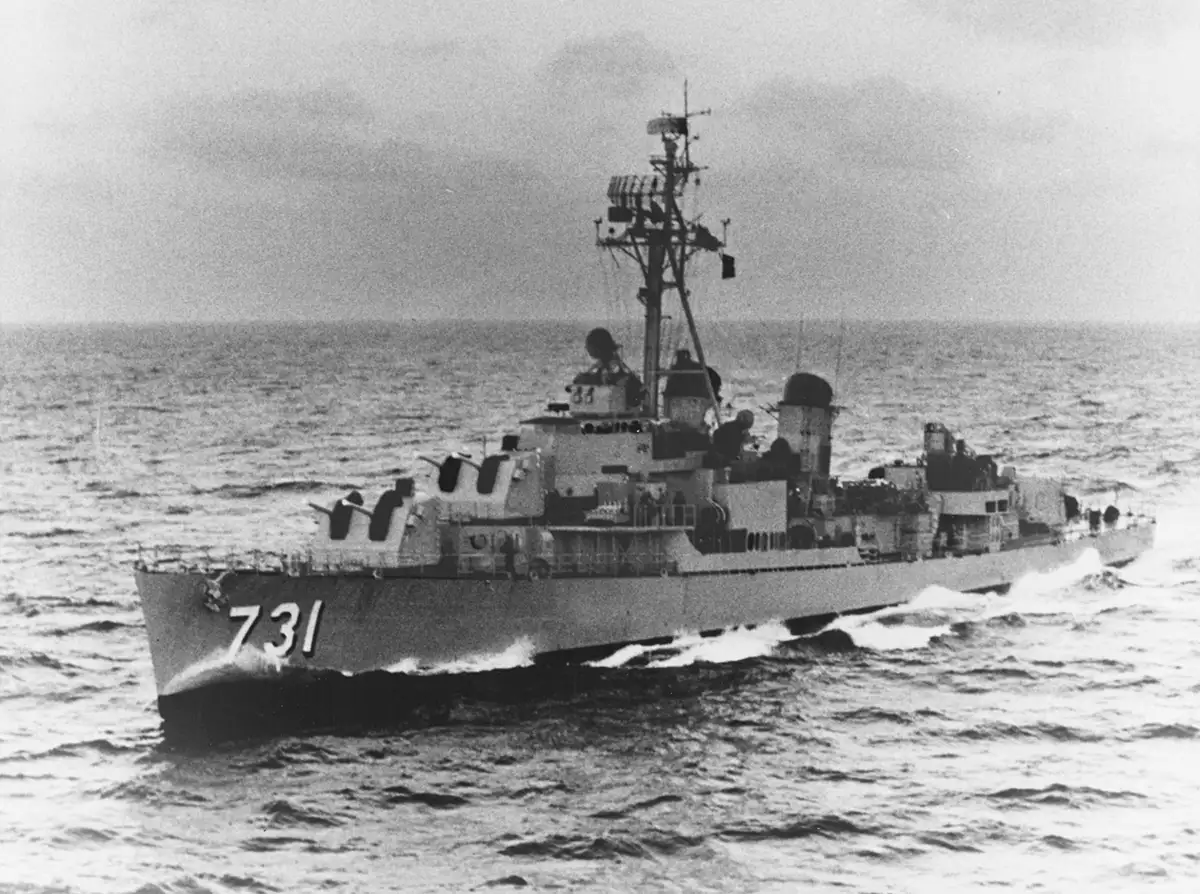

The Gulf of Tonkin Phantom Attack
The Intelligence Failure, Executive Authority, and the Escalation of the Vietnam War

I. Introduction: The Geopolitical Crucible of 1964
The Gulf of Tonkin incident stands as the definitive watershed moment in the American involvement in the Vietnam War. Ostensibly comprised of two separate naval engagements in early August 1964 between the United States Navy and the naval forces of the Democratic Republic of Vietnam (DRV), the event catalyzed the passage of the Gulf of Tonkin Resolution. This legislative act granted President Lyndon B. Johnson sweeping executive powers to wage war without a formal declaration, fundamentally altering the constitutional balance of war powers in the United States and setting the nation on a trajectory toward a decade-long conflict that would claim over 58,000 American lives and millions of Vietnamese lives.
To understand the events of August 1964, one must look beyond the immediate tactical maneuvers in the Gulf to the broader geopolitical and operational context. The United States was in the throes of the Cold War, guided by the containment policy and the domino theory, which posited that the fall of South Vietnam to communism would precipitate the collapse of all Southeast Asia. By 1964, the situation in South Vietnam was deteriorating rapidly. Following the coup and assassination of President Ngo Dinh Diem in November 1963, the political landscape in Saigon was characterized by instability and a succession of weak military juntas. The Johnson administration, facing a presidential election against the hawkish Senator Barry Goldwater, was under immense pressure to demonstrate firmness against communist aggression while avoiding a reckless expansion of the war.
The official narrative presented to the American public and Congress in August 1964 was one of unprovoked aggression against United States naval vessels lawfully present in international waters. However, historical analysis, bolstered by declassified National Security Agency (NSA) archives, high-level diplomatic retrospectives, and the release of the “Pentagon Papers,” confirms a bifurcated reality. The engagement on August 2, 1964, was a genuine combat incident, albeit one provoked by a campaign of covert U.S. operations known as OPLAN 34A. Conversely, the alleged attack on August 4, 1964, was a “phantom battle” generated by environmental anomalies, sonar malfunction, confirmation bias, and a systemic failure of intelligence analysis.
This report provides an exhaustive reconstruction of the timeline, the intelligence apparatus, and the political machinery that transformed a non-event into the justification for war. It integrates the findings of the 2005 declassified NSA study by historian Robert J. Hanyok, the 1995 admissions by North Vietnamese General Vo Nguyen Giap, and the internal dissent within the Johnson administration, most notably from Undersecretary of State George Ball.
II. The Covert Infrastructure: Operation 34A and DESOTO
The “unprovoked aggression” narrative cited by the Johnson administration masked a complex web of espionage and sabotage operations that placed U.S. destroyers on a collision course with North Vietnamese coastal defenses. The escalation in the Gulf of Tonkin cannot be decoupled from two parallel but intersecting American programs: Operation 34A (OPLAN 34A) and the DESOTO patrols.
2.1 Operation 34A (OPLAN 34A)
By late 1963, American strategists determined that the survival of the South Vietnamese government required increased pressure on the North. The Central Intelligence Agency (CIA) had been conducting low-level covert operations, but in January 1964, operational control was transferred to the Department of Defense, specifically the Military Assistance Command, Vietnam – Studies and Observations Group (MACV-SOG). This shift marked a significant escalation in the intensity and lethality of the operations.
OPLAN 34A was a highly classified program of covert actions consisting of agent team insertions, aerial reconnaissance, and naval sabotage operations against the Democratic Republic of Vietnam (DRV). While the operations were publicly attributed to South Vietnamese forces to maintain plausible deniability, they were funded, planned, and equipped by the United States. The U.S. Navy provided “Nasty”-class patrol boats—fast, Norwegian-built vessels capable of high-speed raids against coastal installations. These boats were armed with recoilless rifles and mortars, designed to inflict damage on North Vietnamese radar sites and security posts.
The operational tempo increased significantly in the summer of 1964. The objective was to force Hanoi to divert resources to coastal defense and to demonstrate the vulnerability of North Vietnamese territory. On the night of July 30–31, 1964, South Vietnamese commandos launched a raid against North Vietnamese radar and military installations on the islands of Hon Me and Hon Ngu. These islands were strategically located in the Gulf of Tonkin, and the attacks involved heavy shelling from the Nasty-class boats. This raid was not a minor skirmish but a significant military provocation that placed North Vietnamese coastal defenses on high alert.
2.2 The DESOTO Patrols
Simultaneous with OPLAN 34A, the U.S. Navy conducted signals intelligence (SIGINT) missions known as DESOTO (DeHaven Special Operations off Tsingtao) patrols. These missions involved destroyers equipped with mobile “vans”—portable shelters lashed to the deck containing sophisticated electronic listening gear and manned by Naval Security Group (NSG) personnel.
The USS Maddox (DD-731) commenced its DESOTO patrol in late July 1964. Its mission profile was threefold:
- Presence: Establish and maintain a U.S. naval presence in international waters off the Vietnamese coast.
- Intelligence Collection: Intercept North Vietnamese naval communications and map the coastal radar network.
- Stimulation: By its very presence, the destroyer would stimulate North Vietnamese radar operators to turn on their equipment, allowing the NSG technicians to record their frequencies and locations.
The Maddox was specifically ordered to patrol off the coast of North Vietnam during the same period that the OPLAN 34A raids were intensifying. The operational orders for the patrol (SIGAD USN-467N) placed the ship in the Gulf of Tonkin with instructions to approach no closer than eight nautical miles from the mainland and four nautical miles from offshore islands.
2.3 The Convergence of Covert and Overt Missions
While Washington maintained that OPLAN 34A and DESOTO were distinct operations—one South Vietnamese and covert, the other American and overt—the North Vietnamese viewed them as a coordinated threat. The Maddox was patrolling the same waters where the OPLAN 34A raids had occurred just days prior. On August 1, the Maddox came within four miles of Hon Nieu island, one of the targets of the July 30 raids.
Intelligence intercepts confirmed that the North Vietnamese military did not distinguish between the South Vietnamese raiders and the American destroyer. To Hanoi, the Maddox appeared to be the command-and-control vessel supporting the commando attacks. This perception was not accidental; American policymakers understood that the pressure exerted by 34A raids would induce North Vietnamese defensive reactions that the DESOTO patrols could then record. The Maddox was essentially used as bait to light up the North Vietnamese electronic order of battle.
By August 1, the North Vietnamese navy was tracking the Maddox closely. Intercepts indicated that they were preparing to engage what they believed to be an enemy vessel supporting the attacks on their sovereignty. This set the stage for the first engagement on August 2.
III. The First Incident: August 2, 1964
The events of August 2, 1964, constitute the first phase of the Gulf of Tonkin incident. Unlike the subsequent controversy of August 4, the engagement on August 2 is historically undisputed as a genuine naval battle. However, the characterization of the event by the Johnson administration as an act of “unprovoked aggression” is deeply complicated by the preceding covert actions.
3.1 The Prelude to Battle
On the morning of August 2, the USS Maddox was patrolling approximately 28 nautical miles off the North Vietnamese coast. The ship’s Naval Security Group detachment, monitoring North Vietnamese communications, intercepted operational orders indicating that North Vietnamese naval forces had been ordered to prepare for battle. The specific intercept indicated that three P-4 torpedo boats were being sortied from Hon Me island—the same island attacked by OPLAN 34A raiders two nights prior.
Captain John J. Herrick, the commodore of the destroyer division aboard the Maddox, evaluated the situation. Recognizing the threat, he ordered the ship to increase speed and turn seaward, hoping to avoid a confrontation while maintaining his patrol station. However, the P-4 boats continued their pursuit, closing the distance rapidly.
3.2 The Engagement
At approximately 1400 hours local time (timeline variations exist in sources, but the sequence is consistent), the Maddox radar tracked the three North Vietnamese torpedo boats closing at high speed (estimated at 50 knots). When the vessels closed to within 10,000 yards, Captain Herrick ordered the Maddox to fire three warning shots from its 5-inch guns. This action is critical: while the U.S. claimed the North Vietnamese fired first, the Maddox initiated the firing with warning shots, which the North Vietnamese likely interpreted as the commencement of an attack.
The North Vietnamese boats pressed the attack, launching torpedoes and firing 14.5mm machine guns. The Maddox maneuvered aggressively to evade the torpedoes, which were observed passing the ship. The destroyer returned fire with its 5-inch and 3-inch batteries, expending over 280 shells.
Simultaneously, four F-8 Crusader jet fighter-bombers, launched from the nearby aircraft carrier USS Ticonderoga (CVA-14), arrived on the scene. The aircraft strafed the North Vietnamese boats with 20mm cannon fire and Zuni rockets.
3.3 The Outcome and Damage Assessment
The skirmish was decisively one-sided in favor of American firepower:
- North Vietnamese Losses: All three P-4 torpedo boats were heavily damaged. One boat was left dead in the water and burning. Four North Vietnamese sailors were killed, and six were wounded.
- American Damage: The Maddox sustained a single 14.5mm bullet hole in its superstructure. No U.S. casualties were reported. One F-8 Crusader sustained minor wing damage but returned safely to the Ticonderoga.
3.4 The Immediate Political Reaction
Following the August 2 skirmish, President Johnson ordered the Maddox to remain in the area and explicitly reinforced the patrol with a second destroyer, the USS Turner Joy (DD-951). This decision was intended to demonstrate American resolve and refusal to be intimidated from international waters. The administration issued a stern warning to Hanoi that further “unprovoked” attacks would be met with “grave consequences.” Crucially, the administration did not publicly acknowledge the OPLAN 34A raids that had precipitated the North Vietnamese response, maintaining the fiction that the Maddox was on a routine, innocent patrol.
On the night of August 3, while the Maddox and Turner Joy were patrolling, the South Vietnamese navy staged another OPLAN 34A raid. This time, the “Nasty” boats shelled a radar station at Vinh Son. This second raid, occurring while the reinforced U.S. patrol was active in the Gulf, further heightened tensions and reinforced the North Vietnamese belief that the U.S. destroyers were directly facilitating the attacks. The Maddox and Turner Joy were ordered to remain north of the 17th parallel, placing them in the general vicinity of the new raids.
IV. The Phantom Battle: August 4, 1964
The events of the night of August 4, 1964, constitute the core controversy of the Tonkin Gulf incident. Unlike the daylight battle of August 2, the second “attack” occurred on a moonless night under adverse weather conditions, relying almost entirely on ambiguous electronic data and the frayed nerves of the destroyer crews.
4.1 Environmental and Technical Conditions
The night of August 4 was characterized by extreme environmental hostility. The Gulf of Tonkin was engulfed in a tropical disturbance, resulting in total darkness, low visibility, and rough seas with wave heights reaching six feet. Thunderstorms in the area created significant atmospheric disturbance, which can cause erratic radar returns.
Technically, the U.S. ships were operating with degraded capabilities. The Maddox‘s SPS-40 long-range air-search radar was inoperative, and the Turner Joy‘s SPG-53 fire-control radar was also suffering from reliability issues. These equipment malfunctions, combined with the “freak weather,” created a sensory environment ripe for misinterpretation.
4.2 The “Engagement” Timeline
The timeline of the alleged second attack reveals a chaotic sequence of radar contacts and sonar reports that unraveled almost immediately upon tactical review.
19:15
Marine SIGINT detachments at Phu Bai intercept North Vietnamese communications ordering military operations. This is interpreted as an imminent attack on the destroyers.
19:46
Maddox radar detects “skunks” (unidentified surface contacts) 36 miles to the northeast.
20:40
Maddox tracks unidentified vessels. Contacts appear to come from multiple directions.
21:34
Turner Joy detects contacts at 10,000 yards and opens fire.
21:39
Maddox sonar operators report a noise spike interpreted as an incoming torpedo.
21:40 – 23:30
The destroyers engage in high-speed evasive maneuvers. Maddox sonar reports a total of 22 incoming torpedoes. The ships fire over 300 rounds into the darkness at radar ghosts.
The sonar reports were particularly anomalous. The Maddox reported 22 torpedoes, a number that far exceeded the capacity of the North Vietnamese navy’s entire fleet of functional torpedo boats (each P-4 carried only two torpedoes, and several boats had been damaged on August 2). The frantic evasive maneuvers of the destroyers likely generated “knuckle” noise—the sound of the ship’s own propeller wash reflecting off the rudder during sharp turns—which inexperienced or “overeager” sonar operators interpreted as incoming torpedoes.
4.3 The Evidence of Non-Occurrence
Despite the massive expenditure of ordnance (over 300 rounds) and the frantic maneuvering, physical and visual evidence of an enemy force was nonexistent.
Visual Reconnaissance: Commander James Stockdale, a distinguished naval aviator flying air support from the USS Ticonderoga, spent the duration of the “battle” flying at low altitude over the destroyers. Stockdale later testified that he had “the best seat in the house” and saw “nothing but black water and American firepower.” He reported seeing no enemy wakes, no gun flashes from enemy boats, no debris, and no secondary explosions from hit vessels. His testimony stands as one of the most damning pieces of evidence against the existence of the battle.
Herrick’s Doubt and Retraction: By the early hours of August 5 (local time), Commodore Herrick began to realize that the battle was likely a false alarm. The Turner Joy had not detected any torpedoes on its sonar, and the sheer volume of attacks reported by the Maddox was implausible. Herrick sent a priority flash message to the Commander in Chief, Pacific (CINCPAC) in Honolulu:
“Review of action makes many reported contacts and torpedoes fired appear doubtful. Freak weather effects on radar and overeager sonarmen may have accounted for many reports. No actual visual sightings by Maddox. Suggest complete evaluation before any further action taken.”
This cable arrived in Washington just as the administration was preparing to launch retaliatory air strikes. Despite this explicit warning from the on-scene commander, the momentum for retaliation had already taken hold.
V. The Intelligence Failure: The Hanyok Report and Declassified Truths
For decades, the official U.S. government position maintained that the second attack occurred, citing “unimpeachable” signals intelligence (SIGINT). Secretary of Defense Robert McNamara famously testified to Congress that the intelligence evidence was conclusive. However, the 2005 declassification of NSA documents, including a comprehensive study by NSA historian Robert J. Hanyok titled “Skunks, Bogies, Silent Hounds, and the Flying Fish,” revealed that the intelligence used to justify the war was fundamentally flawed, mistranslated, and selectively manipulated.
5.1 The “Attack” Order vs. “Make Ready” Order
On the afternoon of August 4, NSA analysts intercepted a North Vietnamese message ordering naval units to “make ready for military operations.” American analysts, primed by the events of August 2, interpreted this as an order to attack the DESOTO patrol. Hanyok’s analysis reveals that this order was likely a defensive precaution in anticipation of further OPLAN 34A raids, not an offensive order to hunt down U.S. destroyers. The Marine SIGINT unit at Phu Bai made the assumption of an attack based on the previous days’ tensions, creating a confirmation bias that filtered up the chain of command. They saw what they expected to see.
5.2 The Mistranslation of Intercept T-10
The “smoking gun” evidence cited by Secretary McNamara was an intercept (designated T-10) of a North Vietnamese after-action report. The intercept supposedly described the battle in progress, mentioning the downing of American planes and the sacrifice of two ships.
Hanyok’s forensic analysis demonstrated that the NSA had committed a critical error: they had combined two separate North Vietnamese messages and mistranslated a key phrase. The North Vietnamese message referred to “sacrificed two comrades” (dong chi), a reference to the casualties from the August 2 engagement. NSA translators rendered this as “sacrificed two boats,” forcing the text to fit the narrative of a new battle on August 4 where US ships claimed to have sunk enemy vessels.
Furthermore, the timing of the intercept indicated it was a summary of the August 2 fight, not a real-time report of August 4. The “downed planes” mentioned in the report corresponded to the damage inflicted on US aircraft on August 2 (where one F-8 was hit), as no US aircraft were hit or damaged on August 4. The NSA effectively used an after-action report from the first battle to prove the existence of the second battle.
5.3 The Suppression of Contradictory Intelligence
Perhaps the most damning finding of the Hanyok report is the revelation that the vast majority of SIGINT traffic on the night of August 4—approximately 90% of intercepted communications—did not support the conclusion of an attack. These intercepts indicated that North Vietnamese naval units were engaged in salvage operations to recover the torpedo boats damaged on August 2. They were towing damaged vessels, not launching a coordinated assault on the high seas.
This exculpatory intelligence was largely excluded from the reports sent to the White House and the Pentagon. NSA analysts, convinced that an attack was underway, filtered out the data that did not fit their conclusion. This created a skewed intelligence picture that reinforced the administration’s predisposition to retaliate. Hanyok concluded that the NSA “deliberately skewed” the intelligence, not necessarily out of a political conspiracy, but due to analytic error and a refusal to admit uncertainty.
VI. The View from Washington: Political Calculations and the Rush to Judgment
The response in Washington was driven by domestic political imperatives and a pre-existing desire to escalate U.S. involvement in Vietnam. The ambiguity of the tactical situation was overridden by the strategic and political “necessity” of action.
6.1 The Election Year Context and the “Blank Check”
In August 1964, Lyndon B. Johnson was campaigning for a full presidential term against Senator Barry Goldwater. Goldwater, a staunch anti-communist, accused the administration of being “soft on communism” and failing to win the war in Vietnam. Johnson needed to demonstrate firmness without appearing reckless. A retaliatory strike against North Vietnam offered a political opportunity to neutralize Goldwater’s attacks while appearing decisive.
Administration officials had been drafting a congressional resolution to authorize military force in Vietnam months before the Tonkin Gulf incident. State Department official William Bundy had prepared drafts of such a resolution as early as May 1964. The administration was essentially waiting for a suitable provocation to present the legislation to Congress. The August 2 and 4 incidents provided the necessary pretext to enact this pre-planned legislation.
6.2 McNamara’s Role and the “Flying Fish”
Secretary of Defense Robert McNamara played a pivotal role in cementing the narrative of the second attack. Despite receiving Herrick’s cables expressing doubt, McNamara focused on the ambiguous SIGINT intercepts to convince the President that the attack was genuine. In recorded phone conversations, McNamara and Johnson strategized on how to present the incident to Congress, emphasizing the “unprovoked” nature of the attack and carefully omitting the U.S. role in the OPLAN 34A raids.
President Johnson himself harbored private doubts about the second attack. A few days after the resolution passed, he famously remarked to George Ball, “Hell, those dumb, stupid sailors were just shooting at flying fish!” This admission suggests that the administration prioritized the utility of the incident over its veracity. The incident served its purpose regardless of whether it actually happened.
6.3 Internal Dissent: George Ball’s Warnings
While the administration presented a unified front, there was significant internal dissent. George Ball, the Undersecretary of State, was the primary voice of caution. In a series of internal memos, Ball warned against the escalation of the war. In his memo titled “A Compromise Solution for South Vietnam,” Ball argued that the war was unwinnable due to the political instability of South Vietnam and the nature of guerrilla warfare. He predicted that “once on the tiger’s back, we cannot be sure of picking the place to dismount.” Ball’s warnings were prescient but ultimately ignored by Johnson and McNamara, who were committed to the path of escalation.
VII. The Gulf of Tonkin Resolution: The Legal Architect of War
On August 5, 1964, President Johnson ordered retaliatory air strikes (Operation Pierce Arrow) against North Vietnamese naval bases and fuel depots. Simultaneously, he submitted the Southeast Asia Resolution to Congress.
7.1 The Legislative Debate
The speed with which the resolution passed is indicative of the crisis atmosphere manufactured by the administration.
- House of Representatives: Passed 416–0 after only forty minutes of debate.
- Senate: Passed 88–2 after nine hours of debate.
Administration officials, including McNamara and Secretary of State Dean Rusk, testified that the attacks were unprovoked and that the U.S. had no involvement in the South Vietnamese commando raids. When Senator Wayne Morse asked McNamara if there was any connection between the Maddox patrol and the 34A raids, McNamara stated: “Our Navy played absolutely no part in, was not associated with, was not aware of, any South Vietnamese actions.” This statement was factually misleading and effectively a lie to Congress, given the shared objectives and the logistical support the U.S. provided for OPLAN 34A.
7.2 The Dissenters: Morse and Gruening
Only two Senators voted against the resolution: Wayne Morse (D-OR) and Ernest Gruening (D-AK).
- Senator Gruening argued that the resolution authorized sending “American boys into combat in a war in which we have no business, which is not our war.”
- Senator Morse presciently warned that the resolution gave the President war-making powers that the Constitution reserved for Congress. He challenged the administration’s account, suggesting that the U.S. was a provocateur rather than an innocent victim. Morse famously declared, “I believe that history will record that we have made a grave mistake in subverting and circumventing the Constitution of the United States”.
7.3 The Scope of the Resolution
The Gulf of Tonkin Resolution (Public Law 88-408) authorized the President to “take all necessary measures to repel any armed attack against the forces of the United States and to prevent further aggression.” This language, later described by Johnson as “like grandma’s nightshirt—it covered everything,” served as the legal basis for the escalation of the war. It allowed the administration to deploy combat troops, initiate the Rolling Thunder bombing campaign, and escalate the conflict without ever seeking a formal declaration of war.
VIII. Consequences, Repeal, and Legacy
The Gulf of Tonkin incident unleashed a war that would consume the next decade of American foreign policy. The resolution was used to justify the deployment of over 500,000 U.S. troops. However, the unraveling of the narrative began almost immediately.
8.1 The 1968 Fulbright Hearings
By 1968, as the war turned into a stalemate and public support eroded, Senator J. William Fulbright, who had shepherded the resolution through the Senate, launched an investigation into the incident. The Foreign Relations Committee hearings exposed the discrepancies in the administration’s account, particularly regarding the provocation of North Vietnam by OPLAN 34A and the ambiguity of the August 4 evidence. These hearings marked the beginning of the “credibility gap”—the growing skepticism of the American public toward government pronouncements.
8.2 The Repeal and the War Powers Resolution
In January 1971, Congress repealed the Gulf of Tonkin Resolution. However, the Nixon administration argued that it did not need the resolution to continue the war, relying instead on the President’s constitutional authority as Commander-in-Chief. This led to a constitutional clash that resulted in the passage of the War Powers Resolution of 1973. Passed over President Nixon’s veto, this law attempted to claw back congressional war powers, requiring the President to notify Congress within 48 hours of committing troops to combat and setting a 60-day limit on military engagements without congressional authorization. It stands as a legislative monument to the failure of checks and balances in August 1964.
8.3 The McNamara-Giap Meeting (1995)
The final confirmation of the non-event came from the highest level of the North Vietnamese military. In 1995, former Secretary McNamara visited Hanoi and met with General Vo Nguyen Giap. McNamara asked Giap directly if the second attack on August 4 happened. Giap replied, “Absolutely nothing.” He confirmed the August 2 attack but stated categorically that on August 4, no North Vietnamese naval forces were present at the location of the US destroyers. This admission closed the loop on three decades of speculation.
IX. Conclusion
The Gulf of Tonkin incident was a catastrophic convergence of aggressive covert policy, technological error, intelligence failure, and political opportunism.
- Provocation: The United States was not a passive observer. Through OPLAN 34A and DESOTO, the U.S. was actively pressuring North Vietnam, creating a combat environment where a clash was inevitable.
- The Phantom Battle: The “second attack” on August 4 never happened. It was a phantom event created by the misinterpretation of sonar data and the anxiety of crewmen operating in hostile waters.
- Intelligence Manipulation: The NSA’s handling of the SIGINT was a systemic failure. By selectively citing intercepts that supported the attack narrative and suppressing those that indicated salvage operations, the intelligence community provided the “unimpeachable” evidence the administration required.
- Political Expediency: The Johnson administration utilized the confusion to secure a pre-planned legislative goal. The Gulf of Tonkin Resolution was not a reaction to a crisis but the implementation of a strategy waiting for a pretext.
The incident demonstrates the perilous ease with which executive authority can leverage ambiguous intelligence to bypass constitutional restraints on war. It remains a cautionary tale of how the fog of war, when manipulated by the machinery of state, can lead a nation into tragedy.
Table 1: Comparative Analysis of the Two Incidents
Feature
Incident 1 (August 2, 1964)
Incident 2 (August 4, 1964)
Time of Day
Afternoon (Daylight)
Night (Moonless, Stormy)
Weather
Clear, calm seas
Thunderstorms, 6ft waves, low visibility
Visual Confirmation
Verified by ship crews and air support
None (“Black water and American firepower”)
Enemy Damage
3 boats damaged, 4 killed
No debris, no oil slicks found
US Damage
One bullet hole in Maddox
No damage to any US ship
Intelligence Basis
Visual + SIGINT (Attack Order)
SIGINT only (Mistranslated “Make Ready” order)
Commander’s Assessment
“Being attacked” (Confirmed)
“Reported contacts… appear doubtful” (Herrick)
Historical Consensus
Confirmed Battle
Non-Event / False Alarm
Primary Consequence
Warning issued to Hanoi
Air strikes (Pierce Arrow) & Resolution
General Overviews of the Gulf of Tonkin Incident
- Gulf of Tonkin Incident – Wikipedia
- U.S. Involvement & Escalation (1964) – Office of the Historian
- Background, Key Players & Consequences – High Speed History
- Gulf of Tonkin Incident – EBSCO Research Starter
Gulf of Tonkin Resolution & Political Response
- Gulf of Tonkin Resolution – Wikipedia
- Tonkin Gulf Resolution – Miller Center
- Tonkin Gulf Resolution (1964) – National Archives
- Tonkin Gulf Resolution (August 7, 1964) – Vietnam War Commemoration
- Limits of Presidential Power – Constitution Center
- War Powers Case Study – Bill of Rights Institute
- Congress Repeals the Resolution – Vietnam War Commemoration
Declassified Materials, NSA Reports & Naval Accounts
- LBJ Tapes on the Tonkin Incident – National Security Archive
- “Skunks, Bogies, Silent Hounds…” – NSA
- “SIGINT Hounds Were Howling” – NSA
- DESOTO Patrols & OPLAN 34A – NSA Cryptologic School
- Naval Analysis of Tonkin Events – Naval History Command
- USS Maddox Reports (Aug 2 & 4) – Naval History Command
- Gulf of Tonkin: 1964 Incidents – Naval History Command
- Tonkin Incidents (Part II) – Naval History Command
Operations Behind the Incident: DESOTO Patrols & Operation 34A
- Operation 34A – Wikipedia
- Operation 34A & Nasty-Class PT Boats – MRFA
- DESOTO Patrol – Wikipedia
- U.S. Escalates DESOTO Patrols – Vietnam War Commemoration
Primary Sources: Memos, Presidential Recordings & Testimony
- George Ball Confidential Memo to LBJ
- Bundy Memorandum to LBJ – FRUS
- LBJ & McNamara Conversation (Aug 3, 1964)
- LBJ & the Vietnam War – Presidential Recordings
- 40th Anniversary Essay – National Security Archive
- The Gulf of Tonkin 1964 Incidents – GovInfo
- Tonkin Revisited: 30 Years Later
- McNamara Meets Giap
Eyewitness Accounts & Retrospectives
- Admiral James Stockdale – Tonkin Account
- Facing Tonkin Ghosts – Naval Institute
- The Truth About Tonkin – Naval History Magazine
- Encounters in the Tonkin Gulf – Air & Space Forces Magazine
- Incident Part 1 (Aug 2, 1964)
- Incident Part 2 (Aug 4, 1964)


