

The Genealogy of Genocide
The Protocols of the Elders of Zion, Henry Ford, and the Nazi Ideology

Introduction
The trajectory of The Protocols of the Elders of Zion—from a clumsy fabrication by Tsarist secret police to its canonization in Nazi ideology—represents one of the most devastating case studies in the weaponization of disinformation in human history. This report provides an exhaustive examination of the text’s origins, its transposition into the American vernacular by Henry Ford, and its ultimate utilization as a warrant for genocide by the Third Reich. By tracing the intellectual genealogy of this forgery, we expose not only the mechanics of antisemitic propaganda but also the sociopolitical vulnerabilities that allowed a demonstrably false text to shape the trajectory of the twentieth century.
The durability of the Protocols lies not in its authenticity, which was disproven almost immediately upon its release, but in its protean malleability. It provided a universal theory of culpability, offering a single, tangible scapegoat for the complex anxieties of modernity: liberalism, capitalism, socialism, secularization, and cultural upheaval. To understand its eventual deployment by Henry Ford in the United States and Adolf Hitler in Germany, one must first surgically dissect its fraudulent creation and the political machinery that sustained it.
Related Media
Words at War ran from 1943-1945, it was produced by NBC with the cooperation of the Council on Books in War Time the show was self described as ”A series based on the most important books to come out of this war.
Stories of the battlefronts, of behind the scenes diplomacy, of underground warfare, of the homefront, of action on the seas, each is a living record of this war and the things for which we fight.”
Part I: The Anatomy of a Fabrication (1864–1917)
The genesis of the Protocols is deeply rooted in the political instability of late 19th-century Russia, yet its literary DNA is surprisingly French and secular. The text purports to be the transcribed minutes of twenty-four secret meetings held by the “Learned Elders of Zion,” a fictional cabal of Jewish leaders plotting global domination. However, forensic history reveals a far more mundane, albeit sinister, origin.
The Literary Roots: Plagiarism as Prophecy
The Protocols is a patchwork plagiarism, a “literary Frankenstein” stitched together from sources that originally had nothing to do with Jews. The primary source material was Dialogue aux enfers entre Machiavel et Montesquieu (Dialogue in Hell Between Machiavelli and Montesquieu), a political satire published in 1864 by the French lawyer Maurice Joly. Joly’s work was a critique of the authoritarianism of Napoleon III. In his dialogue, Machiavelli represents the cynical, despotic realism of the Emperor, while Montesquieu represents liberal democratic values.
The forgers of the Protocols engaged in a simple act of substitution. They took Joly’s “Machiavelli”—who argues that the ends justify the means and that the masses are incapable of self-governance—and stripped him of his name, attributing his dialogue instead to the “Elders of Zion.” Thus, a French treatise on the dangers of despotism was transformed into a Jewish manifesto for establishing despotism.
A second critical source was Biarritz, an 1868 novel by the German antisemite Hermann Goedsche, writing under the pseudonym Sir John Retcliffe. One chapter, “The Jewish Cemetery in Prague and the Council of Representatives of the Twelve Tribes of Israel,” depicts a gothic, moonlit meeting where Jewish representatives gather at the grave of a rabbi to report on their progress in subverting Christian civilization. This fictional scene provided the dramatic setting and the conspiratorial tone that Joly’s dry political satire lacked.
Primary Contribuors
Country of Origin: France
Bio: A French lawyer and political writer born in Lons-le-Saunier. He was a lifelong rebel who often found himself in legal trouble for his critiques of authority. In 1864, he wrote a political satire criticizing the authoritarian rule of Emperor Napoleon III, for which he was eventually arrested and imprisoned.
Contribution: He is the Unwitting Source. His book, The Dialogue in Hell Between Machiavelli and Montesquieu (1864), provided the structural skeleton for the Protocols. The forgers plagiarized roughly 40% of his book, lifting his arguments about how a dictator could control the masses (originally meant to mock Napoleon III) and attributing them to Jewish Elders instead.
Country of Origin: Germany (Prussia)
Bio: A former postal worker turned spy and writer who used the pen name “Sir John Retcliffe.” He was a deeply anti-Semitic reactionary who worked as an agent provocateur for the Prussian secret police, forging letters to frame political opponents before turning to fiction writing.
Contribution: He is the Narrative Source. In his 1868 novel Biarritz, he wrote a fictional chapter called “The Jewish Cemetery in Prague,” describing a secret midnight meeting of representatives of the Twelve Tribes of Israel. This fictional scene was treated as fact by the forgers and served as the visual setting and inspiration for the “secret meeting” described in the Protocols.
Country of Origin: Russia
Bio: A cunning and ruthless career intelligence officer who served as the head of the Okhrana (Russian secret police) Foreign Bureau in Paris from 1884 to 1902. He was a master of political manipulation, known for forging documents and planting bombs to discredit Russian revolutionaries living abroad.
Contribution: He is the Mastermind. Historians believe he ordered the fabrication of the Protocols around 1900 to discredit liberalism and modernization in Russia. His goal was to convince Czar Nicholas II that the push for democracy was actually a Jewish plot, thereby securing his own position and the Czar’s autocratic rule.
Country of Origin: Russia
Bio: An aristocratic but disgraced writer and journalist who was forced to leave Russia after his activities as a police informant were exposed. He ended up in Paris working for Rachkovsky and the French press. After the Russian Revolution, he opportunistically switched sides to become a Bolshevik propagandist.
Contribution: He is the Drafter. Modern analysis identifies him as the operative who physically wrote the Protocols. Working under Rachkovsky’s orders in the French National Library, he likely sat down with Joly’s Dialogue and Goedsche’s Biarritz and stitched them together into the fraudulent manuscript.
Country of Origin: Russia (born in present-day Moldova)
Bio: A militant ultra-nationalist journalist and publisher based in Kishinev. He was a central figure in the Black Hundreds movement (a violent, pro-monarchy group) and is infamous for inciting the brutal Kishinev pogrom of 1903 through his newspaper rhetoric.
Contribution: He is the First Publisher. In August 1903, he serialized the text in his newspaper, Znamya (“The Banner”), presenting it to the public for the first time. This initial version was shorter and less polished than the one that became famous later, but it introduced the forgery to the Russian public.
Country of Origin: Russia
Bio: A religious mystic and landowner who eventually lost his fortune and turned to apocalyptic writing. He was obsessed with the idea of the Antichrist and sought to influence the Czar by presenting “proof” of a satanic conspiracy against Holy Russia.
Contribution: He is the Final Editor. In 1905, he included the full text of the Protocols as the final chapter of his book, The Great in the Small: The Coming of the Anti-Christ and the Rule of Satan on Earth. This version became the “standard” text that was translated and exported worldwide, cementing the myth in the 20th century.
The Okhrana Connection: Manufacturing a Threat
The fabrication was executed in Paris at the turn of the century, likely between 1897 and 1903, by agents of the Okhrana, the Russian imperial secret police. The chief architect is widely identified as Pyotr Rachkovsky, the head of the Okhrana’s foreign bureau. Rachkovsky was a master of intrigue who sought to influence Tsar Nicholas II against modernization and the encroaching influence of Count Sergei Witte, a minister pushing for industrialization and liberal reforms.
By framing liberalism, constitutionalism, and modernization as tools of a Jewish plot to destroy the “Holy Russian Empire,” the Okhrana hoped to entrench the Tsar’s reactionary instincts. The document was designed to show that the very reforms Witte proposed were actually “Protocols” of a Masonic-Jewish conspiracy.
The Russian Launch: Nilus and Krushevan
The text first surfaced in the Russian Empire in serial form. In late 1903, the newspaper Znamya (The Banner), owned by the virulently antisemitic Pavel Krushevan, published the Protocols. Krushevan was already infamous for inciting the Kishinev pogrom in April 1903, a massacre that left dozens of Jews dead and signaled a new, violent phase of Russian antisemitism.
The text gained its quasi-religious authority in 1905, when the Russian mystic and writer Sergei Nilus included it as an appendix to his book, The Great in the Small: The Coming of the Anti-Christ and the Rule of Satan on Earth. Nilus reframed the political conspiracy as an eschatological one: the Jews were not merely political enemies but agents of the Antichrist. This apocalyptic framing was crucial for its reception in religious circles, suggesting that the struggle against the “Elders” was a spiritual war for the soul of Christianity.
The Structure of the Deception
The text is organized into twenty-four distinct “Protocols,” each addressing a specific vector of attack against the Gentile (Goyim) world. The thematic structure reveals a paranoid reaction to the Enlightenment, framing democratic progress not as human evolution but as a calculated trap.
Table 1: Thematic Analysis of Key Protocols
Protocol – I
The Basic Doctrine
“Right lies in Might.” Freedom is an illusion; Gold is the true power. Liberalism is a tool to weaken Gentile states.
Protocol – II
Economic Wars
The necessity of economic wars to establish international Jewish control. Use of the Press to direct public thought.
Protocol – III
The Symbolic Snake
The “Snake” of Jewish power closing in on Europe. Inciting class warfare (labor vs. capital) to destabilize society.
Protocol – IV
Materialism
Replacing religion with cold calculation and materialism to spiritually bankrupt Gentiles.
Protocol – V
Despotism and Modern Progress
Creating a strong centralized government. Using public opinion to criticize authority until people are confused and give up.
Protocol – VI
Take-Over Technique
Acquisition of land and encouragement of speculation. Raising wages but also raising prices of necessities to neutralize the gain.
Protocol – VII
World-Wide Wars
Increasing armaments and police forces. Creating universal discord and war to force submission.
Protocol – VIII
Provisional Government
Legal justification for the use of vague rights. Using “super-administrators” and experts to mask the true leadership.
Protocol – IX
Re-education
The application of Masonic principles. Deceiving the youth with false theories to corrupt them.
Protocol – X
Preparing for Power
Destroying the importance of the family. Abolishing the constitution to prepare for autocracy.
Protocol – XI
The Totalitarian State
The new constitution. The “Gentiles” are likened to a herd of sheep.
Protocol – XII
Control of the Press
Redefining “freedom of the press” as censorship. Taxing publications and holding a monopoly on information.
Protocol – XIII
Distractions
Distracting the public with amusements, games, and art to keep them from political reflection.
Protocol – XIV
Assault on Religion
Destruction of existing religions to pave the way for the “religion of the future” (materialism/state worship).
Protocol – XV
Ruthless Suppression
Utilization of secret societies (Masonry). Suppression of enemies and strict obedience to authority.
Protocol – XVI
Brainwashing
Emasculating the universities. Abolishing freedom of instruction and replacing it with state doctrine.
Protocol – XVII
Abuse of Authority
Discrediting the clergy and lawyers to remove moral and legal protections.
Protocol – XVIII
Arrest of Opponent
Measures of secret defense. Undermining authority through the “pretence” of conspiracies.
Protocol – XIX
Rulers and People
Making political crimes (dissent) seem shameful, like theft or murder.
Protocol – XX
Financial Programme
Taxation and stagnation of capital. Causing economic depressions by withdrawing money from circulation.
Protocol – XXI
Loans and Credit
Using government loans and national debt to bankrupt the state and make it dependent on foreign capital.
Protocol – XXII
Power of Gold
Money as the power that will restore “order.” The beneficence of the coming rule.
Protocol – XXIII
Instilling Obedience
Reducing the production of luxury goods. Returning to simple obedience and hard work to “cure” society.
Protocol – XXIV
Qualities of the Ruler
Confirming the “King of the Jews.” The dynastic heir must be cold, intelligent, and completely masterful.
Part II: The American Crusade — Henry Ford and the “Dearborn Independent” (1918–1927)
While the Protocols originated in the reactionary decay of Tsarist Russia, it was Henry Ford who industrialized its distribution. In the 1920s, Ford was the personification of American success, a folk hero whose name was synonymous with efficiency and progress. His endorsement of the Protocols granted the fringe conspiracy theory a veneer of legitimacy that no other figure could have provided.
Ford did not merely reprint the Russian text; he “Americanized” it. Through his newspaper, The Dearborn Independent, Ford and his lieutenants adapted the abstract, monarchist themes of the Protocols to fit the specific cultural, economic, and racial anxieties of the United States in the “Roaring Twenties.”
The Machinery of Hate: The Dearborn Independent
In 1918, Ford purchased The Dearborn Independent, a local weekly, and transformed it into his personal megaphone. At its peak, the paper boasted a circulation of 900,000, driven largely by Ford’s mandate that his car dealerships distribute it.
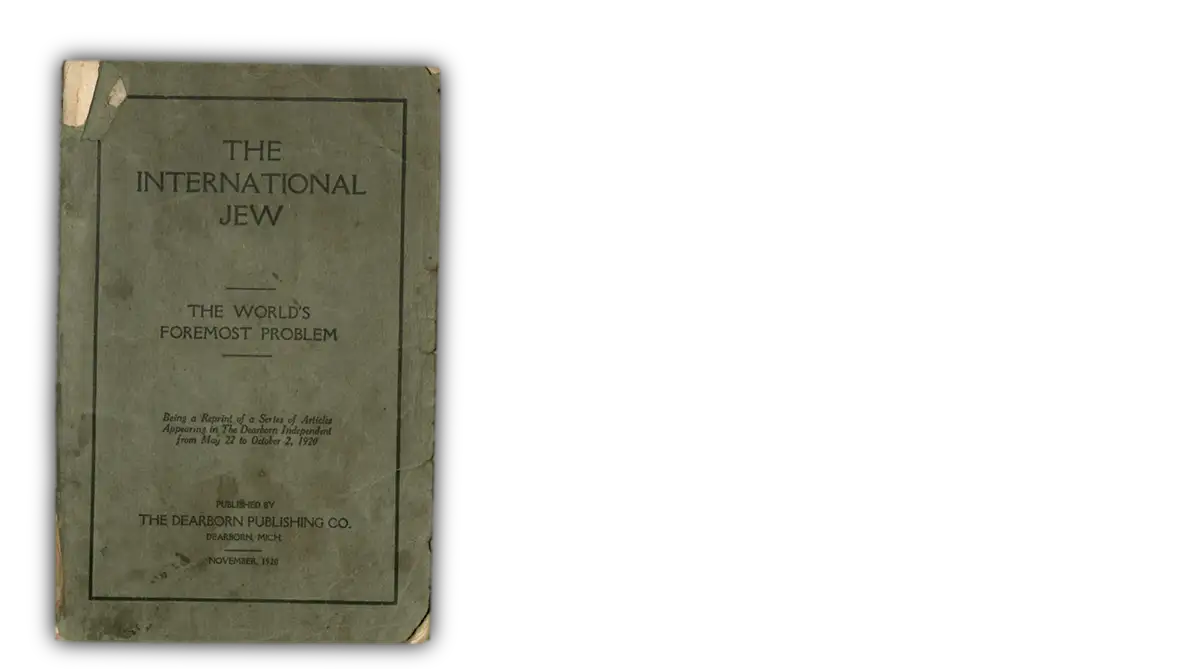
Beginning in May 1920, the paper ran a ninety-one-part series titled “The International Jew: The World’s Foremost Problem.” While Ford provided the funding and the ideological mandate, the articles were largely ghostwritten by William J. Cameron, a talented but prejudiced journalist who served as editor, and Ernest G. Liebold, Ford’s personal secretary and a man noted for his intense antisemitism and rigidity.
These articles were compiled into four volumes that became known collectively as The International Jew:
- The International Jew: The World’s Foremost Problem (1920)
- Jewish Activities in the United States (1921)
- Jewish Influence in American Life (1921)
- Aspects of Jewish Power in the United States (1922).
The “Americanization” of the Protocols
Ford’s team understood that the Russian context of the Protocols—replete with references to Tsars and French aristocracy—would feel alien to American readers. They therefore engaged in a comprehensive localization strategy, mapping the conspiracy onto American institutions.
1. The War on Jazz and Cultural “Degeneracy”
Ford viewed the Jazz Age with horror. To him, the new music was not a cultural evolution but a symptom of moral rot. The International Jew explicitly framed Jazz as a “Jewish creation” designed to debase the white American youth.
The language used in these attacks was deeply racialized, triangulating Jews, Black Americans, and White Americans. The articles claimed that Jews were exploiting “African” rhythms to corrupt Anglo-Saxon morality. The rhetoric was visceral:
“The mush, slush, the sly suggestion, the abandoned sensuousness of sliding notes, are of Jewish origin. Monkey talk, jungle squeals, grunts and squeaks and gasps suggestive of calf love are camouflaged by a few feverish notes…”.
Ford’s propaganda suggested that “Jewish Jazz” was a “moron music” invading decent homes, a direct application of Protocol IX’s directive to corrupt the youth.
2. The Corruption of the National Pastime: Baseball
In 1920, American baseball was reeling from the “Black Sox” scandal, in which eight members of the Chicago White Sox were accused of throwing the 1919 World Series. For Ford, this was not a case of individual greed but proof of systemic Jewish corruption.
The International Jew seized upon the involvement of Arnold Rothstein, a notorious Jewish gambler and crime boss. While non-Jewish players and organizers were involved, Ford’s paper focused almost exclusively on Rothstein (and figures like Abe Attell) to paint the scandal as a Jewish assault on an American institution. The articles argued that the “Lasker Plan”—a proposal for reorganizing baseball governance—was a Jewish plot to seize control of the sport entirely.
3. Revisionist History: Benedict Arnold
Perhaps the most audacious attempt to Americanize the conspiracy was the rewriting of the American Revolution. Ford’s writers dedicated chapters to “The Jewish Associates of Benedict Arnold,” specifically targeting David Franks and Major David Salisbury Franks. The articles alleged that Arnold, the quintessential American traitor, was not acting alone but was corrupted by Jewish aides who facilitated his treason. This narrative sought to weave antisemitism into the foundational myths of the United States, suggesting that the “Jewish peril” had been present since 1776.
4. Agriculture and the Assault on Cooperatives
Ford’s populist image was tied to the American farmer. He viewed the financial struggles of the agrarian Midwest as the result of manipulation by the Federal Reserve (which he termed a Jewish banking instrument). This culminated in a vicious attack on the cooperative movement.
In 1924, The Dearborn Independent targeted Aaron Sapiro, a Jewish attorney who had successfully organized farm cooperatives across the country. Ford’s paper accused Sapiro of being the front man for a “Jewish ring” seeking to exploit farmers and seize control of American agriculture.
The Sapiro Trial: The Humbling of Henry Ford
Sapiro sued Ford for libel in a federal court in Detroit, demanding $1 million in damages. The trial, which began in 1927, became a national spectacle and the undoing of Ford’s antisemitic campaign.
The defense strategy was to separate Ford from the articles, claiming he had no editorial control—a claim contradicted by testimony from former employees like James M. Miller, who swore Ford intended to expose Sapiro. As the trial progressed, Ford faced the prospect of taking the witness stand. Given his documented ignorance of history and politics (he once famously stated “History is bunk”), his lawyers feared he would be humiliated and his lack of knowledge regarding the very articles published under his name would be exposed.
The trial ended in a mistrial under suspicious circumstances. Ford’s private detectives had been investigating the jury and alleged that a juror, Cora Hoffman, had lied about her background and was biased against Ford. The detectives claimed she had made remarks about “old man Ford” and had met with a Jewish figure named “Kid” Miller. Hoffman denied the charges, but the judge declared a mistrial.
Despite the mistrial, Ford knew he could not win a retrial. The negative publicity was impacting Ford Motor Company sales, and he faced a growing boycott.
The Apology: A Calculated Retreat
In July 1927, Ford capitulated. He reached out to Louis Marshall, the president of the American Jewish Committee, to negotiate a settlement. Marshall wrote the apology himself, which Ford signed.
The text was sweeping in its contrition:
“I deem it to be my duty as an honorable man to make amends for the wrong done to the Jews as fellow-men and brothers… It is needless to add that the pamphlets which have been distributed throughout the country and in foreign lands will be withdrawn from circulation.”.
Ford claimed he was “shocked” by the content of the magazine, a lie that allowed him to save face while ending the litigation. The Dearborn Independent ceased publication in December 1927. However, the damage was irreversible. While Ford halted US distribution, he did little to stop the rampant circulation of The International Jew in Europe, where it was already fueling a much darker fire.
Part III: The Nazi Appropriation — The Ideological Bridge (1919–1945)
If Henry Ford planted the seeds of the Protocols in the West, Adolf Hitler harvested the crop. The intellectual transfer of the Protocols from Ford’s American populism to Nazi racial ideology is a direct and documented historical link. Ford was not merely a source of funds or industrial inspiration for the Nazis; he was an ideological mentor whose writings provided a “proof of concept” for the Nazi worldview.
Der Internationale Jude: The Bestseller of Hate
Translations of The International Jew flooded Weimar Germany in the early 1920s. Published as Der Internationale Jude, the books became bestsellers. For a defeated and humiliated Germany seeking an explanation for its loss in World War I, Ford’s Americanized Protocols provided an external validator. The fact that the most successful industrialist in the world—a non-German—supported these theories gave them a credibility that domestic German propaganda lacked.
Baldur von Schirach, the future leader of the Hitler Youth, explicitly cited Ford as a primary influence on his own radicalization. At the Nuremberg trials, he recalled:
“I read it and became anti-Semitic. In those days this book made such a deep impression on my friends and myself because we saw in Henry Ford the representative of success… it was Henry Ford who to us represented America.”.
Hitler’s “Single Great Man”
Adolf Hitler’s reverence for Ford was profound and public. In Mein Kampf, Ford is the only American mentioned by name. Hitler wrote:
“It is Jews who govern the stock exchange forces of the American Union. Every year they become more and more the controlling masters of the producers in a nation of one hundred and twenty millions; only a single great man, Ford, to their fury still maintains full independence.”.
Journalists visiting Hitler’s office in Munich in the 1920s reported seeing a large portrait of Henry Ford hanging on the wall and copies of The International Jew on the table. Hitler viewed Ford as a kindred spirit, telling the Chicago Tribune in 1923, “I wish that I could send some of my shock troops to Chicago and other big American cities to help”.
The ideological synergy was rooted in the Protocols. Both men believed in a “supra-national” Jewish power structure. However, where Ford saw this as a corruption of culture and economics to be fought with publicity and “Americanism,” Hitler saw it as a biological and racial struggle requiring extermination. Ford’s work helped transition the German public from religious or social anti-Judaism to the conspiratorial, racial antisemitism of the Nazis.
The Grand Cross of the German Eagle (1938)
The Nazi regime’s gratitude to Ford culminated in 1938, on the occasion of Ford’s 75th birthday. He was awarded the Grand Cross of the German Eagle, the highest honor Nazi Germany could bestow upon a foreigner.
The ceremony took place in Dearborn, Michigan. The medal was presented by Karl Kapp, the German consul at Cleveland, and Fritz Heiler, the German consul at Detroit. The award was given “for industrial accomplishments,” but the subtext of ideological solidarity was unmistakable. Despite the growing atrocities in Germany—the Nuremberg Laws were in full effect, and Kristallnacht was months away—Ford accepted the award, cementing his legacy as a sympathizer of the regime.
Institutionalizing the Lie: Education and Propaganda
Upon seizing power in 1933, the Nazi party integrated the Protocols and the theories promulgated by Ford into the official state curriculum and propaganda machine.
The Concept of “Inner Truth”
The Nazi hierarchy was aware that the Protocols was likely a forgery. Goebbels and Hitler likely knew of the 1935 Bern Trial judgment which declared the text “ridiculous nonsense.” However, they argued that the “inner truth” of the document was more important than its factual provenance. To the Nazis, the Protocols accurately described the “nature” of the Jew, regardless of who wrote it. This concept allowed them to dismiss forensic debunking as mere “Jewish trickery” designed to hide the truth.
Poisoning the Youth: Der Giftpilz
The themes of the Protocols were distilled into children’s books to indoctrinate the next generation. The most infamous example is Der Giftpilz (The Poisonous Mushroom), published by Julius Streicher in 1938.
The book used the metaphor of the toadstool: just as it is hard to tell a poisonous mushroom from an edible one, it is hard to tell a Jew from a “good” German. The stories within explicitly utilized the tropes found in the Protocols and The International Jew:
- The Cattle Dealer: Depicting Jews as financially predatory toward rural Germans (echoing Ford’s defense of farmers).
- The Lawyer: Portraying Jewish lawyers as manipulating the law to destroy Gentiles (Protocol VIII and XVII).
Another key text was the Handbuch der Judenfrage (Handbook of the Jewish Question) by Theodor Fritsch, which served as a guide for educators. It treated the Protocols as factual history, ensuring that German students were tested on the “conspiracies” of the Elders.
The Warrant for Genocide
The Protocols provided the structural framework for the “Judeo-Bolshevik” conspiracy theory. It allowed the Nazis to link the Soviet Union (Bolshevism) with Western Capitalism (finance) as two arms of the same “Jewish Octopus”—a direct visual metaphor taken from the Protocols and used in Der Stürmer. This dual threat justification was essential for the war effort, framing the invasion of Russia and the war against the Allies not as aggression, but as a defensive strike against a unified Jewish aggressor described in Protocol VII (Global War).
Part IV: The Mechanics of Debunking vs. Belief
It is critical to note that the Protocols survived despite rigorous, public debunking.
Philip Graves and The Times (1921)
In 1921, Philip Graves, a correspondent for The Times of London in Constantinople, was approached by a Russian monarchist who handed him a copy of Joly’s 1864 Dialogue in Hell. Graves immediately recognized the similarities to the Protocols. The Times published a series of articles presenting the texts side-by-side, proving the plagiarism conclusively.
- Joly: “How are loans made? By the issue of government bonds… which entail the obligation to pay interest.”
- Protocols (XX): “A loan is an issue of government paper which entails an obligation to pay interest…”.
The Bern Trial (1933-1935)
In Switzerland, the Federation of Jewish Communities sued the Swiss National Front for distributing the Protocols. The court heard testimony from Russian historians and former officials. In May 1935, the court declared the Protocols a forgery and “ridiculous nonsense”.
Yet, these facts failed to halt the spread of the text. For Ford and Hitler, the Protocols were not a historical document to be verified, but a script to be enacted.
Conclusion
The history of The Protocols of the Elders of Zion is a testament to the resilience of the conspiracy theory when backed by industrial power and state violence.
The causal chain is clear and damning:
- Fabrication: A Russian plagiarism of a French satire, designed to prop up a failing autocracy.
- Amplification: Henry Ford’s International Jew legitimizes the forgery for a Western audience, “Americanizing” the hate by linking it to Jazz, Baseball, and Agriculture.
- Radicalization: The Nazi regime adopts Ford’s validation and the Protocols’ text to indoctrinate a nation, using the concept of “inner truth” to bypass factual reality and justify the Holocaust.
Ford’s apology in 1927 was a legal maneuver that did little to stem the tide; the “genie” of legitimate American antisemitism had been let out of the bottle. Even today, the Protocols remain widely available, circulated by hate groups who view Ford not as a debunked industrialist, but as a prophet. The tragedy of the Protocols is that while the Elders of Zion never existed, the millions of deaths caused by the belief in them were horrifyingly real.
Analytical Tables
Table 2: The Transatlantic Exchange of Hate
Feature
Henry Ford’s The International Jew (USA)
Nazi Ideology & Der Stürmer (Germany)
Shared Source (Protocols)
Culture
“Monkey talk” Jazz, corruption of youth.
“Degenerate Art” (Entartete Kunst).
Protocol 9: Corrupting youth/education.
Economics
Federal Reserve as Jewish control.
“Interest Slavery” (Zinsknechtschaft).
Protocol 20: Loans/Financial ruin.
Politics
Benedict Arnold/David Franks conspiracy.
“Stab in the Back” myth (WWI defeat).
Protocol 10: Infiltration of state.
Symbolism
The “International Banker.”
The “Jewish Octopus.”
Protocol 3: The Symbolic Snake.
Solution
Publicity, exclusion, “Americanism.”
Elimination, deportation, extermination.
(Divergent solutions to same “threat”)
Table 3: Key Figures in the Dissemination Network
Name
Role
Contribution to the Narrative
Pyotr Rachkovsky
Okhrana Chief
Orchestrated the original forgery in Paris (c. 1900).
Sergei Nilus
Russian Mystic
Published Protocols as the “Coming of Anti-Christ” (1905).
Henry Ford
Industrialist
Funded Dearborn Independent; lent credibility to the text.
William J. Cameron
Editor
Ghostwrote The International Jew; testified in Sapiro trial.
Baldur von Schirach
Hitler Youth Leader
Cited Ford as the primary inspiration for his antisemitism.
Julius Streicher
Nazi Publisher
Published Der Giftpilz; adapted Protocols for children.
Louis Marshall
Jewish Leader
Forced Ford’s apology; drafted the retraction text.
The Protocols of the Elders of Zion: Origins, Debunking & Historical Context
- Unpacking the Notorious Antisemitic Forgery – antisemitism.org.uk
- Protocols of the Elders of Zion – Jewish Currents
- Real History Debunking the Dark Conspiracy Theory – HistoryExtra
- Protocols of the Elders of Zion (Forgery Overview) – Britannica
- Understanding the Protocols – My Jewish Learning
- Protocols of the Elders of Zion – Yad Vashem
- Protocols: Key Dates – USHMM
- An Antisemitic Conspiracy – USHMM
- Summary & History – Study.com
- The Protocols of the Elders of Zion – Wikipedia
- 1920 Primary Source – Consider the Source NY
Modern Antisemitic Conspiracies & Online Hate
- How JFK Conspiracy Theorists Spread Antisemitic Hatred – Combat Antisemitism
- Antisemitism Over Time – Echoes & Reflections
- Antisemitic Tropes – Wikipedia
Henry Ford, The International Jew & American Antisemitism
- The International Jew – Wikipedia
- Jewish Influences in American Life (Vol. III) – Project Gutenberg
- Aspects of Jewish Power in the U.S. (Vol. IV) – Project Gutenberg
- Henry Ford’s War on Jews & Hate Speech Case – State Bar of Michigan
- Power, Ignorance & Antisemitism: Henry Ford – Hanover College
- Ford Mistrial – TIME Magazine
- Ford Counsel Moves for Mistrial – Jewish Telegraphic Agency
- Henry Ford’s Apology – Reform Judaism
- Statement by Henry Ford (Dearborn Independent Retraction) – BJPA
- Henry Ford & Antisemitism – American Jewish Archives
Henry Ford, Nazi Germany & Propaganda Connections
- Order of the German Eagle – Wikipedia
- Photo: Henry Ford Receiving Grand Cross – eBay
- Henry Ford Receives the Grand Cross – Getty Images
Nazi Propaganda, Antisemitism & Conspiracy Culture
- Protocols in Nazi Propaganda (1933–1945) – ResearchGate
- Protocols in Nazi Propaganda – Oxford Academic
- Der Giftpilz (The Poisonous Mushroom) – Wikipedia
- Jew-Hatred & the German Press – Edition Lumière
- Nazi Conspiracy Theory: Fantasies of Jewish Power – Edinburgh University Press


