
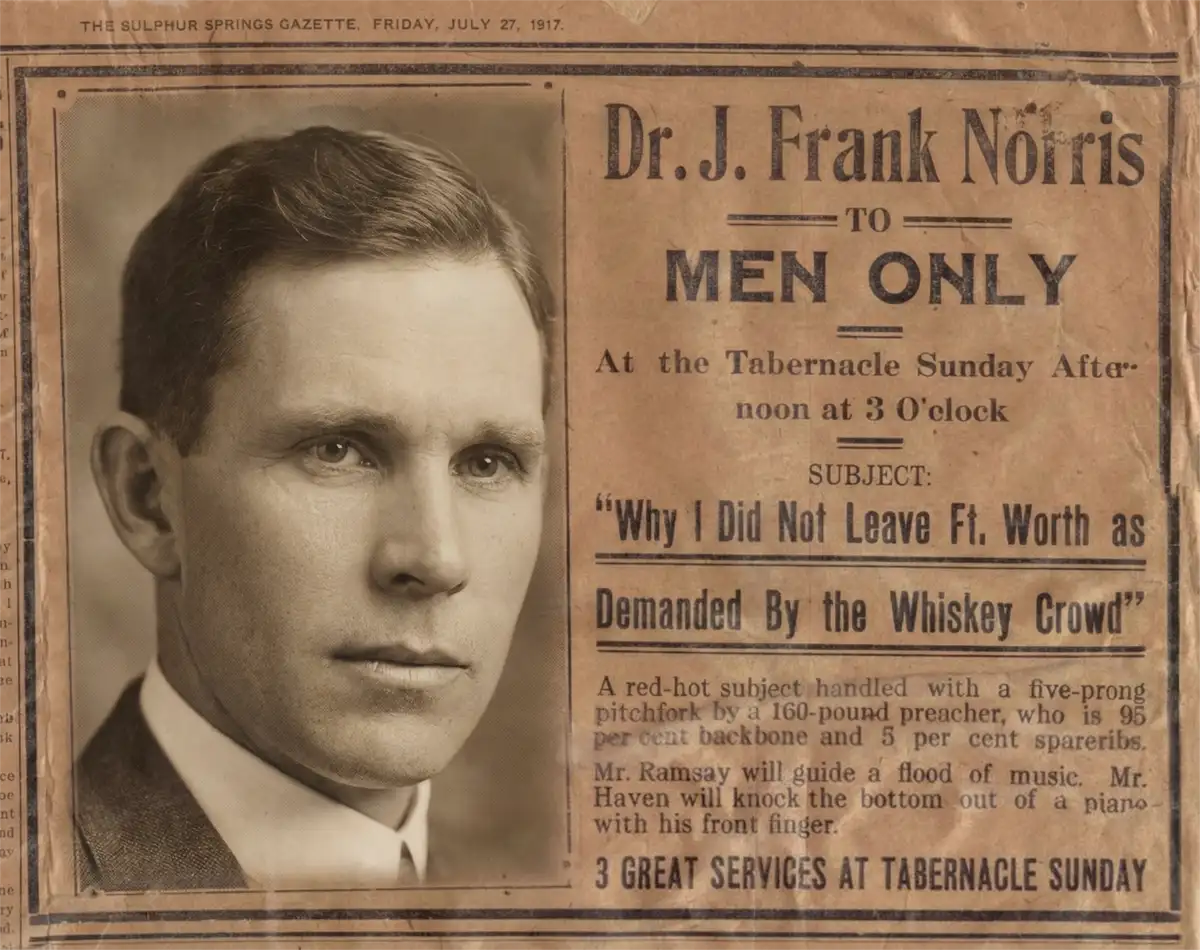

Texas Tornado
Preacher, Killer, Political Kingmaker

Summary
The trajectory of American Protestantism in the twentieth century is often narrated through the lens of theological schisms—the Great Reversal, the Scopes Monkey Trial, and the retreat of conservative evangelicals into a subculture of separation. Yet, this narrative is incomplete without accounting for the volatile, gun-toting phenomenon of J. Frank Norris. Pastor of the First Baptist Church of Fort Worth, Texas, for over four decades, Norris was not merely a participant in the Fundamentalist-Modernist controversy; he was its most aggressive combatant, a man who fused the populist rage of the radio age with the frontier justice of the Texas range.
This report offers an exhaustive examination of Norris’s career, analyzing his role as a precursor to the modern “megachurch” pastor and his function as a violent, Protestant counterweight to Father Charles Coughlin. While Coughlin utilized the airwaves to spread a gospel of economic grievance and antisemitism from the industrial Midwest, Norris leveraged the same medium to wage a holy war against “Rum and Romanism” from the sun-baked plains of Texas. Both men represented a dangerous new synthesis of religion, mass media, and demagoguery, yet Norris distinguished himself by crossing the threshold from rhetorical violence to actual lethal force.
Drawing upon extensive archival records, court transcripts from the 1926 murder trial of Dexter Chipps, and contemporary accounts of his war against Baylor University, this report argues that Norris invented a specific “theology of confrontation.” This theology did not merely anticipate persecution; it actively manufactured it through sensationalism, arson (alleged), and physical violence, ultimately reshaping the landscape of independent fundamentalism in ways that resonate to this day.
Part I: The Forge of Violence — The Psychological Origins of the “Texas Tornado”
1.1 The Blood of the Father
To understand the lethal trajectory of J. Frank Norris’s ministry, one must first descend into the chaos of his origins. Born in Dadeville, Alabama, in 1877, John Franklyn Norris was a child of the Reconstruction South, a world characterized by crushing poverty and a shattered social order. The Norris family, led by his father James Warner Norris, migrated to the hardscrabble farming communities of Arkansas and eventually Hubbard, Texas. James Warner was not merely a sharecropper; he was a functioning alcoholic whose addiction defined the domestic sphere of Frank’s childhood.
The psychological imprint of his father’s alcoholism cannot be overstated. It provided Norris with his first and most enduring enemy: “Rum.” This was not an abstract theological concept for the young Norris; it was a visceral, destructive force that consumed his family’s resources and fueled his father’s rage. In a seminal moment of his youth, Norris emptied his father’s liquor bottles in an act of defiant purity. The resulting beating he endured at his father’s hands established a pattern that would define his adult life: the conviction that righteousness requires suffering, and that the moral agent must be willing to endure violence to purge sin.
This “siege mentality” was calcified by a brush with death at age fifteen. In 1891, the violence of the Texas frontier visited the Norris homestead when cattle thieves attacked the family. Both Frank and his father were shot. The teenage Norris was gravely wounded, requiring a grueling three-year recuperation. This event taught him two lessons that would permeate his theology: first, that the world is a fundamentally hostile place where enemies lurk in the shadows; and second, that survival depends on vigilance and, if necessary, the willingness to shoot back. The pulpit would later become his fortress, but the lesson of the gun was learned on the porch in Hubbard.
1.2 The Intellectual Warrior: Baylor and the Seminary
Despite his rugged upbringing, Norris possessed a sharp, aggressive intellect. Following a conversion experience at a brush arbor revival—the quintessential rite of passage for the Southern Baptist—he pursued the ministry with relentless ambition. He enrolled at Baylor University in Waco, Texas, in 1898. At the time, Baylor was the intellectual epicenter of Texas Baptist life, a place where the rustic faith of the frontier met the emerging academic rigor of the twentieth century.
Norris thrived in this environment, not as a rebel, but as a conqueror. He graduated in 1903 and proceeded to the Southern Baptist Theological Seminary in Louisville, Kentucky, where he earned a Master of Theology. It is a profound irony that the man who would later wage a scorched-earth war against Baptist academia was himself a product of its highest institutions. During these early years, Norris was the ultimate denominational insider. As the young editor of the Baptist Standard from 1907 to 1909, he was instrumental in unifying the fractured Texas Baptist landscape, ending newspaper wars, and advocating for the relocation of the Southwestern Baptist Theological Seminary to Fort Worth. He was a builder of institutions, a man who understood the mechanics of power within the Southern Baptist Convention (SBC).
However, the “Company Man” phase of his career was short-lived. Upon assuming the pastorate of the First Baptist Church of Fort Worth in 1909, the internal tension between his desire for respectability and his addiction to conflict began to fracture. The city of Fort Worth, with its volatile mix of “Cattle Kings” and oil money, was about to become the stage for his transformation from denominational statesman to religious outlaw.
Part II: The War for Cowtown — Vice, Arson, and the 1912 Trials
2.1 The Sociology of Hell’s Half Acre
In 1909, Fort Worth was a city of stark dichotomies. On one side stood the respectable society of the cattle barons and the emerging oil tycoons; on the other lay “Hell’s Half Acre,” a notorious district of saloons, gambling dens, and brothels that served the transient population of cowboys and roughnecks. For decades, the city’s elite had maintained an uneasy truce with the Acre, tolerating its existence as a necessary economic engine for the cattle trade.
Norris shattered this truce. Realizing that the dignified homilies of his predecessors were failing to fill the massive auditorium of First Baptist, he adopted a strategy of “sensationalism.” He began to preach against the vice district with a specificity that was unprecedented. He did not stick to general condemnations of sin; he engaged in investigative journalism from the pulpit. He hired private detectives to gather evidence on the ownership of the brothels and gambling halls, revealing that many of the city’s most respectable citizens—including members of his own congregation—were profiting from the rent paid by vice lords.
In a sermon series that would become legendary, Norris preached on “The Ten Biggest Devils in Fort Worth—Names Given”. The audacity of publicly shaming the city’s power brokers electrified the working class, who flocked to the church to see the elite skewered. Attendance soared, but so did the threats. Norris was no longer just a pastor; he was a populist agitator attacking the economic foundations of the local oligarchy.
2.2 The Inferno of 1912
The retaliation against Norris was not subtle. It was kinetic. In early 1912, the atmosphere in Fort Worth turned toxic. Norris claimed to receive letters written in blood, warning him to cease his crusade or face death. Shots were fired through the stained-glass windows of his study while he worked.
Then came the fire. On January 11, 1912, a blaze damaged the church auditorium. Weeks later, on February 4, the destruction was total. A massive fire consumed the First Baptist Church, reducing the sanctuary to ash. Simultaneously, a fire erupted at the parsonage where Norris lived with his wife and children.
The timing—two fires, at two properties connected to the pastor, igniting almost simultaneously—immediately raised suspicions. But the local authorities, heavily influenced by the very businessmen Norris had been attacking, did not look for the vice lords. They looked at the pastor.
2.3 The Perjury and Arson Trials
The theory presented by the prosecution was Machiavellian: Norris, facing a decline in popularity after a church split in 1911 (where 1,000 members had walked out over his aggressive tactics), had orchestrated the fires to cast himself as a martyr and rally support.
In March 1912, a grand jury indicted J. Frank Norris on charges of perjury and arson. The perjury charge stemmed from the threatening notes; handwriting experts testified that the script matched Norris’s own hand, suggesting he had forged the “blood letters” to manufacture a narrative of persecution.
The trials were a spectacle that gripped Texas.
- The Perjury Trial (April 1912): Norris’s defense team portrayed the indictment as a conspiracy by the “Romanist” and “Liquor” interests to silence a prophet of God. The courtroom became a revival meeting. When the jury returned a verdict of acquittal, the gallery erupted in song, with women singing “Old Time Religion” as Norris wept.
- The Arson Trial (1914): The arson case dragged on for two years, keeping Norris under a cloud of suspicion. When it finally came to trial, the result was the same: acquittal.
While the courts cleared him, the court of public opinion was permanently divided. To his followers, he was the “Man of God” who had walked through the fiery furnace and survived, a living Daniel. To his detractors, he was a dangerous sociopath who would burn down the house of God to save his own career. This ambiguity became his armor; the suspicion of violence made him fearsome, while the legal vindication made him untouchable.
Table 1: The Fires of J. Frank Norris
Jan 11, 1912
Partial fire at First Baptist Church.
Height of anti-gambling crusade.
Damaged auditorium; deemed suspicious.
Feb 4, 1912
Total destruction of First Baptist Church.
Same night as parsonage fire.
Led to arson indictment.
Feb 4, 1912
Fire at Norris’s Parsonage.
Simultaneous with church fire.
Used as evidence of “martyrdom” or fraud.
Jan 12, 1929
Total destruction of rebuilt church.
Height of Al Smith/political battles.
Ruled arson; Norris out of town; no charges filed.
Part III: The War on Modernism — The Assault on Baylor University
3.1 The Theological Battleground
Having survived the arson trials, Norris emerged in the 1920s as the undisputed warlord of Texas Fundamentalism. The cultural landscape had shifted; the enemy was no longer just local vice, but the global threat of “Modernism”—specifically, the teaching of Darwinian evolution in Baptist schools.
Norris turned his sights on his alma mater, Baylor University. In his view, the university had been infiltrated by “German rationalism” and “infidelity.” This was a strategic pivot; by attacking Baylor, the pride of Texas Baptists, Norris positioned himself as the sole guardian of the true faith, forcing every Baptist in the state to choose a side.
3.2 The Case of Professor Grove Samuel Dow
The flashpoint was a sociology textbook, Introduction to the Principles of Sociology by Professor Grove Samuel Dow. Norris discovered that the text described primitive man as occupying a status “halfway between the anthropoid ape and modern man”. For Norris, this was not scientific inquiry; it was blasphemy paid for by the tithes of faithful widows.
Norris utilized his newspaper, The Searchlight, to launch a campaign of character assassination. He did not engage Dow in academic debate; he ridiculed him. He labeled the faculty “professor apes” and “long-haired smart-alecks.” He organized rallies where he would mockingly interview monkeys, asking them if they were related to the professors at Baylor.
The populist appeal of this attack was undeniable. Norris framed the issue as a class war: the simple, Bible-believing people of the pews versus the arrogant, elitist intellectuals of the university. He tapped into the deep vein of anti-intellectualism that ran through the rural South, arguing that “education” without biblical literalism was merely “damnation”.
3.3 The Expulsion and Independence
The pressure on Baylor President Samuel Palmer Brooks was immense. While Brooks tried to defend academic freedom, the financial lifeline of the university depended on the support of the churches. Professor Dow eventually resigned, a casualty of Norris’s crusade.
However, the Baptist General Convention of Texas (BGCT) had had enough. In a move designed to quarantine the infection, the Convention voted in 1922 and 1923 to deny seats to the messengers from First Baptist Church of Fort Worth. This was a stunning rebuke: the largest church in the state was effectively excommunicated.
Far from chastening Norris, this expulsion liberated him. No longer bound by the need for denominational consensus, he declared the SBC “apostate” and began to build his own empire. He founded the Premillennial Missionary Baptist Fellowship (later the World Baptist Fellowship), creating a parallel denomination centered entirely on his personality. He was now an independent operator, answerable to no bishop, board, or convention—only to the crowds that filled his 5,000-seat auditorium.
Part IV: The Radio Demagogue — A “Violent Father Coughlin”
4.1 The Power of the Airwaves
The user query posits a comparison between J. Frank Norris and Father Charles Coughlin, the “Radio Priest” of Detroit. This comparison is not merely atmospheric; it is structural. Both men rose to power by recognizing that radio was the perfect medium for populism. It allowed them to bypass the gatekeepers of their respective hierarchies—the Catholic bishops for Coughlin, the Baptist Convention for Norris—and speak directly to the anxieties of the common man.
Norris established the first regular radio ministry in Texas, broadcasting over stations KFQB, KTAT, and KSAT. Like Coughlin, he built a “virtual congregation” that dwarfed his physical attendance. His radio voice was distinct: where Coughlin was smooth, baritone, and hypnotic, Norris was strident, emotional, and explosive. He shouted, he wept, and he pounded the pulpit, the audio distortion only adding to the raw energy of the broadcast.
4.2 The Theology of Grievance
Both men preached a gospel of grievance, though their targets differed in accordance with their demographics.
- Coughlin’s Targets: The “International Banker,” the Jew, the Communist, and eventually Franklin D. Roosevelt.
- Norris’s Targets: The “Romanist” (Catholic), the Bootlegger, the Modernist, and the corrupt local politician.
The irony of their comparison lies in Norris’s virulent anti-Catholicism. His “Rum and Romanism” sermons painted the Catholic Church as a sinister, global conspiracy to undermine American liberty. Yet, structurally, Norris and Coughlin were twins. They both mobilized the lower-middle class—those who felt squeezed by the Depression and threatened by social change—by offering them scapegoats. They both flirted with authoritarianism, admiring strongmen who could “clean up the mess” of democracy.
4.3 Flirtations with Fascism
The “fascist” label attached to both men is supported by historical record.
- Coughlin: Explicitly antisemitic by the late 1930s, reprinting The Protocols of the Elders of Zion in his paper Social Justice and expressing admiration for Hitler’s anti-communism.
- Norris: While Norris eventually supported the Jewish state (due to his dispensationalist theology requiring a restored Israel for the End Times), his methods were seen as fascistic by his contemporaries. In Detroit, union leaders described his rallies—where he burned Soviet flags and preached hyper-nationalism—as a “mask to promote dictatorship”. Norris’s “Americanism” was exclusive, militant, and enforced by the threat of mob violence. He was a “gun-toting” Coughlin in the sense that while Coughlin’s violence was rhetorical and incited street thugs, Norris carried a revolver in his pocket and was willing to use it.
Part V: The Deep Research Hook — The Murder of Dexter Chipps (1926)
5.1 The Context: “Rum and Romanism”
By the summer of 1926, the temperature in Fort Worth was boiling. Norris was locked in a death struggle with Mayor H.C. Meacham. The conflict was a synthesis of all Norris’s obsessions: Meacham was a “wet” (anti-Prohibition) and, Norris alleged, a puppet of the Catholic Church. Norris accused Meacham of funneling city funds to Catholic institutions and firing Protestant employees to replace them with Catholics.
Norris mobilized his youth group, an “army” of boys, to distribute inflammatory leaflets outside Meacham’s department store, driving away customers and damaging the mayor’s business. The rhetoric was violent; Norris preached that the city needed to be “purged” of the mayor’s corrupting influence.
5.2 The Victim: Dexter Elliott Chipps
Dexter Elliott Chipps was a wealthy lumberman and a close friend of Mayor Meacham. He was not a public figure, but a loyalist who was enraged by Norris’s relentless destruction of the mayor’s reputation. Chipps was also known to be a heavy drinker, which made him the perfect antagonist in Norris’s moral play.
On Saturday, July 17, 1926, the tension snapped. Chipps, reportedly intoxicated, called Norris to demand he stop the attacks. When Norris refused, Chipps went to the First Baptist Church.
5.3 The Shooting: July 17, 1926
The confrontation took place in Norris’s church study, a room adorned with pictures of William Jennings Bryan. According to Norris’s testimony—the only surviving account—Chipps was belligerent and menacing. Norris claimed Chipps shouted, “I’ll kill you!” and made a motion toward his hip pocket.
Norris did not wait to see a weapon. He opened his desk drawer, retrieved a revolver, and fired.
- Shot 1: Struck Chipps in the belly.
- Shot 2: Struck him in the shoulder.
- Shot 3: Struck him in the chest.
Dexter Chipps collapsed and died on the floor of the pastor’s study. When police arrived, they searched the body. Dexter Chipps was unarmed.
5.4 The Trial of the Century
The indictment of J. Frank Norris for murder triggered a media circus that rivaled the Scopes Trial. The New York Times ran front-page headlines. Because the jury pool in Fort Worth was hopelessly polarized, the trial was moved to Austin, the state capital.
The Prosecution’s Case
Prosecutor William McLean painted Norris as a cold-blooded assassin who had lured Chipps to the office to execute him. “Norris had murder in his heart,” McLean thundered, “and wanted an excuse to kill Chipps.” The prosecution emphasized the fact that Chipps was unarmed and that Norris had fired repeatedly, ensuring death rather than merely stopping a threat. They argued that a “man of God” should have turned the other cheek, or at least called the police, rather than reaching for a gun.
The Defense: “Stand Your Ground”
Norris’s defense team, led by Dayton Moses, understood Texas psychology perfectly. They did not deny the shooting; they justified it. They invoked the right of Self-Defense, a sacred tenet of Texas law.
- The Strategy: They put the dead man on trial. Witnesses were called to testify to Chipps’s drinking, his temper, and his threats against Norris. They painted Chipps as a violent emissary of the corrupt “Romanist” machine sent to assassinate the prophet.
- The Testimony: Norris took the stand and delivered the performance of his life. He wept. He described his terror. He reenacted the moment Chipps reached for his hip. “I thought he had a gun,” Norris testified. “I shot to save my own life.”
- The Closing Argument: Moses’s closing statement was a masterpiece of cultural manipulation: “Thank God, in Texas you don’t have to wait until you are shot down to protect your own life”.
The Verdict
The jury, composed of farmers and tradesmen—the demographic base of Norris’s populism—deliberated for a short time. On January 25, 1927, they returned a verdict: Not Guilty.
The acquittal was a vindication for Norris’s followers, who saw it as divine intervention. But for the nation, it cemented the image of the “Shooting Salvationist”—a fanatical preacher who enforced his theology with a.38 caliber revolver.
Part VI: The Tale of Two Cities — The Detroit Empire and the Labor War
6.1 The Megachurch Pioneer
Following the trial, Norris did not retreat; he expanded. In 1935, he accepted the pastorate of the Temple Baptist Church in Detroit, Michigan, while retaining his position in Fort Worth. For the next fifteen years, he commuted between the two cities, first by train and later by plane, managing two massive congregations simultaneously.
This “dual pastorate” was a logistical marvel. Norris effectively presided over a combined membership of over 25,000 people, arguably the largest Protestant constituency in the world at the time. He created the template for the modern megachurch: a celebrity CEO-pastor, multi-site campuses (separated by 1,200 miles), and a brand unifying it all.
6.2 The “Hillbilly Highway” and Anti-Unionism
The connection between Fort Worth and Detroit was demographic. Detroit was the terminus of the “Hillbilly Highway,” the migration route for poor Southerners seeking jobs in the auto industry. These migrants felt culturally alienated in the North; Norris provided them with a familiar Southern religious environment—emotional, fundamentalist, and fiercely individualistic.
Norris’s role in Detroit was politically potent. He became a staunch ally of the auto manufacturers (like Ford) and a bitter enemy of the United Auto Workers (UAW).
- The Theology of Anti-Labor: Norris preached that unionism was a form of Communism, a collectivist threat to the individual soul’s relationship with God. He encouraged his congregants to reject union membership and remain loyal to their employers.
- The Flag Burning: In a spectacular display of political theater in 1938, Norris burned a Soviet flag during a revival in Detroit, flanked by police and Ford executives. This act symbolized his fusion of Christianity, Americanism, and Capitalism. To the liberal establishment and the unions, Norris was a strikebreaker in a clerical collar, a “fascist” tool of the industrial oligarchy.
Part VII: The Final Schism — The Collapse of the Autocracy (1950)
7.1 The Limits of Control
Norris’s empire was held together by the sheer force of his personality. He demanded absolute loyalty and tolerated no dissent. However, by 1950, his grip was slipping. The Bible Baptist Seminary in Fort Worth, which he had founded, was being run by G. Beauchamp Vick, his longtime lieutenant and the co-pastor of the Detroit church.
Vick was a capable administrator who had built the Detroit church into a powerhouse. Unlike Norris’s previous subordinates, Vick had his own base of support. The conflict began when Norris, jealous of Vick’s success and paranoid about losing control, accused Vick of “misappropriating power” and attempted to purge the seminary of Vick’s supporters.
7.2 The Meeting at Philippi
The showdown occurred at a fellowship meeting in Fort Worth in May 1950. Norris, in a typical power play, packed the meeting with his loyalists and attempted to steamroll Vick. But Vick refused to be bullied. In a dramatic moment, Vick resigned his position, declaring that he could no longer work under Norris’s tyranny.
The result was a catastrophic split. Vick walked out, and thousands of pastors and students followed him. They formed the Baptist Bible Fellowship International (BBFI), establishing a new headquarters and college in Springfield, Missouri.
- The Impact: This was the end of Norris’s hegemony. The BBFI quickly outgrew Norris’s World Baptist Fellowship. Norris kept the name and the history, but Vick took the future.
Part VIII: Conclusions and Legacy
8.1 The DNA of Independent Fundamentalism
J. Frank Norris died in 1952, attending a youth camp in Florida. But his ghost haunts American Christianity. The Independent Fundamental Baptist (IFB) movement is his direct lineage. The aggressive soul-winning tactics, the strict separation from culture, the authoritarian “Man of God” pastoral model, and the suspicion of education—all these are Norris’s inheritance.
8.2 The Violence of the Sacred
The comparison to Father Coughlin remains the most instructive lens through which to view Norris. Both men proved that in the 20th century, religion could be weaponized through mass media to create powerful political movements. But where Coughlin was silenced by his church, Norris silenced his critics—sometimes with a lawsuit, sometimes with a split, and once, with a gun.
Norris was the “Shooting Salvationist” not just because he killed Dexter Chipps, but because he viewed the ministry as a shootout. He brought a knife to a theological debate and a gun to a pastoral counseling session. In doing so, he defined a strain of American Christianity that views the world not as a field to be harvested, but as a battlefield to be conquered.
Table 2: The Norris-Coughlin Axis of Populism
Feature
J. Frank Norris
Father Charles Coughlin
Title
The “Texas Tornado” / “Shooting Salvationist”
The “Radio Priest”
Base
Southern Baptist / Rural & Migrant Working Class
Northern Catholic / Urban Working Class
Primary Villain
The “Romanist” (Catholic) & The Modernist
The “International Banker” & The Jew
Violence
Physical (Shot & killed Dexter Chipps)
Rhetorical (Incited antisemitic violence)
Political End
Allied with winners (Truman/Israel)
Silenced for Sedition (WWII)
Legacy
The Independent Baptist Movement (IFB)
The Christian Right / Paleoconservatism
The story of J. Frank Norris is a Rabbit Hole that leads to the dark underbelly of American religious history—a place where the line between the prophet and the gunman is blurred, and where the “Good News” is delivered with the safety off.
Biographies & General Overviews
- J. Frank Norris – Wikipedia
- John Franklyn Norris – TSHA Handbook of Texas
- J. Frank Norris – Grokipedia
- Gallery of Militants, Moderates & Millionaires – Christian History Institute
- J. Frank Norris and Baptist Fundamentalism
Sermons, Archives & Primary Documents
- Sermons by J. Frank Norris – SermonIndex
- J. Frank Norris Papers – Southern Baptist Historical Library & Archives
- J. Frank Norris Murder Trial of 1927 – TTU Archive
- Historical Baptist Archives (related contexts)
Historical Context: Fort Worth, Fundamentalism & Cultural Conflicts
- Hell’s Half Acre (Fort Worth) – TSHA
- One Foot in the Pulpit, One Foot in the Witness Stand – Hometown by Handlebar
- Baptists, Darwin & Confession of Faith – Bob Rogers
- Evolution Controversy at Baylor (1920–1929) – SFA ScholarWorks
Extremism, Populism & Political Influence
- Media & Populist Persuasion (Coughlin comparison) – Princeton Economics
- The Father Coughlin Story – PBS
- Apostles of Fascism & Reactionary Clergy – Antifascist Archive


