
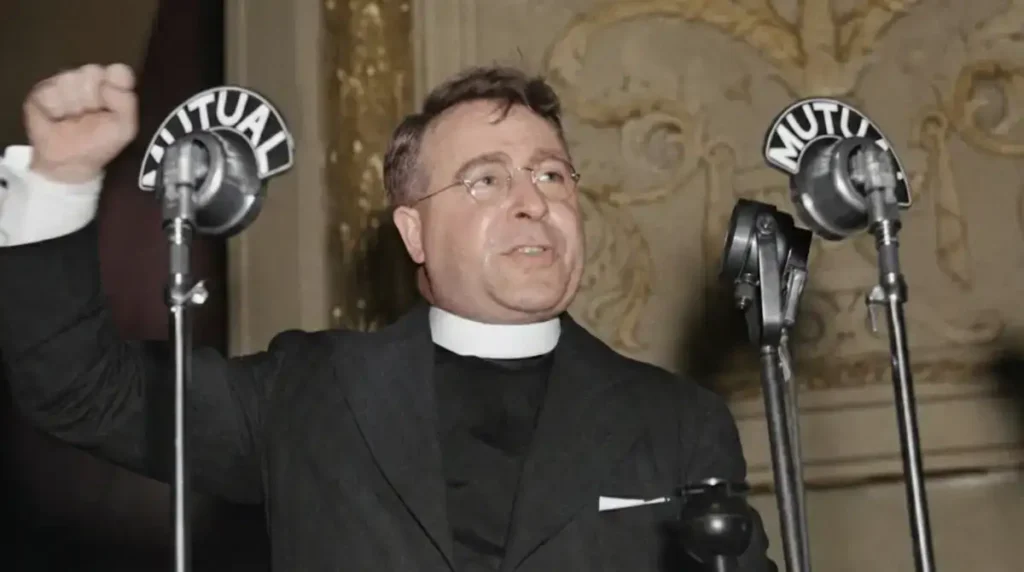

America’s First Media Messiah Charles Coughlin
The Great Depression, and the Rise of American Demagoguery

Executive Summary
The history of Father Charles Edward Coughlin serves as a singular, harrowing chapter in the narrative of American democracy, religion, and mass media. Rising from the obscurity of a small suburban parish in Michigan to command a weekly radio audience of thirty million listeners, Coughlin became the first true mass-media messiah of the 20th century. His trajectory—from a progressive supporter of the New Deal to a virulent anti-Semite, fascist sympathizer, and seditionist—mirrors the turbulent anxieties of the Great Depression itself. This report offers an exhaustive analysis of Coughlin’s life, his theological and economic radicalization, the paramilitary “Christian Front” he inspired, and the complex geopolitical and ecclesiastical maneuvering required to silence him in 1942.
1. Genesis of a Radical: Early Life and Theological Formation (1891–1926)
1.1 The Hamilton Upbringing and Irish-Catholic Identity
Charles Edward Coughlin was born on October 25, 1891, in Hamilton, Ontario, Canada, a bustling port city on the western tip of Lake Ontario. To understand Coughlin, one must understand the specific cultural milieu of his upbringing: working-class, Irish-Catholic, and deeply conscious of the sectarian divides of the era. He was the only child of Thomas Coughlin, a seaman on the Great Lakes who later became a sexton, and Amelia Mahoney, a seamstress.
Amelia was the dominant force in young Charles’s life. Having harbored ambitions of becoming a nun herself—a vocation she regretted not pursuing—she transferred her religious aspirations onto her son with intense fervor. The household was situated between a Catholic cathedral and a convent, physically and metaphorically enclosing Charles in the structures of the faith from birth. This environment instilled in him not only a devout piety but also a sense of religious destiny. The Irish-Catholic experience in Ontario, as in much of North America at the time, was one of defensive solidarity against a Protestant majority that often viewed Catholics with suspicion. This early exposure to sectarian friction would later inform Coughlin’s “us against them” rhetoric, though the targets of his exclusion would shift from Protestants to “international bankers” and Jews.
1.2 The Basilian Influence and Economic Medievalism
Coughlin’s intellectual framework was forged at St. Michael’s College at the University of Toronto, where he graduated in 1911. Following his undergraduate studies, he entered the novitiate of the Congregation of St. Basil (the Basilian Fathers) and was ordained to the priesthood in 1916.
The Basilian influence is critical and often overlooked in popular summaries of Coughlin’s life. The order was deeply rooted in a traditionalist interpretation of medieval scholasticism. In this theological worldview, the economic structures of the Middle Ages—where the Church regulated prices and strictly forbade usury (the lending of money at interest)—were seen as the ideal Christian social order. The Basilians taught that the rise of modern capitalism, with its interest-bearing loans and speculative finance, was a moral aberration that had enslaved the worker and elevated the “money changer.”
This theological foundation provided Coughlin with a moral vocabulary for his economic populism. When he later railed against “usury” and “modern Shylocks,” he was not merely engaging in demagoguery; he was articulating a specific, albeit radicalized, strain of Catholic socio-economic theory that viewed modern banking as intrinsically sinful.
1.3 The Move to Detroit and the Klan Incident
From 1916 to 1923, Coughlin taught at Assumption College in Sandwich (now Windsor), Ontario, directly across the river from Detroit. His time there was marked by a flair for the dramatic; he taught English and directed Shakespearean plays, developing the stage presence and vocal modulation that would later captivate millions. However, his ambition chafed against the constraints of the monastic order. In 1923, seeking greater autonomy, he left the Basilians and was incardinated into the Diocese of Detroit, crossing the border into the United States.
In 1926, Bishop Michael Gallagher—a figure who would become Coughlin’s staunchest protector—assigned him to establish a new parish in Royal Oak, Michigan. At the time, Royal Oak was a semi-rural suburb, but it was also a stronghold of the Ku Klux Klan. The 1920s incarnation of the Klan was virulently anti-Catholic, viewing the Church as a foreign power hostile to American values.
Shortly after Coughlin began construction on his church, the Shrine of the Little Flower (named for St. Thérèse of Lisieux), the Klan burned a cross on the church lawn. This incident was catalytic. It confirmed Coughlin’s worldview of the Church as a besieged fortress and convinced him that he needed a weapon to fight back. That weapon would not be violence, initially, but the airwaves. To pay the parish debts and combat the bigotry of the Klan, Coughlin turned to the nascent technology of radio.
2. The Golden Hour: The Architecture of Mass Influence (1926–1932)
2.1 The Voice and the Medium
Coughlin’s broadcasting career began on October 17, 1926, over station WJR in Detroit. His initial broadcasts were catechetical, designed to explain Catholic doctrine to children and dispel Protestant prejudices. However, the medium of radio was perfectly suited to Coughlin’s talents.
Contemporaries struggled to describe the hypnotic quality of his voice. Novelist Wallace Stegner famously described it as “a voice of such mellow richness, such manly, heart-warming confidential intimacy, such emotional and ingratiating charm, that anyone tuning past it almost automatically returned to hear it again”. In an era before television, when the American living room was dominated by the radio console, Coughlin’s voice became a fixture of Sunday afternoons. He did not shout (at first); he confided. He spoke with a trilling, Irish-tinged brogue that sounded authoritative yet accessible.
2.2 The Shift to Politics and the Great Depression
The stock market crash of 1929 and the subsequent Great Depression transformed Coughlin from a religious broadcaster into a political force. As the auto factories of Detroit shuttered and his own parishioners faced destitution, Coughlin’s sermons shifted from the theological to the economic. He ceased preaching about the Kingdom of Heaven and began preaching about the Federal Reserve.
He articulated the anger of the “common man” against the distant, unseen forces of high finance that had wrecked the economy. His attacks on President Herbert Hoover were savage; he called the President “the banker’s friend” and the “Holy Ghost of the rich”. By 1930, CBS had picked up his program, the “Golden Hour of the Little Flower,” broadcasting it nationally.
However, his radicalism quickly alienated the network. In January 1931, when CBS tried to censor a broadcast in which Coughlin planned to attack the Treaty of Versailles, he went on air and asked his listeners to decide whether he should be silenced. The network was deluged with over a million letters of support. CBS eventually dropped him, but it didn’t matter. Coughlin simply purchased airtime on independent stations, building his own syndicated network that eventually reached nearly every major media market in the country.
2.3 The Infrastructure of Influence
By the early 1930s, the statistics of Coughlin’s operation were staggering:
- Audience: An estimated 30 to 40 million weekly listeners, representing roughly one-third of the U.S. population.
- Mail: The Shrine received an average of 80,000 letters per week. A dedicated post office was constructed in Royal Oak solely to process his mail, employing over 100 clerks.
- Finance: The operation was funded entirely by small donations from listeners, freeing Coughlin from the oversight of corporate sponsors or network executives. This financial independence was the key to his political survival; he was accountable only to his audience and his Bishop.
The Shrine itself was rebuilt as an Art Deco masterpiece, funded by “radio money.” It featured a massive limestone tower, the “Charity Crucifixion Tower,” from which Coughlin broadcast—a literal and figurative tower of power looming over the Midwest.
3. The New Deal and the Great Betrayal (1932–1936)
3.1 “Roosevelt or Ruin”
In the election of 1932, Father Coughlin threw the full weight of his movement behind Franklin D. Roosevelt. He viewed FDR not merely as a Democrat, but as a savior figure who would implement the principles of “social justice” and crush the money power. Coughlin coined the slogan “Roosevelt or Ruin,” telling his listeners that the choice was binary: elect Roosevelt or face the collapse of American civilization.
Roosevelt, a master politician, recognized the value of Coughlin’s support and courted him, inviting him to Hyde Park and allowing the priest to believe he was an insider in the campaign. Coughlin claimed that “The New Deal is Christ’s Deal,” fusing his religious authority with the President’s political agenda.
3.2 The Policy Rift: Silver and Sovereignty
The honeymoon was short-lived. Following the inauguration, Coughlin expected to be consulted on policy, specifically regarding monetary reform. Coughlin was a “silverite”—he believed that the Great Depression was caused by a gold shortage manipulated by international bankers to keep money scarce and debts high. He demanded the remonetization of silver to inflate the currency and help debtors.
When Roosevelt refused to fully embrace silver and instead focused on banking stabilization through the Emergency Banking Act (which saved the private banks rather than nationalizing them), Coughlin felt betrayed. He viewed the Federal Reserve as a corrupt, unconstitutional entity that had usurped Congress’s power to coin money. In his view, Roosevelt’s refusal to abolish the Fed was a capitulation to the “money changers”.
The rift widened over foreign policy. Coughlin was a staunch isolationist and opposed U.S. entry into the World Court, which Roosevelt supported. Coughlin mobilized his radio army to bombard the Senate with telegrams, playing a decisive role in the treaty’s defeat in 1935.
3.3 The National Union for Social Justice (NUSJ)
In November 1934, signaling his break from the Democrats, Coughlin formed the National Union for Social Justice (NUSJ). This was not a political party per se, but a lobby of the people, designed to pressure the government.
Platform of the NUSJ:
- Liberty of Conscience and Education: Protection against state encroachment.
- Living Wage: A just, annual wage for all citizens.
- Nationalization of Public Necessities: Government control of banking, credit, electricity, and natural resources.
- Abolition of the Federal Reserve: Establishment of a government-owned central bank.
- Rights of Labor: Protection of unions against vested wealth.
- Conscription of Wealth: In wartime, wealth should be conscripted just as men are.
The preamble to the NUSJ platform explicitly rejected modern capitalism, warning that it would lead to Communism: “I will deal with the substantial error associated with modern industrialism–an error which, if not eradicated, will logically lead us into the perpetuation of the dole system and thence into communism”.
3.4 The Election of 1936: The Union Party
By 1936, the breach was irreparable. Coughlin publicly denounced the President, changing his slogan to “Roosevelt and Ruin.” He called FDR “anti-God” and “Franklin Double-Crossing Roosevelt”. To defeat him, Coughlin engineered a third-party alliance.
He merged his movement with the remnants of Huey Long’s “Share Our Wealth” organization (led by Gerald L.K. Smith) and Dr. Francis Townsend’s pension movement. They formed the Union Party and nominated Representative William Lemke of North Dakota for President.
Coughlin’s hubris was at its peak. He promised to deliver 9 million votes. He famously declared on air that if he could not deliver these votes, he would “get off the air” forever.
The result was a catastrophe. Roosevelt won in the largest landslide in modern history. The Union Party received fewer than 900,000 votes—less than 2% of the total. The election demonstrated that while Americans loved listening to the Radio Priest, they trusted FDR with their wallets. The defeat humiliated Coughlin, shattered his claim to represent the “majority,” and, critically, removed the check of democratic hope from his rhetoric.
4. The Descent: Antisemitism, Conspiracy, and Propaganda (1936–1939)
Following the 1936 defeat, Coughlin did not retire as promised. Instead, he returned to the airwaves with a darker, more venomous message. Stripped of his mainstream political influence, he radicalized. The “money changers” of his early broadcasts were now explicitly identified as “Jews.”
4.1 The Mechanism of Hate: Social Justice Magazine
While his radio broadcasts were monitored (though loosely) by station owners, his weekly newspaper, Social Justice, became the laboratory for his most extreme views. The publication had a circulation of nearly one million at its height and was sold on street corners in major cities.
In 1938, Social Justice began serializing The Protocols of the Elders of Zion. This fraudulent document, concocted by the Russian secret police at the turn of the century, purported to be the minutes of a meeting of Jewish leaders plotting world domination. Despite the Protocols having been debunked as a forgery by the Times of London in 1921, Coughlin presented them as truth.
When challenged by Jewish leaders and Catholic intellectuals, Coughlin offered a chilling defense: the “factuality” of the document was irrelevant because its “prophetic” quality was confirmed by current events. He argued that the chaos of the modern world “fitted” the plot described in the Protocols, therefore they must be true in spirit, if not in origin.
4.2 The “Am I an Anti-Semite?” Defense
Aware of the growing backlash, Coughlin published a pamphlet titled Am I an Anti-Semite? (1938) to insulate himself from criticism. In this text, he employed a rhetorical distinction that became a staple of his defense:
- The “Religious Jew”: Coughlin claimed to respect the “good” Jew who adhered to the laws of Moses and the Old Testament.
- The “Atheistic Jew”: His enemy, he claimed, was the secular, “apostate” Jew who had abandoned religion for “International Finance” or “International Communism”.
He wrote: “We are opposed, however, to having atheistic Jews impose their code of life upon our political structure…”.
This distinction was a smokescreen. In practice, Coughlin used the terms “Communist,” “Banker,” and “Jew” interchangeably. He popularized the term “Judeo-Bolshevism,” arguing that the Russian Revolution was a Jewish plot to destroy Christian civilization. He cited lists of Soviet leaders, claiming (falsely) that the vast majority were Jews, thereby implicating the entire Jewish people in the crimes of the Soviet state.
4.3 The Kristallnacht Broadcast (November 20, 1938)
The defining moment of Coughlin’s descent into fascism occurred ten days after Kristallnacht (The Night of Broken Glass), the massive state-sponsored pogrom in Nazi Germany where synagogues were burned and Jews murdered.
Millions of Americans tuned into the “Golden Hour” expecting a condemnation of Nazi brutality. Instead, Coughlin delivered an apologia for the Third Reich. He asked his audience, “Why is there persecution in Germany today?” He answered by claiming that “Jewish persecution only followed after Christians first were persecuted”.
Coughlin argued that the Nazi violence was a “defense mechanism” against Jewish Communism. He claimed that Jewish-led Communists in Russia had murdered over 20 million Christians and stolen billions in property—figures he plagiarized directly from a speech by Nazi propaganda minister Joseph Goebbels. By framing the Jews as the instigators and the Nazis as the victims retaliating, Coughlin provided a moral justification for the Holocaust to an American audience.
The Fallout:
- Station Cancellations: WMCA in New York City and WDAS in Philadelphia refused to carry his broadcasts unless he submitted scripts in advance. Coughlin refused, citing “censorship,” and whipped his followers into a frenzy. Picketers marched outside radio stations chanting anti-Semitic slogans.
- Nazi Praise: The German press hailed Coughlin. The New York Times reported that the priest had become “the hero of Nazi Germany”.
5. The Christian Front: Paramilitarism and Sedition (1938–1940)
As his access to the airwaves became more precarious, Coughlin sought to move his movement from the ether to the streets. He called for the formation of “platoons” of Christian men to battle the “anti-Christian forces of the Red Revolution.” The result was the Christian Front.
5.1 Structure and Ideology
The Christian Front was an explicitly fascist paramilitary organization. It was strongest in cities with large Irish and German Catholic populations, particularly New York City and Boston. The members, often young working-class men, viewed themselves as the shock troops of Coughlin’s crusade.
Activities of the Christian Front:
- “Buy Christian” Campaigns: They organized boycotts of Jewish merchants, pasting stickers on store windows and intimidating shoppers.
- Street Violence: “Fronters” harassed Jews on the streets of New York, sparking brawls and riots. They assaulted people selling anti-fascist literature and disrupted meetings.
- Rallies: They held mass rallies, often in conjunction with the German American Bund (the American Nazi party), where speakers denounced “Rosenfelt” (Roosevelt) and praised Hitler and Franco.
Coughlin was the group’s spiritual advisor and “hidden hand.” While he did not hold an official leadership title, he communicated privately with its leaders and encouraged their militancy. He advised them to emulate the methods of Francisco Franco, the fascist dictator of Spain, whom Coughlin revered as a savior of the Church.
5.2 The 1940 Sedition Trial (“The Brooklyn Boys”)
The radicalism of the Front culminated in a plot that stunned the nation. In January 1940, the FBI raided the homes of 17 Christian Front members in Brooklyn. The arsenal seized included Browning automatic rifles, thousands of rounds of ammunition, and homemade bombs.
The indictment charged the men with seditious conspiracy. The government alleged they planned to:
- Bomb public buildings and Jewish-owned businesses.
- Assassinate Congressmen.
- Seize the federal gold reserves and post offices.
- Overthrow the U.S. government and install a military dictatorship aimed at purging Jews and Communists.
The leader of the group, John F. Cassidy, was a man Coughlin had publicly endorsed as the “captain” of the movement. When the arrests were announced, Coughlin’s reaction was erratic. He initially disavowed the group, claiming he knew nothing of the plot. However, sensing that his base sympathized with the “Brooklyn Boys,” he reversed course. He issued a statement declaring: “I take my stand beside the Christian Fronters… they are pro-American, pro-Christian, anti-Communist and anti-Nazi”.
The trial was a disaster for the prosecution. The defense portrayed the men as harmless braggarts rather than serious revolutionaries. Ultimately, the jury deadlocked or acquitted the defendants. However, the trial succeeded in exposing the violent potential of Coughlin’s movement, leading to increased scrutiny from federal authorities.
6. The Silencing: Geopolitics, Ecclesiastical Pressure, and the End (1940–1942)
The outbreak of World War II in Europe placed Coughlin in a precarious position. He was a staunch isolationist, but his isolationism was rooted in sympathy for the Axis powers. He argued that the war was a “Jewish war” and that the U.S. had no business saving the British Empire or the “international bankers”. After the Japanese attack on Pearl Harbor in December 1941, this rhetoric transitioned from controversial to treasonous.
6.1 The Strategy of Attorney General Francis Biddle
The Roosevelt administration determined that Coughlin was a threat to national unity and the war effort. However, Attorney General Francis Biddle was wary of arresting a Catholic priest. He feared that putting Coughlin on trial for sedition (like the Christian Fronters) would turn him into a martyr and alienate the millions of loyal Catholics fighting in the armed forces.
Biddle devised a strategy to silence Coughlin using administrative law rather than criminal law. In April 1942, he invoked the Espionage Act of 1917. This act allowed the Postmaster General to revoke the second-class mailing permit of any publication deemed to be aiding the enemy.
Biddle argued that Social Justice was effectively reprinting Axis propaganda. By revoking the mailing permit, the government made it prohibitively expensive for Coughlin to distribute his newspaper, cutting off his primary source of revenue and communication.
6.2 The Church Steps In: Archbishop Mooney’s Ultimatum
Simultaneously, the administration applied pressure on the Catholic hierarchy. Roosevelt communicated with the Vatican, implying that Coughlin’s continued activities could damage Church-State relations in America. The Vatican, eager to maintain good relations with the U.S. during the war, pressured Archbishop Edward Mooney of Detroit to act.
Mooney had long struggled to control Coughlin. Under canon law, a bishop has authority over his priests, but Coughlin’s independent wealth and national following had made him difficult to discipline. However, with the threat of a federal indictment looming, Mooney had the leverage he needed.
In May 1942, Mooney summoned Coughlin and issued a stark ultimatum:
- Cease all public political activities immediately (radio and print).
- Step down from the leadership of the National Union for Social Justice.
- Restrict his ministry solely to the parish duties at the Shrine.
The alternative was laicization—being defrocked and removed from the priesthood. Facing the loss of his sacramental identity and the very real possibility of federal prison if he continued without Church protection, Coughlin submitted.
On May 1, 1942, Coughlin announced his retirement from the public eye. He famously stated, “Disobedience is a great sin,” and the voice that had captivated millions went silent.
7. The Long Silence: Later Years and Death (1942–1979)
7.1 The Parish Priest
For the next 24 years, Charles Coughlin lived a life of relative obscurity as the pastor of the Shrine of the Little Flower. He administered the sacraments, oversaw the parish school, and managed the church’s finances. The Shrine remained a thriving parish, and Coughlin retained the loyalty of his local congregation, many of whom remembered him as the man who fought the Klan and fed the poor during the Depression.
He largely adhered to the terms of his silencing. He did not broadcast again, and Social Justice ceased publication. However, he remained a wealthy man, living in a comfortable home, and continued to harbor the same resentments and prejudices in private.
7.2 The Unrepentant Interview (1968)
Coughlin retired in 1966 at the age of 75. Two years later, he gave a rare interview to the New York Times. Those expecting contrition were disappointed. Coughlin expressed no regret for his anti-Semitic broadcasts or his opposition to WWII. He maintained that he had been right about the bankers and the Communists.
“I couldn’t honestly take back much of what I said and did in the old days when people still listened to me,” he told the interviewer. He portrayed himself as a victim of a conspiracy between the government and a timid Church hierarchy.
7.3 Death and Funeral
Father Charles Coughlin died on October 27, 1979, at his home in Bloomfield Hills, Michigan, at the age of 88.
His funeral was held at the Shrine of the Little Flower. It was a stark contrast to the mass rallies of the 1930s. There were no crowds of millions, no national radio hookups. The attendees were mostly elderly parishioners and surviving members of his movement. He was buried in Holy Sepulchre Cemetery in Southfield, Michigan.
8. Historical Analysis: The Legacy of the Radio Priest
8.1 The Blueprint for Modern Populism
Historians, most notably Alan Brinkley in Voices of Protest, argue that Coughlin was a pivotal figure in the evolution of American populism. He demonstrated that economic anxiety could be weaponized against democratic institutions. He pioneered the “paranoid style” in mass media, showing that a charismatic leader could bypass traditional gatekeepers (political parties, newspapers) and speak directly to the people to create a personal political base.
Coughlin is frequently cited as the forefather of right-wing talk radio and cable news punditry. His rhetorical style—emotional, confrontational, loose with facts, and centered on grievance—established a template used by figures ranging from Rush Limbaugh to Alex Jones.
8.2 Comparison to Contemporary Politics
In recent years, scholars and journalists have drawn parallels between Coughlin’s “America First” isolationism and the populist movements of the 21st century. His attacks on “globalists,” his defense of authoritarian leaders as bulwarks against leftist chaos, and his use of new media technology to spread disinformation find echoes in modern political discourse.
8.3 Summary of Radicalization
The following table traces the evolution of Coughlin’s rhetoric, illustrating his slide from mainstream reformer to pariah.
Period
Primary Target
Key Rhetoric/Slogan
Political Alliance
Media Platform
1926–1930
Ku Klux Klan, Bigotry
“Religious Tolerance”
None (Apolitical)
Local Radio (WJR)
1930–1932
Hoover, Bankers
“Roosevelt or Ruin”
Pro-FDR
CBS Network
1933–1935
Wall St., Fed. Reserve
“Social Justice”
Critical Support of FDR
Independent Network
1935–1936
FDR, New Deal
“Roosevelt AND Ruin”
Union Party (Third Party)
Independent Radio & Social Justice
1937–1939
Jews, Communists
“Judeo-Bolshevism”
Pro-Fascist / Axis
Social Justice, Christian Front
1939–1942
War Mongers, British
“America First”
Isolationist / Seditious
Social Justice (Mailing revoked)
9. Conclusion
Father Charles Coughlin stands as a monumental warning in American history. He possessed immense gifts: a golden voice, a sharp intellect, and a genuine empathy for the suffering of the working class. In the depths of the Great Depression, he offered hope to millions who felt abandoned by the machinery of capitalism.
However, his career tragedy lies in his inability to resist the allure of hatred. When his economic theories failed to gain traction and his political ambitions were thwarted by the democratic process, he did not moderate; he radicalized. He allowed his medieval theology of usury to metastasize into modern anti-Semitism. He traded the Gospel of love for the Protocols of the Elders of Zion.
His silencing in 1942 was a victory for the rule of law and the integrity of the Church, but it required the combined weight of the Vatican and the White House to achieve. Coughlin proved that in times of crisis, the line between a populist hero and a fascist demagogue is perilously thin, and that the tools of mass communication can be used to dismantle democracy just as easily as they can be used to defend it.
Biographies & General Overviews
- Charles Coughlin – Wikipedia
- Charles E. Coughlin – Britannica
- Father Charles Edward Coughlin – EBSCO Research Starter
- Charles E. Coughlin – Holocaust Encyclopedia
- Coughlin, Father Charles – Detroit Historical Society
- Father Charles Coughlin Biography – Study.com
- Historical Exploration of Coughlin’s Influence – University of Detroit Mercy
- Reverend Charles E. Coughlin | American Experience – PBS
- Father Charles E. Coughlin – Social Security History
- The Father Coughlin Story – PBS (Exploring Hate)
Coughlin’s Social Justice Movement & Writings
- Father Coughlin & The Search for “Social Justice” – Social Security History
- Social Justice Newspaper (Vol V, No. 5) – UDM Libraries
- Am I an Anti-Semite? – UDM Libraries
Antisemitism, Conspiracy Theories & the Protocols Connection
- Protocols of the Elders of Zion: Key Dates – Holocaust Encyclopedia
- Father Coughlin and the Jews – BJPA
- When Fascism Was American – Jacobin
- Conspiratorial Radicalization & the Making of a Fascist – ScholarWorks, UMass Boston
- Fascism in American Politics – Esquire


