
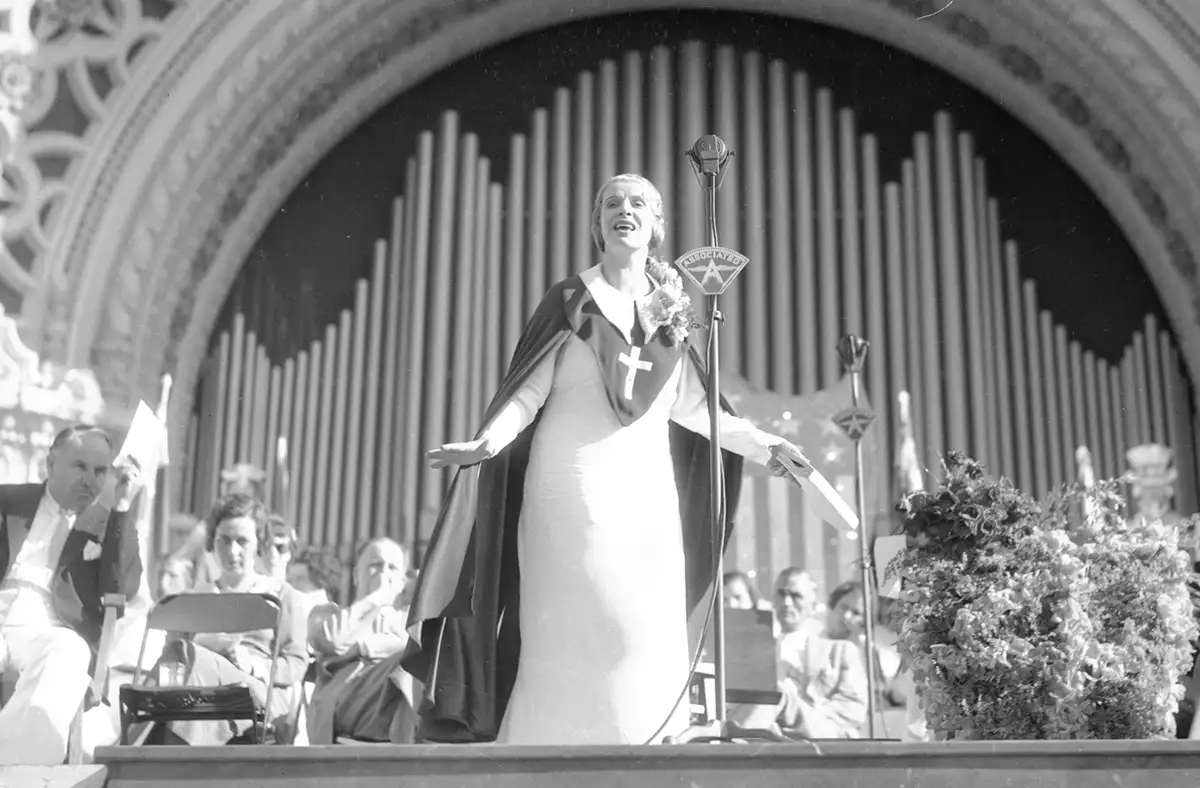

Aimee Semple McPherson
America’s First Celebrity Evangelist

OVERVIEW
Aimee Semple McPherson was the most influential religious innovator of early twentieth-century America, fusing Hollywood spectacle with Pentecostal fervor to create the template for modern megachurch ministry. Born in 1890 on an Ontario farm and dead at 53 from an accidental overdose, she packed her half-century with achievements that shaped American Christianity for a hundred years: the first megachurch, one of the first religious radio stations, theatrical “illustrated sermons” featuring live lions and fog machines, and a denomination that today claims 8.8 million members worldwide. Her 1926 disappearance—a five-week mystery involving alleged kidnapping, a suspected affair, and a grand jury investigation—made her the most sensational religious figure of the Jazz Age. McPherson didn’t just preach the gospel; she staged it, broadcast it, and turned herself into the first celebrity pastor in American history.
From Canadian Farm Girl to Revival Phenomenon
Aimee Elizabeth Kennedy was born October 9, 1890, in Salford, near Ingersoll, Ontario, to an unusual couple: her Methodist father James was 50 when he married her Salvation Army mother Minnie, who was just 15. Minnie dedicated her unborn daughter to God’s service, and that dedication proved prophetic—though not before teenage Aimee rebelled, reading novels, attending dances, and writing letters to newspapers questioning the teaching of evolution.
Everything changed in December 1907 when seventeen-year-old Aimee attended a Pentecostal tent revival led by Robert James Semple, an Irish-born evangelist ten years her senior. She experienced a dramatic conversion and fell in love with both the message and the messenger. They married in August 1908 in a Salvation Army ceremony, and the couple trained at William Durham’s Full Gospel Assembly in Chicago before departing as missionaries to China in 1910. Tragedy struck almost immediately: Robert contracted malaria and dysentery and died in Hong Kong in August 1910. Aimee, widowed at 20 and pregnant, gave birth to daughter Roberta Star Semple one month after her husband’s death.
After a brief, unhappy second marriage to accountant Harold McPherson—which produced son Rolf in 1913 but left Aimee spiritually restless—she abandoned domestic life in 1915 to pursue her calling. What followed was an extraordinary rise. By 1919, newspapers were comparing her crowd sizes to those of legendary revivalist Billy Sunday. At a 1921 faith-healing ceremony in San Diego’s Balboa Park, 30,000 people gathered, and the American Medical Association reportedly found the healings “genuine, beneficial and wonderful.” By October 1922, she had articulated her “Foursquare Gospel” vision, and on January 1, 1923, the 5,300-seat Angelus Temple opened its doors in Los Angeles.
Angelus Temple: The First American Megachurch
The massive domed structure at 1100 Glendale Boulevard in the Echo Park neighborhood represented something unprecedented in American religion: a church designed from the ground up for spectacle. Architect Brook Hawkins created a fireproof concrete-and-steel building crowned by a 125-foot unsupported dome—the largest in North America at the time—coated with a mixture of ground abalone shells that shimmered in the California sun. The interior ceiling was painted azure blue with fluffy clouds, a constant reminder, McPherson said, to “look for His coming.”
The temple cost approximately $1.5 million (some sources say $250,000 for construction alone), raised entirely through donations from followers. McPherson insisted on bright, joyous décor, with eight stained-glass windows depicting Christ’s life and a magnificent Kimball pipe organ. The stage could accommodate a 100-piece choir and full orchestra, with a hydraulic lift system—the same technology P.T. Barnum had used at his Hippodrome—to raise and lower elaborate sets. The building filled three times daily, seven days a week. Within the first six months, 8,000 converts knelt at the altar and 1,500 were baptized. The temple received 40 million visitors in its first seven years.
The dome’s lighted cross became a Los Angeles landmark, and during the Depression, the temple opened a commissary that fed an estimated 1.5 million people, operating soup kitchens and free clinics without distinguishing between “deserving” and “undeserving” poor. Designated a National Historic Landmark in 1992, Angelus Temple still operates today, now in partnership with the Los Angeles Dream Center.
KFSG: Pioneering Religious Broadcasting
On February 6, 1924, at 8:00 p.m., the words of John 3:16 crackled out from twin radio towers atop Angelus Temple, inaugurating KFSG—”Kall Four-Square Gospel”—as one of the first religious broadcasting operations in the United States. McPherson had the license approved in January 1924, making her the second woman to receive an FCC broadcast license from the Department of Commerce.
The station’s state-of-the-art 500-watt Western Electric transmitter, built at a cost of $25,000 raised by the congregation, broadcast live sermons, midnight organ recitals, children’s programming hosted by daughter Roberta, and concerts by the Temple Silver Band. Chief engineer Kenneth Ormiston—later infamous for his alleged role in McPherson’s disappearance—was hired from rival station KHJ for $3,000 per year.
Signals reached listeners not only across California but as far as New Zealand, Australia, and the Cape Verde Islands. McPherson called radio the “cathedral of the air” and developed an intimate broadcasting style, speaking directly into homes with precise enunciation and a faintly singsong cadence. A Radio Missionary Society formed to sponsor the station through listener donations, keeping it non-commercial for years. Though KFSG ceased operation in July 1961, its pioneering model shaped religious broadcasting for decades—McPherson even applied for an experimental television license shortly before her death in 1944, suggesting she would likely have become America’s first televangelist.
Illustrated Sermons: Worship as Theatrical Spectacle
McPherson’s most distinctive innovation was the “illustrated sermon”—theatrical productions that helped audiences “see the messages as well as hear them.” Reasoning that visual spectacle would bring more souls to Christ, she employed artists, electricians, scenic designers, costume makers, and carpenters to create what became the hottest ticket in Los Angeles.
The productions featured live animals (lions, camels, tigers, lambs), elaborate painted backdrops, fog and lighting effects, costume changes, and full orchestral accompaniment. For her famous “Arrested for Speeding” sermon in March 1925, McPherson dressed as a traffic cop, rode a real police motorcycle across the access ramp to the pulpit, blared the siren, and shouted, “Stop! You’re speeding to Hell!” In “Weighed in the Balances,” a giant pair of scales demonstrated that a child carrying a family Bible outweighed all worldly amusements. For her Daniel sermon, a live lion appeared on stage—footage captured by Fox Movietone newsreels.
The city of Los Angeles arranged for extra police and trolley cars on nights McPherson debuted new productions. Charlie Chaplin, though an agnostic, secretly attended services and was so impressed he consulted with McPherson on ways to improve her presentations. Critics called her the “P.T. Barnum of Christianity,” and a Harper’s Monthly reporter described scenes where “Heaven and Hell, sinner and saint, Satan, the fleshpots of Egypt, angels of Paradise and temptations of a bejazzed World are made visual by actors, costumes, and theatrical tricks of any and every sort.”
The Template for Modern Megachurches
Historians credit McPherson with pioneering virtually every element now standard in contemporary megachurch culture. Her innovations included entertainment-style worship incorporating professional production values, the use of broadcast media for religious outreach, celebrity pastor branding, and large-scale social ministry.
Washington State University historian Matthew Avery Sutton, author of the definitive academic biography, argues that McPherson “ushered Pentecostalism into the mainstream of American culture” and that her “celebrity status, use of spectacle, and mass media savvy came to define modern evangelicalism.” Christianity Today ranks her alongside Billy Sunday as “the most significant revivalist in the early twentieth century.” The San Francisco Chronicle noted that “decades before televangelists like Billy Graham, Pat Robertson or Jim and Tammy Faye Bakker started mixing show business and conservative Christianity, there was Aimee Semple McPherson.”
Her influence extended through direct lineage. Graduates of LIFE Bible College—the school she founded—include Jack Hayford, whose Church On The Way grew from 18 to over 12,000 members, and Chuck Smith, founder of the Calvary Chapel movement, which now encompasses more than 1,500 churches. Pentecostalism today claims 600 million adherents worldwide—a quarter of the world’s Christians—and McPherson, historians note, is “a big part of that story.”
Wealth, Glamour, and Financial Controversy
McPherson lived lavishly by the standards of Depression-era America, and her lifestyle drew criticism even as she fed millions. She drove a Packard touring car painted with “Jesus is Coming Soon—Get Ready,” entertained Hollywood celebrities, and built “Aimee’s Castle”—a 5,000-square-foot Moorish Revival mansion in Lake Elsinore costing $286,000 (approximately $4.9 million today), featuring a cerulean-tiled dome and minarets.
Encyclopedia.com describes her as “kindly, affable, entertaining, self-indulgent, taking unashamed pleasure in wealth and luxury, and yet hard-working and in her own way devout.” Critics noted the contrast between her glamorous lifestyle and her congregation of struggling migrant workers from the South and Midwest. One quipped that Sister Aimee “put the ‘cost’ in Pentecost.”
Financial controversies dogged her ministry. In 1928, lawsuits alleged she had fraudulently promoted “Tahoe Cedars,” a fictional Lake Tahoe development, to congregation members, allegedly receiving a 10% cut of lot sales. Plaintiffs sued for $150,000. McPherson settled without admitting legal responsibility, ensuring “everyone got their money back.” During the 1930s, Angelus Temple accumulated significant debt, with administrator Giles Knight later “disposing of 40 or so lawsuits” and eliminating “spurious projects.” Her own associate Rheba Crawford Splivalo sued McPherson for over $1 million for allegedly calling her a “Jezebel.” Britannica notes McPherson “was also accused of a number of financial improprieties, but none was proved.”
Remarkably, despite millions passing through her ministry, McPherson died with a personal estate of only $10,000, while the Foursquare Church she founded was worth $2.8 million.
Three Marriages: Tragedy, Restlessness, and Scandal
McPherson’s first marriage to Robert Semple, the evangelist who converted her, lasted only two years before his death from malaria in Hong Kong. On his headstone she inscribed: “He led me to Christ.” Widowed at 20 with an infant daughter, she returned to New York and in February 1912 married Harold McPherson, an accountant she met through Salvation Army work. The marriage produced son Rolf but left Aimee spiritually unfulfilled. During a near-death experience with appendicitis in 1914, she heard a voice calling her to preach. By 1915, she had left Harold, taking the children. He filed for divorce on grounds of abandonment, finalized in August 1921.
Her third marriage proved most controversial. In September 1931, McPherson eloped with David Hutton Jr., a baritone from the Angelus Temple choir, marrying in Yuma, Arizona. Two days later, Hutton was sued for “alienation of affections” by another woman—he settled for $5,000. The marriage violated Foursquare Gospel tenets prohibiting divorced persons from remarrying while former spouses lived. While McPherson recovered from a fractured skull in Europe in 1932, she learned Hutton was billing himself as “Aimee’s Man” in cabaret acts and posing with scantily clad women. They separated in 1933 and divorced in 1934. McPherson publicly repented of this marriage for both theological and personal reasons.
The Five-Week Disappearance: America’s Great Unsolved Mystery
On May 18, 1926, Aimee Semple McPherson walked into the Pacific Ocean at Venice Beach and vanished for 36 days, creating the most sensational scandal of the Jazz Age. Her secretary Emma Schaffer watched McPherson swim out and, when she looked up again, Aimee was gone.
The search was massive: Coast Guard cutters, deep-sea divers, aviator Fred Hoyt scanning from above, Hollywood studios lending giant searchlights. On Memorial Day, 25,000 people showed up at the beach to search. Followers dynamited Santa Monica Bay hoping to raise her body. Two people died in the search—one young church member drowned herself in grief; a diver died of hypothermia. Ransom notes demanding up to $500,000 arrived from mysterious groups calling themselves “the Revengers” and “the Avengers.” McPherson was reportedly “seen” in 16 different cities on a single day. A memorial service was held June 20.
Then, just before 3:00 a.m. on June 23, McPherson stumbled into Agua Prieta, Mexico, looking distressed, shoes white with desert dust, cactus spines in her legs. She claimed she had been kidnapped by three people—”Steve,” “Rose,” and an unnamed man—who held her in a boarded-up room and then a remote Mexican shack, burned her hand with a cigar, and were evaded when she cut her bonds on a tin can lid and walked 13-20 miles through the desert.
Prosecutors suspected differently. KFSG radio engineer Kenneth Ormiston had disappeared at roughly the same time, and investigators discovered he had rented a cottage in Carmel-by-the-Sea under an assumed name, occupying it with an unidentified woman from May 18-29. Key evidence included a green women’s bathing suit matching what McPherson wore the day she vanished and grocery slips in what a handwriting expert said was her penmanship. However, no fingerprints linked McPherson to the cottage, and the most credible witnesses who saw “Miss X” up close—including a stonemason who worked on the property throughout the period—testified that McPherson was “NOT the woman.”
McPherson, her mother, and Ormiston were charged with criminal conspiracy, perjury, and obstruction of justice, facing up to 42 years in prison. But all charges were dropped on January 10, 1927, after star witness Lorraine Wiseman-Sielaff proved unreliable and key evidence mysteriously disappeared. McPherson was never charged with a crime, and her family always maintained the kidnapping was real. Her return had drawn 30,000-50,000 people to the train station—more than for almost any other personage in Los Angeles history. She remained hugely popular with followers, though the scandal permanently shadowed her reputation.
The Foursquare Gospel: A Global Denomination
The International Church of the Foursquare Gospel, officially incorporated in December 1927 after 100 branch churches had been established, represents McPherson’s most enduring institutional legacy. The name derives from Ezekiel’s vision of four living creatures representing four aspects of Christ’s ministry: Jesus the Savior (salvation), Jesus the Baptizer with the Holy Spirit (spirit baptism), Jesus the Healer (divine healing), and Jesus the Soon-Coming King (second coming).
McPherson authored the denomination’s 22-section Declaration of Faith, emphasizing verbal inspiration of Scripture, the Trinity, substitutionary atonement, spirit baptism evidenced by speaking in tongues, divine healing through prayer, and the pre-millennial return of Christ. Today the denomination claims 8.8 million members in 67,500 churches across 150 countries, with over 71,000 ministers—a remarkable expansion from one woman’s vision.
LIFE Bible College, founded in 1923 as Echo Park Evangelistic and Missionary Training Institute and renamed in 1926 (the acronym stands for Lighthouse of International Foursquare Evangelism), has trained over 27,000 students. Now called Life Pacific University and headquartered in San Dimas, California, it remains the Foursquare flagship institution, offering pathways to ministerial licensing and ordination. The school earned WASC accreditation in 2019 and launched a seminary granted associate membership in the Association of Theological Schools in 2024. Its alumni include figures who shaped American Christianity far beyond Foursquare borders.
Elmer Gantry and Her Cultural Shadow
Sinclair Lewis began writing his satirical novel Elmer Gantry in 1926—the same year McPherson made headlines with her disappearance—and newspapers explicitly connected the book to her when it became America’s best-selling novel in 1927. The 1960 film adaptation, directed by Richard Brooks and starring Burt Lancaster and Jean Simmons, features the character Sister Sharon Falconer, a female revival evangelist loosely inspired by McPherson.
Jean Simmons’s Sharon Falconer shares key parallels with McPherson: both were theatrical female evangelists who built large tabernacles and incorporated pageantry into services. In the film, Sharon admits her real name is “Katie Jones” with humble origins, echoing McPherson’s background as a Canadian farm girl. However, the character is a composite—some fire-and-brimstone sermons were taken from Billy Sunday’s actual preaching.
The film won three Academy Awards, including Best Actor for Lancaster and Best Supporting Actress for Shirley Jones, with a 94% Rotten Tomatoes score. Other cultural portrayals include Frank Capra’s The Miracle Woman (1931) starring Barbara Stanwyck, the 1976 NBC movie The Disappearance of Aimee with Faye Dunaway and Bette Davis, and the 2020 HBO series Perry Mason, featuring Tatiana Maslany as Sister Alice McKeegan, a character “heavily inspired” by McPherson. The Foursquare Foundation even co-produced a 2012 Broadway musical, Scandalous, though it closed after only 29 performances.
Death at 53: An Accidental Overdose
Aimee Semple McPherson died on September 27, 1944, in her Oakland hotel room, twelve days before what would have been her 54th birthday. She had traveled to Oakland to preach her popular “Story of My Life” sermon. When her son Rolf went to her room at 10:00 a.m., he found her unconscious with pills and a half-empty bottle of capsules nearby. She was dead by 11:15 a.m.
The autopsy revealed a heart attack likely caused by an overdose of barbiturates, including Seconal, a powerful sedative that had not been prescribed to her. She had suffered from insomnia for years, particularly after exhausting faith-healing services, and had experienced various health problems including a nervous breakdown in 1930, a fractured skull in 1932, and an intestinal infection contracted in Mexico in 1943. The death was ruled accidental, though speculation about suicide persisted. The Foursquare Church has historically maintained it was accidental.
Between 45,000 and 50,000 people filed past her casket as she lay in state for three days at Angelus Temple. Eleven trucks transported $50,000 worth of flowers to her burial at Forest Lawn Memorial Park Cemetery in Glendale, where she rests in a marble sarcophagus flanked by two angels. Her son Rolf succeeded her as Foursquare president, leading the church for 44 years and overseeing its growth to millions of members worldwide.
Aimee Semple McPherson: Timeline of Key Events
1890
Born October 9 in Salford, Ontario, Canada
1907
Attends Pentecostal revival led by Robert Semple; experiences dramatic conversion
1908
Marries Robert Semple in August
1910
Departs for China as missionary; Robert dies of malaria in Hong Kong (August); daughter Roberta Star Semple born one month later
1912
Marries Harold McPherson in February
1913
Son Rolf McPherson bor
1915
Leaves Harold McPherson to pursue evangelism
1918
Settles in Los Angeles
1919
Crowd sizes compared to Billy Sunday
1921
30,000 attend faith-healing service at Balboa Park, San Diego; divorce from Harold McPherson finalized (August)
1922
Articulates the “Foursquare Gospel” vision (October)
1923
Angelus Temple opens January 1 (5,300 seats); founds Echo Park Evangelistic and Missionary Training Institute (later LIFE Bible College)
1924
KFSG radio station begins broadcasting February 6
1925
Performs famous “Arrested for Speeding” illustrated sermon (March)
1926
Disappears May 18 at Venice Beach; reappears June 23 in Agua Prieta, Mexico, claiming kidnapping; charged with conspiracy, perjury, and obstruction of justice
1927
All charges dropped January 10; International Church of the Foursquare Gospel officially incorporated (December)
1928
Sued over “Tahoe Cedars” real estate promotion; settles lawsuit
1930
Suffers nervous breakdown
1931
Marries David Hutton Jr. in September
1932
Suffers fractured skull; learns of Hutton’s cabaret appearances
1933
Separates from David Hutton
1934
Divorces David Hutton
1943
Contracts intestinal infection in Mexico
1944
Dies September 27 in Oakland hotel room from accidental barbiturate overdose; 45,000-50,000 view her casket at Angelus Temple; buried at Forest Lawn Memorial Park, Glendale
Conclusion: The Template She Created Still Shapes American Faith
Aimee Semple McPherson’s legacy transcends any single scandal or achievement. She demonstrated that American Christianity could embrace entertainment, celebrity, and mass media without abandoning its evangelical core—a synthesis that defines megachurch culture a century later. Her Angelus Temple was filling 5,300 seats three times daily before the word “megachurch” existed. Her KFSG broadcasts pioneered religious radio before most Americans owned sets. Her illustrated sermons presaged the multimedia worship experiences now standard from Hillsong to Lakewood.
The Foursquare Church she founded continues to grow, with nearly 9 million members in 150 countries, while LIFE Pacific University still trains ministers in her tradition. The 1926 disappearance remains genuinely mysterious—historians like Sutton believe she likely had an affair with Ormiston, but the most credible eyewitnesses couldn’t identify her, no fingerprints were found, and all charges were dropped. Her family always insisted the kidnapping was real.
What is certain is that McPherson showed a generation of American preachers—and the televangelists who followed—how to command attention in the age of mass media. As historian Matthew Avery Sutton observes: “If we wish to understand the use of celebrity and technology by religious conservatives, not only to spread the gospel but to influence politics as well, we must look to its beginnings in the ministry of Aimee Semple McPherson.” She wasn’t just ahead of her time; she created the time that came after.
Biographical Overviews & General Reference
- Aimee Semple McPherson – Wikipedia
- Aimee Semple McPherson – Britannica
- Aimee Semple McPherson – EBSCO Research Starter
- Encyclopedia.com: Aimee Semple McPherson
- Revivalstory.org – Aimee Semple McPherson
Angelus Temple, Foursquare Church & Organizational History
- Angelus Temple – Wikipedia
- Foursquare Church – Wikipedia
- Ministry Innovation: The Illustrated Sermon – Foursquare Resources
- Echo Park Evangelistic Association
- Angelus Temple, Scandalous! – Grokipedia
Documentaries, Journalism & Popular Media
- Smithsonian: The Incredible Disappearing Evangelist
- PBS American Experience: Sister Aimee
- PBS SoCal Lost LA: Who Was Sister Aimee?
- 99% Invisible: Sister Aimee & the Birth of the Megachurch
- SF Gate: Fake Megachurch in Tahoe Story
- LA Times/Yahoo: The Gospel of Reinvention
Books & Academic Studies
- Aimee Semple McPherson and the Resurrection of Christian America – Harvard University Press
- Preaching.com: The Life and Ministry of Aimee Semple McPherson


