
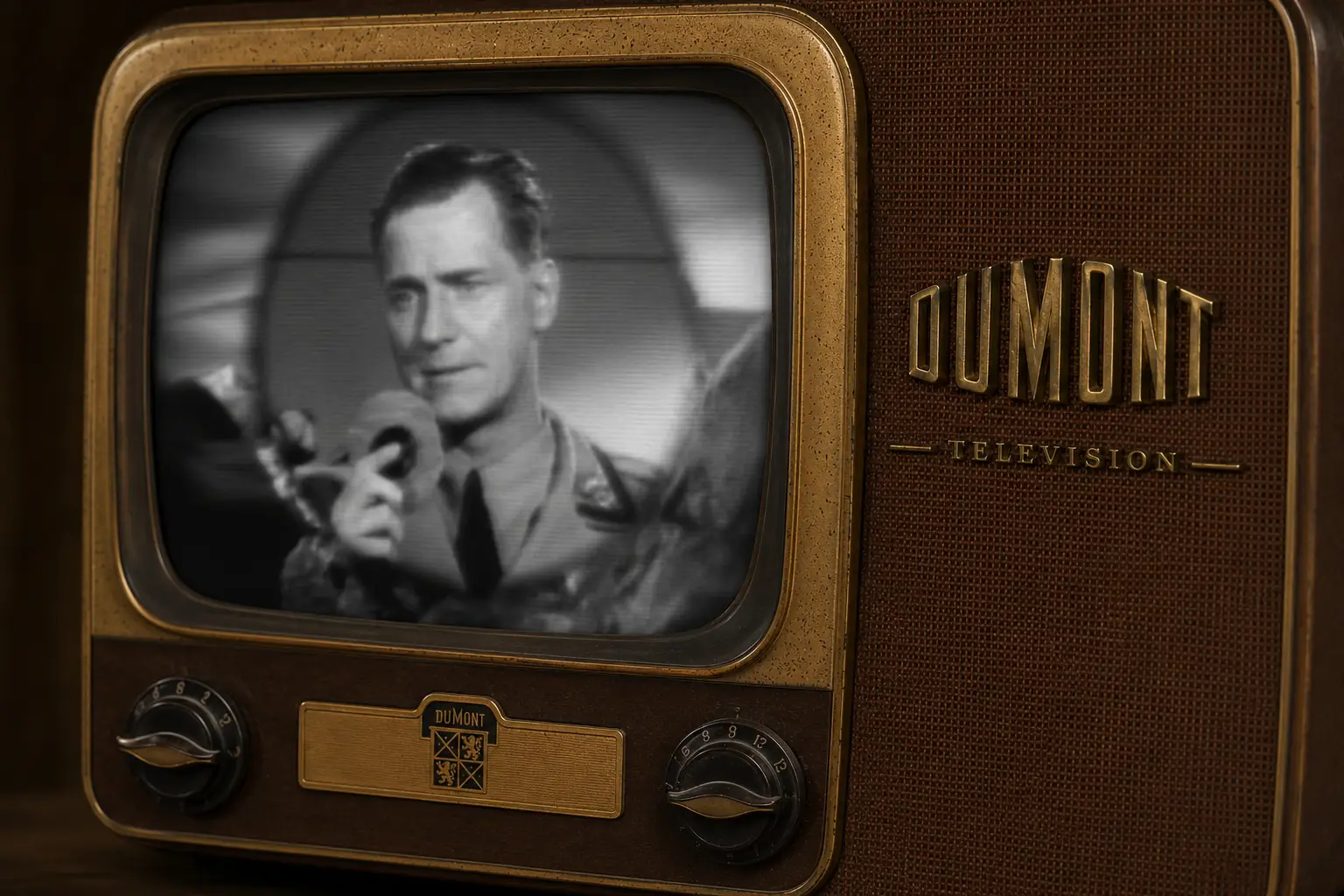

The DuMont Television Network
Rise and Fall of a Pioneer

The DuMont Television Network: Engineering Innovation, Programmatic Trailblazing, and the Systemic Collapse of a Commercial Pioneer
The historical landscape of mid-twentieth-century American broadcasting is commonly defined by the hegemony of the “Big Three” networks: NBC, CBS, and ABC. Yet, the foundational decade of commercial television featured a fourth competitor that was, in many respects, more technically advanced and structurally innovative than its radio-entrenched rivals. The DuMont Television Network, founded by the visionary engineer Dr. Allen B. DuMont, operated nationally from 1946 to 1956. Lacking the financial safety net, pre-existing affiliate contracts, and cross-promotional power of a parent radio network, DuMont was conceived as a television-first enterprise, relying purely on manufacturing profits and live advertising sales. While this singular focus yielded historic technological developments and landmark programming, it also left the network uniquely vulnerable to regulatory discrimination, anti-competitive corporate alliances, and the physical constraints of early broadcast infrastructure. The corporate trajectory of DuMont Laboratories and its broadcasting arm provides a profound case study in the intersection of federal regulatory policy, anti-competitive market structures, and the tragic loss of an irreplaceable physical archive.
Allen Balcom DuMont: The Crucible of Science, Invention, and Corporate Foundation
To trace the origins of the DuMont Television Network, one must examine the highly disciplined intellectual and professional life of its founder. Born in Brooklyn, New York, on January 29, 1901, Allen Balcom DuMont’s life was altered at the age of ten when he contracted polio. Quarantined in his family’s Eastern Parkway apartment for nearly a year, DuMont turned to books on wireless communication and a crystal radio receiver provided by his father. He repeatedly disassembled, modified, and rebuilt the receiver, eventually constructing a functional transmitter and erecting a thirty-foot transceiving antenna on his landlord’s roof. To regain the use of his legs, he was advised to practice swimming. This led his family to relocate to Montclair, New Jersey, in 1914, where he swam year-round at the local YMCA indoor pool, eventually graduating from Montclair High School in 1919.
DuMont’s passion for wireless communications manifested early when, in 1915 at age fourteen, he became the youngest American to secure a first-class commercial radio operator’s license. He spent his high school and college summers working as a shipboard radio operator, making voyages to the Caribbean, South America, and Europe. In the summer of 1922, he was stranded in Copenhagen for months due to a dock workers’ strike. He matriculated at Rensselaer Polytechnic Institute (RPI) in Troy, New York, joining the Alpha chapter of the Theta Xi fraternity and graduating with a Bachelor of Science in Electrical Engineering in 1924.
Jan 29, 1901
Birth (Brooklyn, NY)
Early childhood exposure to electrical engineering during post-polio quarantine.
Developed a lifelong focus on wireless radio and cathode-ray tube electronics.
1924–1928
Westinghouse Lamp Company
Redesigned automated machinery for vacuum tube manufacturing.
Boosted production from 500 to 50,000 tubes daily; won the inaugural Westinghouse Award.
1928–1931
De Forest Radio Company
Directed research on Jenkins’ mechanical TV patents; proved mechanical scanning obsolete.
Resigned after being denied funding to develop a purely electronic television display tube.
1931
Foundation of DuMont Labs
Established a basement laboratory in Upper Montclair with $1,000 in capital.
Invented the first commercially practical, long-life cathode-ray tube.
1932
“Magic Eye” Tube Invention
Developed an inexpensive electronic visual tuning indicator for consumer radios.
Sold the patent rights to RCA for $20,000, funding ongoing television research.
1938
Launch of the Model 180
Manufactured the first commercial, all-electronic consumer television receiver.
Outpaced RCA’s consumer sets by several months, setting the industry gold standard.
1939
Paramount Pictures Alliance
Sold a 40% minority stake to Paramount Pictures in exchange for a $400,000 cash advance.
Created a long-term regulatory blockade under the FCC’s strict five-station ownership limit.
1946
Official Network Launch
Linked flagship station WABD (New York) to WTTG (Washington, D.C.) via coaxial cable.
Established the world’s first licensed, fully commercial television network.
1955
Electronicam System Rollout
Deployed a dual-lens hybrid film-television production camera.
Allowed high-quality 35mm film recording of live broadcasts, bypassing expensive coaxial lines.
Nov 14, 1965
Death (New York, NY)
Served as Group General Manager of the DuMont Division under Fairchild Camera.
Inducted into the National Inventors Hall of Fame; honored as a founding pioneer of television.
Following graduation, DuMont joined the Westinghouse Lamp Company in Bloomfield, New Jersey, where he was placed in charge of radio tube production. Showing an early gift for process automation, DuMont designed high-speed production and testing apparatuses that elevated factory output from a stagnant 500 vacuum tubes per day to an unprecedented 50,000 tubes per day. Westinghouse rewarded him with a $500 bonus, a nominal raise, and established the “Westinghouse Award” to recognize his achievements—a precursor to today’s prestigious Regeneron Science Talent Search.
By 1928, DuMont was recruited as vice president and production manager for the De Forest Radio Company by radio pioneer Dr. Lee de Forest. DuMont modernized the de Forest factory, integrating automated grid-winding, sealing, and cutting machinery that drove production to 30,000 tubes daily. When de Forest purchased the mechanical television patents of C. Francis Jenkins, DuMont began overseeing transmissions from experimental station W2XCD in Passaic, New Jersey. He quickly concluded that mechanical scanning systems, which relied on spinning perforated discs, were fundamentally inadequate for commercial television, asserting that a clear, stable image required a purely electronic system using a cathode-ray tube (CRT). When de Forest’s investors, focused on immediate financial returns, refused to fund research into a long-lasting electronic tube, DuMont resigned.
In 1931, DuMont founded Allen B. DuMont Laboratories in the basement of his home with $1,000, half of which was borrowed from his father. At the time, imported German cathode-ray tubes were fragile, expensive, and possessed a operating life of only 25 to 30 hours. DuMont’s team extended the operational lifespan of the CRT to over 1,000 hours, transforming it into a durable consumer product and making commercial television viable.
To fund his television developments, DuMont Laboratories commercialized the CRT as a visual measuring instrument, designing and mass-producing the modern laboratory oscilloscope, which DuMont termed the “oscillograph”. By the 1940s, his company was the undisputed market leader in oscilloscopes, generating steady profits that were immediately channeled into television receiver design.
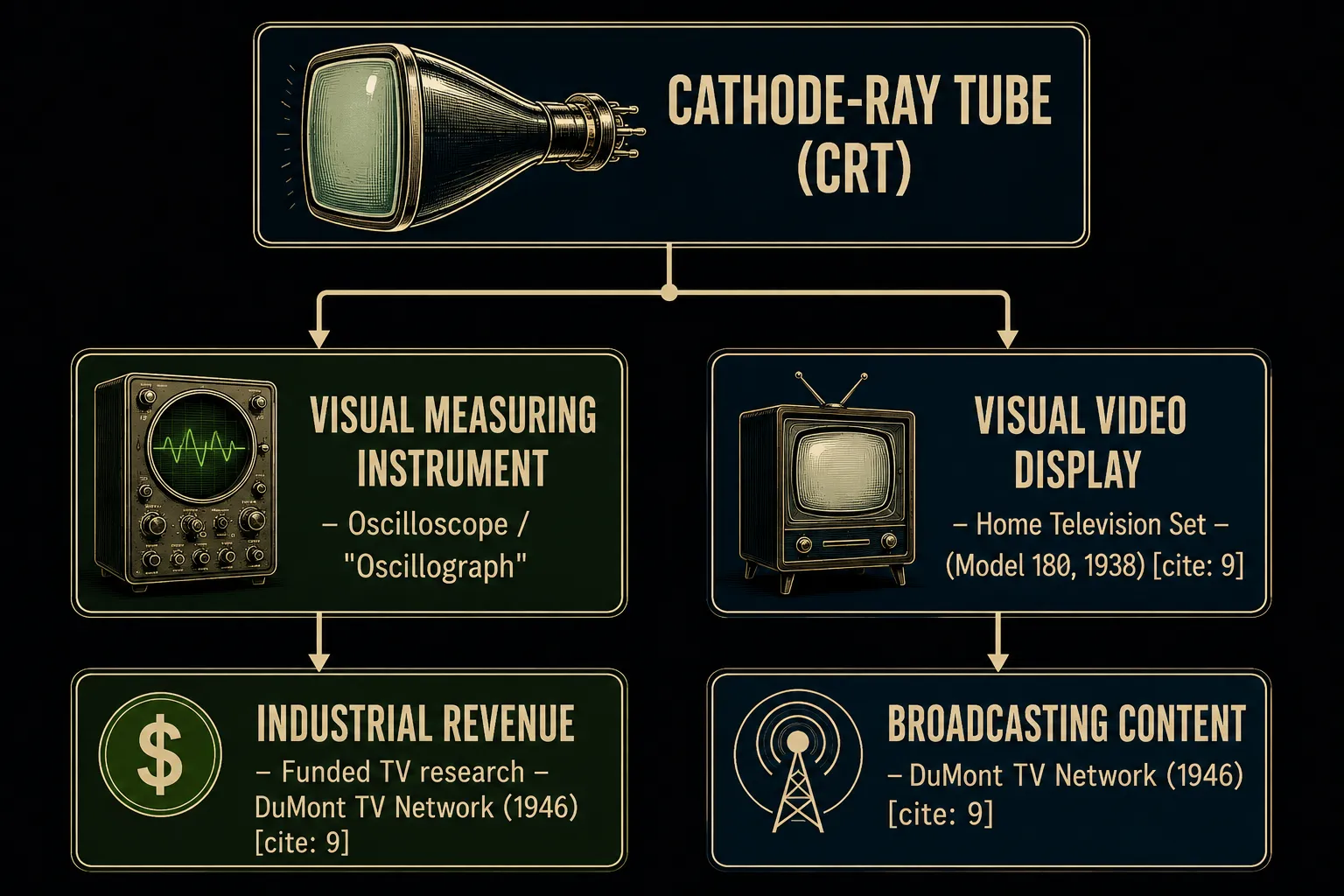
In 1932, DuMont invented the “magic eye tube” (or Electron Ray Tube), which used a green phosphor glow to visually indicate radio tuning accuracy. He sold the patent rights to RCA for $20,000 to fund his ongoing television research. In June 1938, DuMont Laboratories launched the Model 180, the first all-electronic television set sold to the American public, beating RCA’s commercial debut by nearly a year.
Personally, DuMont was a modest, dedicated man who avoided the public spotlight, preferring to focus on his engineering work and his family. He married Ethel DuMont, and the couple had two children, Allen B. Jr. and Yvonne. Outside the laboratory, his primary recreation was power-boat racing, where he won numerous trophies for navigating and calculating power-boat velocity with high mathematical accuracy.
The Infrastructure of an Upstart: Network Beginnings and Strategic Alliances (1938–1946)
The primary barrier to marketing television receivers in the late 1930s was the complete lack of regularly scheduled programming. To resolve this and demonstrate the quality of his sets, DuMont opened an experimental station, W2XVT, in Passaic, New Jersey, in 1938. In 1940, the station relocated to Manhattan as W2XWV on Channel 4, commencing regular broadcasts on April 13 of that year. Unlike its competitors, NBC and CBS, which scaled back or ceased their television broadcasts during World War II, DuMont maintained active experimental and commercial transmissions throughout the war. In 1944, W2XWV received its commercial license—the third in New York City—under the call letters WABD (for Allen B. DuMont), moving to Channel 5 in 1945.
To expand his operations into a true network, DuMont needed to link multiple cities. In May 1945, DuMont established experimental station W3XWT in Washington, D.C., which secured a commercial license in November 1946 as WTTG. The station’s call letters were named in honor of Dr. Thomas T. Goldsmith Jr., DuMont’s vice president of research, chief engineer, and closest friend. Dr. Goldsmith, who earned his PhD in physics from Cornell University in 1936 under Frederick Bidell by building a custom oscilloscope, directed the engineering efforts that turned laboratory CRTs into mass-produced television screens.
Goldsmith chaired the Synchronization Panel of the first National Television System Committee (NTSC), establishing the technical standards that governed American black-and-white television. To control the standard horizontal scanning rate, the committee established a precise line frequency $f_H$, where:
fH = 525(lines) × 29.97(frames per second) = 15,734.25 Hz When color was introduced, the NTSC modified the color subcarrier frequency fsc to prevent interference with the monochrome signal:
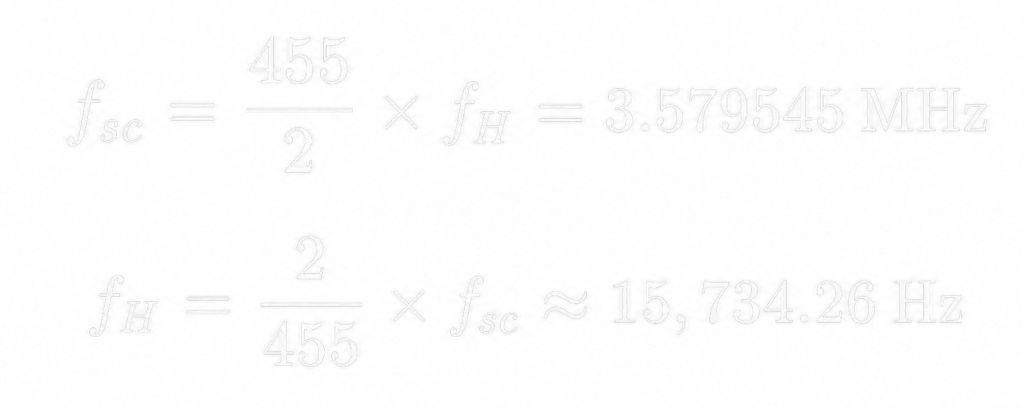
his mathematical precision ensured backward compatibility with existing black-and-white sets, a system Goldsmith helped codify.
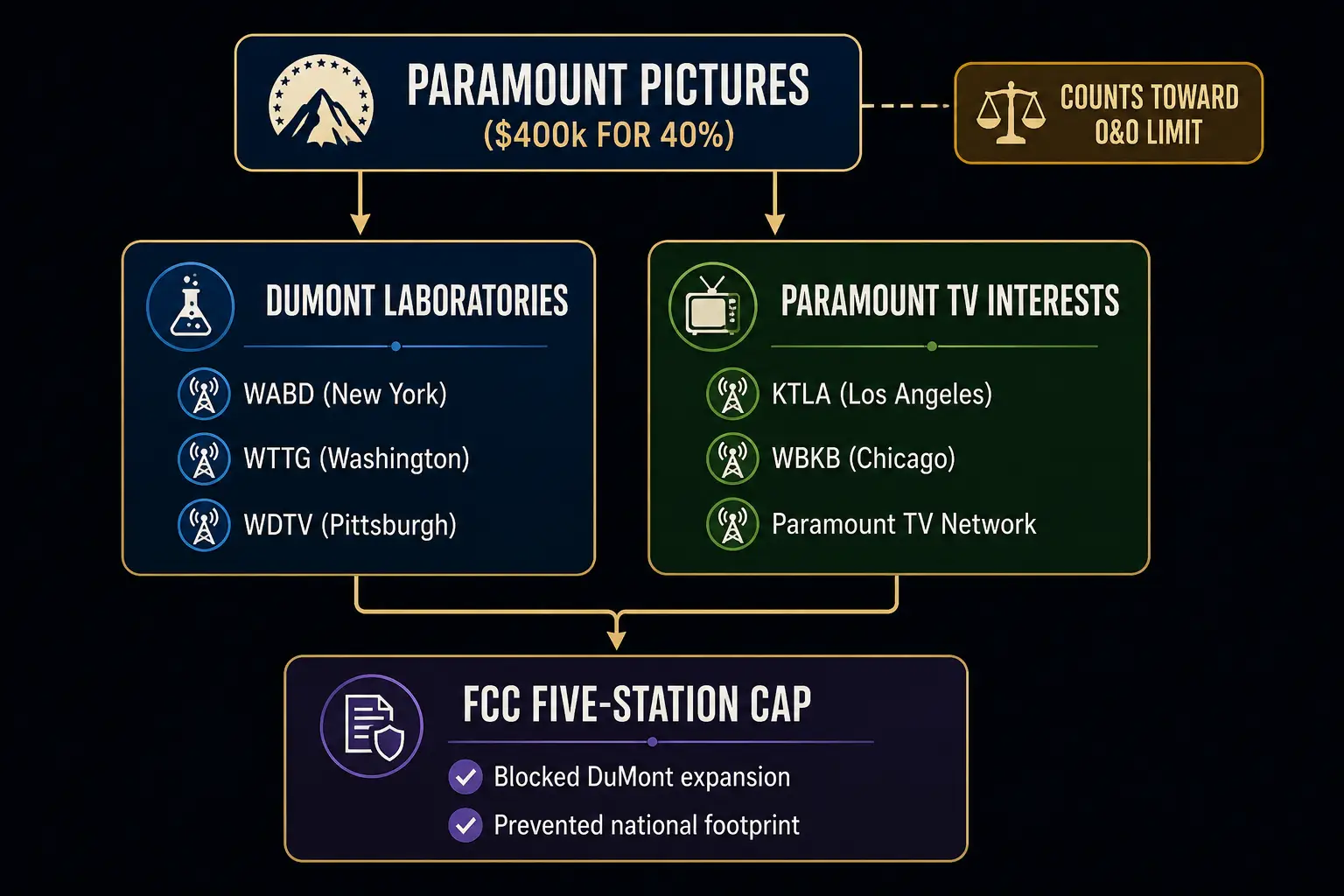
To finance his transition into network broadcasting, DuMont Laboratories had sold a 40% minority interest in the company to Paramount Pictures in 1939 for $400,000. DuMont claimed that the original 1937 acquisition proposal contractually bound Paramount to expand its television footprint exclusively “through DuMont”. Paramount representative Paul Raibourn denied this claim until 1953, when an examination of the original draft document proved DuMont correct. Despite this, Paramount launched its own experimental stations in Los Angeles (KTLA) and Chicago (WBKB) without DuMont’s involvement. Paramount stopped financially supporting DuMont in 1941, never supplied the network with programs or star talent, and eventually launched the competing Paramount Television Network in 1949, directly undercutting DuMont.
Furthermore, AT&T, which owned the physical coaxial cable lines necessary to transmit live television, gave preferential treatment to the older radio networks, NBC and CBS, allocating them over 100 hours of transmission time per week. ABC received roughly 50 hours, while DuMont was allotted only 37 hours per week. Additionally, AT&T contractually forced DuMont to lease expensive radio lines along with its television lines, despite the fact that DuMont had no radio stations to utilize them.
Despite these hurdles, DuMont began physical coaxial cable hookups between WABD in New York and WTTG in Washington. Following the official launch of the DuMont Television Network on August 15, 1946, the network expanded into physical facilities. Early broadcasts originated from DuMont’s headquarters at 515 Madison Avenue.
Needing more space, in 1946 DuMont leased and converted the historic auditorium inside Wanamaker’s Department Store at Ninth Street and Broadway into three broadcast studios, including a 2,000-square-foot facility with seating for 280 viewers. This allowed shoppers to watch live television production in real time, serving as an interactive showroom to sell sets. In 1954, the network opened the lavish, state-of-the-art DuMont Tele-Centre at 205 East 67th Street, which is today the site of the Fox Television Center.
Early Programming: The Golden Age of Innovation (1946–1953)
Because DuMont did not have a radio network, it could not draw on established sponsor relationships, affiliate loyalty, or radio profits to subsidize its television operations. While NBC and CBS populated their schedules with legendary radio stars like Lucille Ball, Jack Benny, Sid Caesar, and Ed Sullivan, DuMont programmers had to rely on their wits and connections with the Broadway theater community to develop low-cost, original formats.
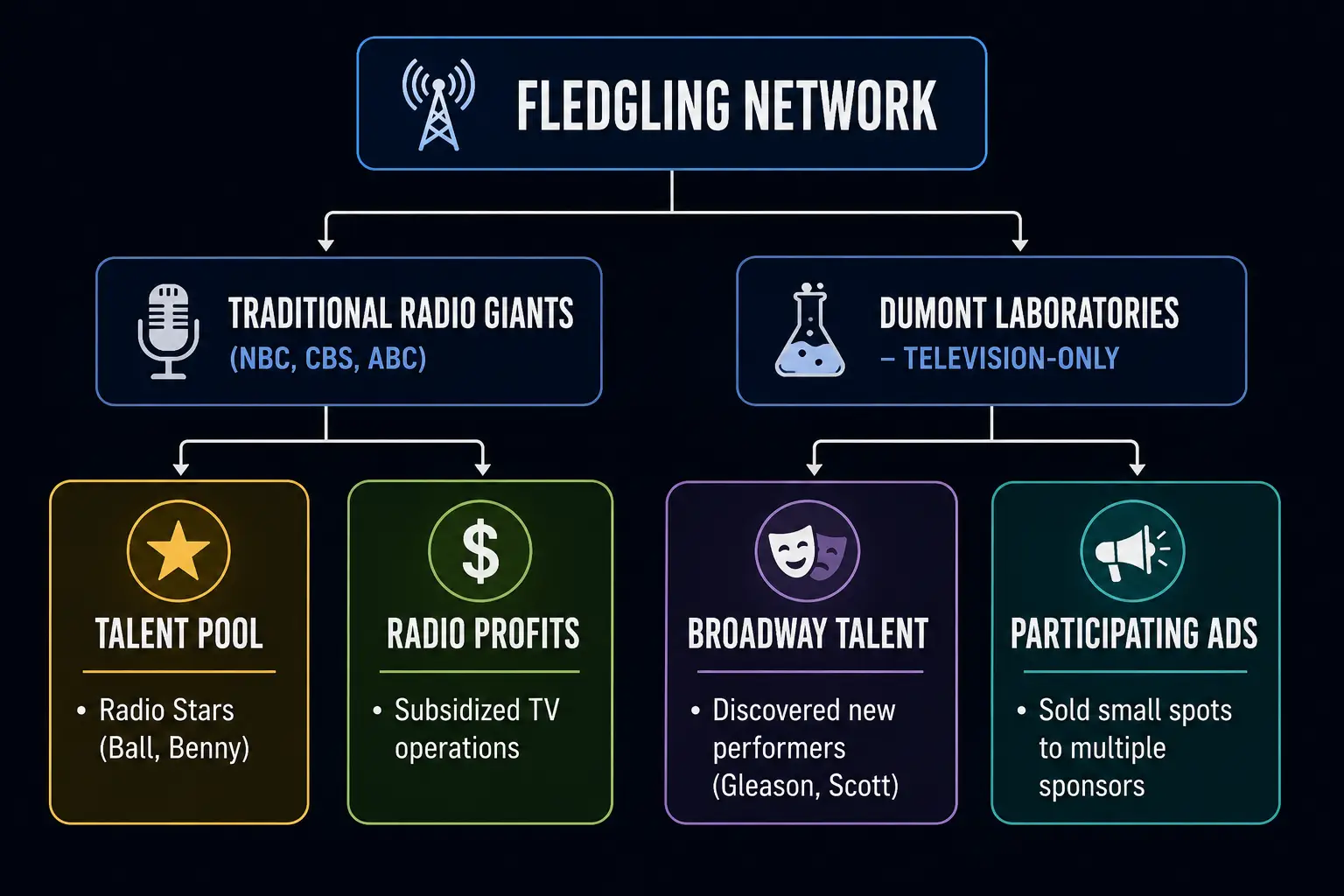
This creative pressure yielded some of the most influential programs of the Golden Age. In 1946, DuMont launched Faraway Hill, adapted from an unfinished novel by David P. Lewis, which became the first network television soap opera. To cater to the domestic schedules of housewives, the program featured stream-of-consciousness voiceovers, allowing viewers to look away to complete household chores without losing track of the plot. In 1947, DuMont introduced the first television sitcom, Mary Kay and Johnny.
The network also broadcast Ted Mack’s The Original Amateur Hour (1948–1949), Small Fry Club (1947–1951), and the Peabody Award-winning The Johns Hopkins Science Review, which used simple, live demonstrations to explain advanced scientific principles to the general public.
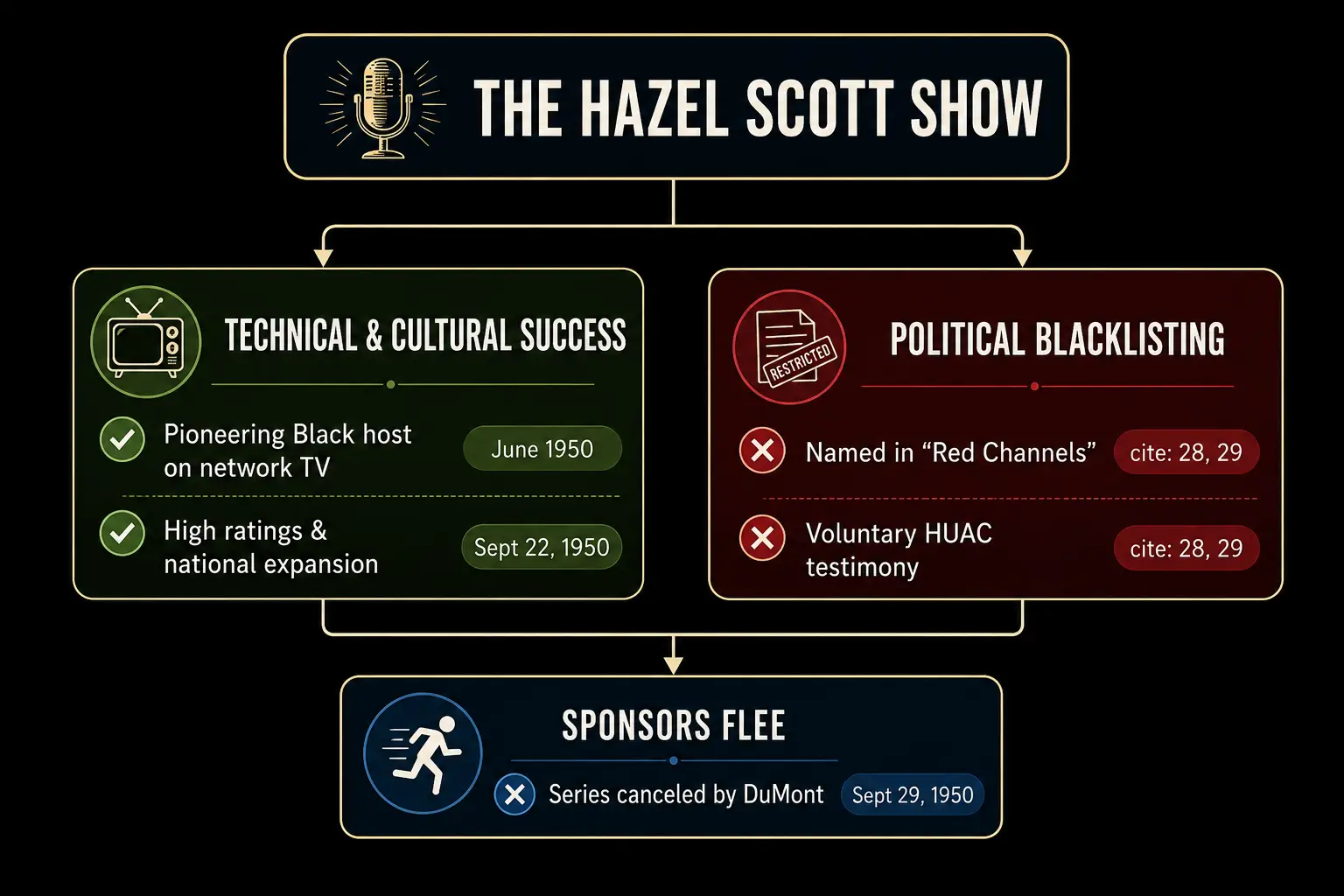
DuMont’s most significant cultural achievement occurred in July 1950 with the launch of The Hazel Scott Show, a 15-minute musical variety program hosted by the Trinidadian-born classical and jazz piano prodigy Hazel Scott. Broadcast on Monday, Wednesday, and Friday evenings, the show featured Scott performing show tunes and classical showpieces, backed by legendary musicians Charles Mingus and Max Roach. Scott presented an image of elegance and sophistication, dressed in gorgeous gowns and performing in a set designed to resemble a Manhattan penthouse. This was a direct, conscious rejection of the racist, subservient caricatures of Black Americans that dominated contemporary Hollywood films and radio broadcasts.
Within weeks, the show’s high ratings prompted DuMont to expand it to a national broadcast. However, in June 1950, Scott was listed in the anti-Communist publication Red Channels. Although she voluntarily testified before the House Un-American Activities Committee on September 22, 1950, to vigorously deny any Communist ties and explain that her appearances at civil rights events were at the behest of her manager, sponsors pulled their support. Under severe financial pressure, DuMont canceled The Hazel Scott Show on September 29, 1950, replacing it with the short-lived The Susan Raye Show.
DuMont’s most commercially successful program was Cavalcade of Stars, hosted by comedian Jackie Gleason starting in July 1950. Gleason’s writers developed a series of domestic sketches, settling on the title “The Honeymooners” and casting Pert Kelton as Alice and Art Carney as Ed Norton. The sketch debuted on October 5, 1951, presenting a gritty, realistic portrayal of working-class life in Brooklyn. This realism drove DuMont’s audience share from 9% to 25%. However, when Gleason’s contract expired in 1952, the financially strained network could not compete with CBS’s lucrative contract offer, and Gleason moved his entire show—including “The Honeymooners”—to CBS.
To fill its schedule on a limited budget, DuMont developed an erratic, sport-heavy lineup during the 1946–1947 season. The network left Sundays entirely unprogrammed, giving NBC a virtual monopoly on weekend viewers. On Mondays, DuMont broadcast Boxing from Jamaica Arena from 9:00 PM to 11:00 PM, competing directly with NBC’s Boxing from St. Nicholas Arena, which held a distinct advantage by starting thirty minutes earlier. DuMont’s Friday schedule paired western films with wrestling matches, but these cheap programs struggled to compete with NBC’s premier Boxing from Madison Square Garden. On Wednesdays, DuMont frequently ceded half-hour blocks to local affiliates right in the middle of prime time, creating a fragmented viewing experience.
1946–1947
Erratic, sport-heavy scheduling. Left Sundays completely unprogrammed.
Faraway Hill (first network soap opera). Cash and Carry (first network game show).
Minimal national footprint; struggled to compete with NBC’s early sports head-starts.
1948–1949
Expansion of live variety, talent, and children’s programming.
Expansion of live variety, talent, and children’s programming.
Expansion of live variety, talent, and children’s programming.
1950–1951
Primetime variety and dramatic experimentation.
The Hazel Scott Show. Cavalcade of Stars (featuring Jackie Gleason).
The Hazel Scott Show. Cavalcade of Stars (featuring Jackie Gleason).
1952–1953
High-concept public service and religious broadcasting.
Life Is Worth Living (Bishop Fulton J. Sheen). The Johns Hopkins Science Review.
Sheen won an Emmy; DuMont achieved temporary parity with the newly merged ABC.
1954–1955
Terminal decline; shift to cheap, unscripted daytime filler.
DuMont Evening News. Low-budget returns like Opera Cameos and The Music Show.
Dropped all scripted programs in April 1955; canceled physical AT&T line leases in May.
1938
Launch of the Model 180
Manufactured the first commercial, all-electronic consumer television receiver.
Outpaced RCA’s consumer sets by several months, setting the industry gold standard.
1955–1956
Occasional sports feeds and local broadcasts.
Boxing from St. Nicholas Arena (Chris Schenkel).
National network dissolved on August 6, 1956; local stations spun off to Metromedia.
Late-Stage Decline, the Electronicam, and National Disintegration (1954–1956)
By the 1954–1955 television season, the DuMont Television Network was in a state of terminal financial collapse. Lacking the funds to produce high-budget scripted entertainment, the network’s final programming schedule was characterized by extreme budget cuts, uninspiring unscripted programs, and desperate attempts to fill airtime cheaply.
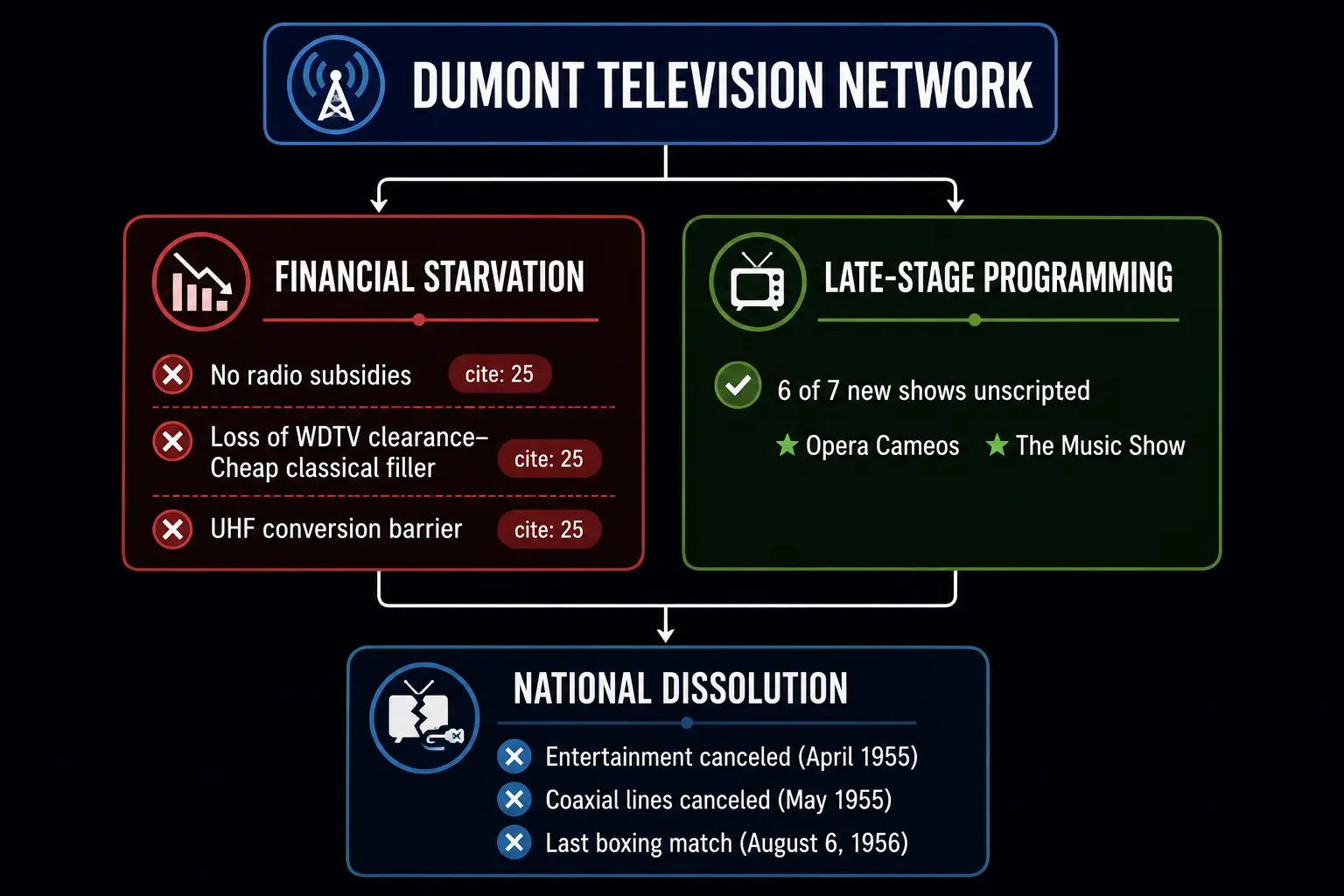
To survive on a highly restricted budget, DuMont relied almost entirely on unscripted series. Out of the seven new series that premiered during the 1954–1955 season, six were unscripted. The network’s returning lineup became increasingly cheap to produce, featuring low-budget titles such as Opera Cameos and The Music Show.
To fill its evening slots, the network launched the DuMont Evening News Monday through Friday at 7:15 PM. This marked the network’s third attempt to establish a viable national news show after already canceling its first two news programs due to high production costs and poor clearances.
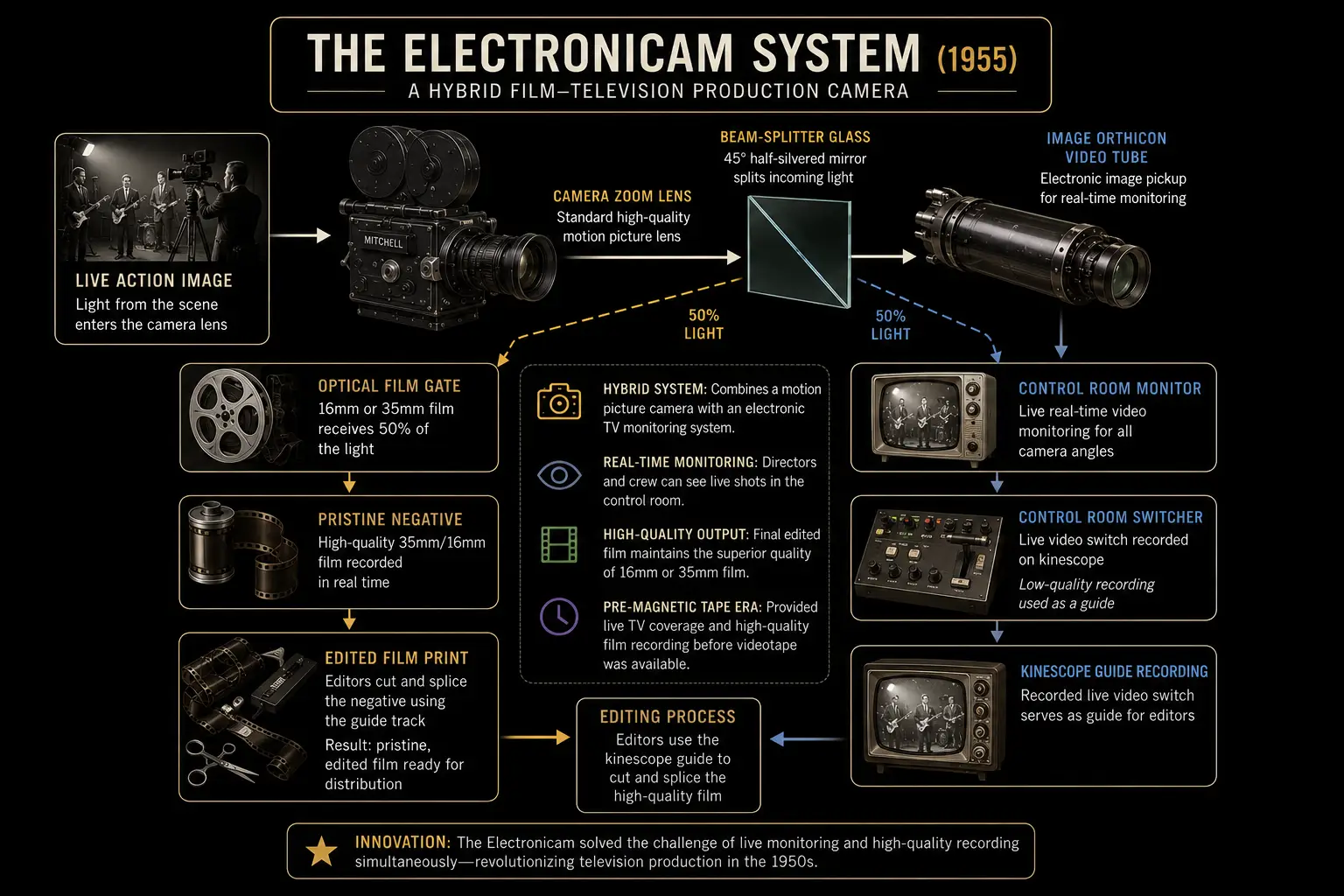
To bypass the prohibitive costs of broadcasting live over AT&T’s coaxial cable lines, production director James L. Caddigan invented the Electronicam system in 1955. Before the advent of magnetic videotape, the standard method for recording live broadcasts was the “kinescope,” which involved a motion picture camera filming a live television monitor. Kinescopes suffered from low contrast and optical distortion.
The Electronicam was a hybrid film-television production camera. It utilized a specialized housing that mounted a standard electronic image orthicon television tube alongside a high-quality 35mm or 16mm Mitchell motion picture camera. Light entering the camera lens passed through an optical beam-splitter, sending 50% of the light to the film gate and 50% through a 45-degree mirror into the electronic video tube.
This allowed the director and technical crew to monitor all camera angles in real time in the control room, a capability that was impossible with standard film cameras at the time. The live video switch was recorded via a low-quality kinescope to serve as a guide for physical editing. Editors then used this guide to cut and splice the high-quality 35mm film reels, creating a pristine, edited film print ready for physical distribution to affiliates.
Although the Electronicam was designed to save DuMont’s network operations, it was deployed too late to halt the financial bleeding. By February 1955, DuMont officials accepted that they could not sustain a national schedule. On April 1, 1955, the network dropped almost all of its scripted entertainment programs, including its longest-running show, Captain Video. Bishop Sheen’s Life Is Worth Living aired its final DuMont episode on April 26 before migrating to ABC.
By May 1955, DuMont canceled its AT&T coaxial-cable leases, ending live national interconnections. Inexpensive, unscripted summer replacement series like It’s Alec Templeton Time sustained what was left of the network. A panel show, What’s the Story, was the last regularly scheduled non-sports program, ending on September 23, 1955.
Following that date, DuMont reserved its live network feed exclusively for occasional sporting events, such as high school and professional football games. The final program broadcast nationally by the DuMont Television Network was Boxing from St. Nicholas Arena, hosted by Chris Schenkel, which went dark on August 6, 1956.
Structural Failure and the Desecration of the Archive
The collapse of the DuMont Television Network was driven by a combination of regulatory limits and structural disadvantages:
The Paramount Blockade: Under the FCC’s strict ownership limits, no entity could own more than five VHF stations. Because Paramount Pictures held a 40% stake in DuMont Laboratories and owned its own stations in Los Angeles and Chicago, the FCC ruled that Paramount “essentially controlled” DuMont. This blocked DuMont from acquiring stations in Cleveland and Cincinnati, preventing the network from building a competitive national footprint. Furthermore, Paramount vetoed a proposed merger with ABC in 1953, which would have created a massive broadcasting force under the name “ABC-DuMont”.
The FCC Freeze and UHF Transition: The FCC’s four-year freeze on new licenses (1948–1952) locked early station affiliations in place, allowing NBC and CBS to secure the most profitable VHF channels. When the FCC opened the UHF band in 1952, DuMont was forced to expand on these less-desirable channels. Because television set manufacturers were not legally required to include built-in UHF tuners until the All-Channel Receiver Act of 1962, consumers had to buy expensive external converters. DuMont’s UHF affiliates broadcast to virtually non-existent audiences, starving the network of critical advertising revenue.
The Forced Sale of WDTV: Facing severe cash shortages, DuMont was forced to sell its only highly profitable VHF station, WDTV in Pittsburgh, to Westinghouse in late 1954 for $9.75 million. Because WDTV held a de facto monopoly in Pittsburgh—then the nation’s sixth-largest market—DuMont had utilized it as a crucial bargaining chip to force NBC, CBS, and ABC to clear its programs in other major cities. Without WDTV, DuMont’s leverage vanished, and its network advertising revenues collapsed to less than half of their 1953 levels.
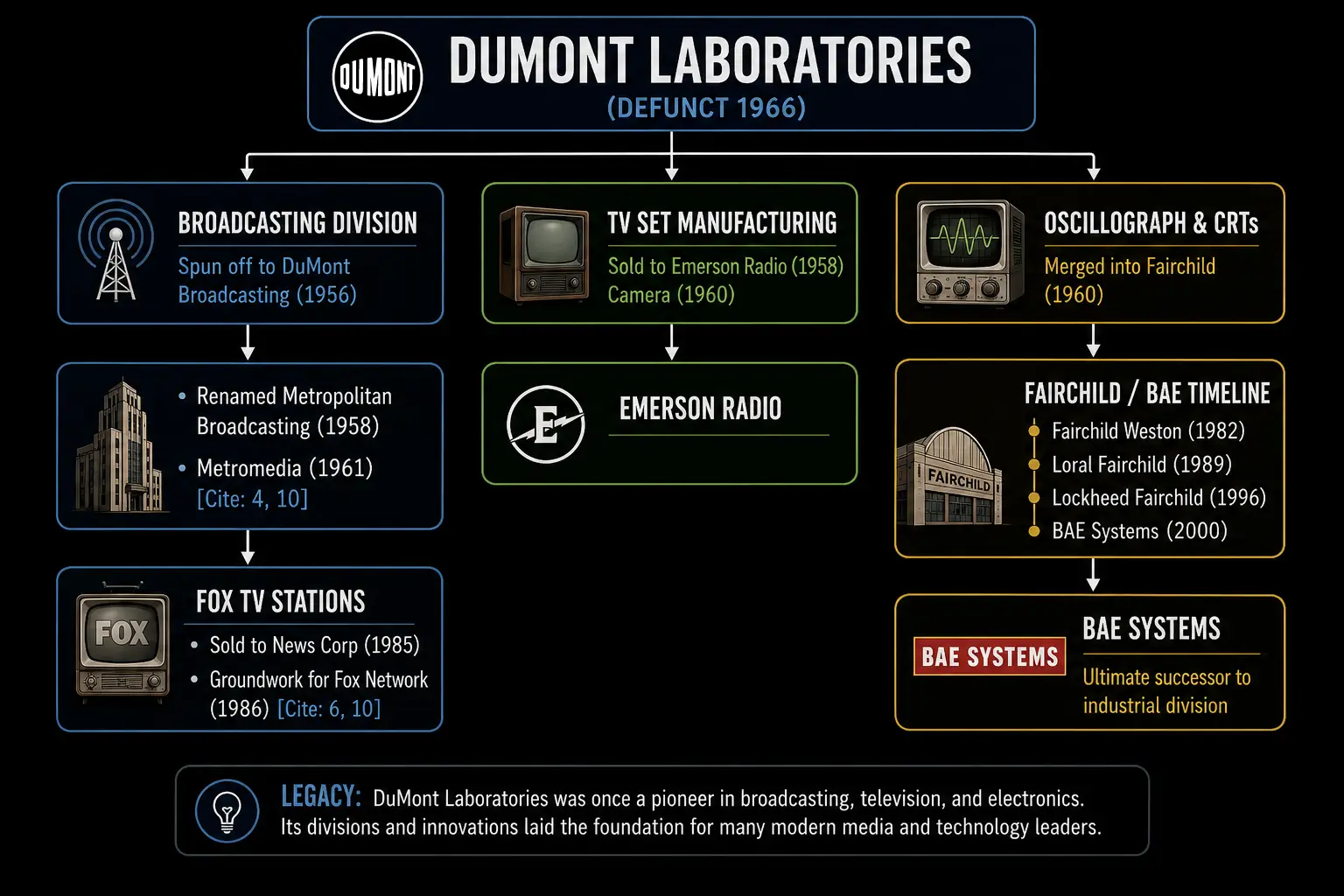
Following the network’s dissolution, DuMont Laboratories spun off its remaining New York (WABD) and Washington (WTTG) stations as the DuMont Broadcasting Corporation, which was renamed the Metropolitan Broadcasting Corporation in 1958, and later Metromedia in 1961. In 1985, Rupert Murdoch’s News Corporation acquired Metromedia’s stations, utilizing the original DuMont facilities as the foundation for the Fox Television Stations group and the launch of the Fox network in 1986.
DuMont sold its consumer television set manufacturing division to Emerson Radio in 1958. In 1960, the remaining laboratory and industrial electronics divisions merged with Fairchild Camera and Instrument. Fairchild’s DuMont division eventually evolved through acquisitions into Fairchild Weston Systems, Loral Fairchild Systems, Lockheed Fairchild Systems, and was ultimately acquired by BAE Systems in 2000.
The physical legacy of the DuMont network suffered a tragic end. During the late 1950s, DuMont Laboratories melted down a significant portion of its early kinescope library to reclaim the silver content embedded in the film emulsion. The remaining library of 35mm and 16mm kinescopes was stored in a warehouse under the care of Metromedia. In the early 1970s, to clear warehouse space for newer magnetic videotapes, Metromedia executives ordered the destruction of the archive.
The kinescopes were loaded onto three flatbed trucks and dumped directly into the East River and the Upper New York Bay. Because acetate and nitrate film emulsions dissolve rapidly in salt water, the physical recordings were destroyed, rendering the films unrecoverable. Out of more than 20,000 episodes produced, only about 350 survive today.
Conclusions
- The Fallacy of Hardware Subsidization: DuMont’s reliance on television receiver manufacturing to fund a broadcast network proved unsustainable. While NBC and CBS could absorb immense television losses through their highly profitable radio networks, DuMont was forced to starve its programming budgets whenever consumer television sales lagged, illustrating that early television was economically non-viable as a standalone medium.
- Regulatory Vulnerability in Infant Industries: The FCC’s ownership and spectrum decisions created a highly consolidated market. By counting Paramount’s independent stations against DuMont’s ownership cap, the FCC prevented DuMont from acquiring VHF stations in major markets. This, combined with the delayed rollout of standard UHF tuning, demonstrates how regulatory policy can inadvertently dismantle a technological pioneer to the benefit of established market players.
- The Irreversibility of Cultural Eradication: The destruction of the DuMont kinescope archive illustrates the danger of commercial entities acting as the sole custodians of media history. Because Metromedia prioritized short-term warehouse efficiency over cultural preservation, a decade of pioneering television history was lost. This loss serves as a powerful argument for independent, public archives to protect early broadcasting history from the volatile realities of corporate survival.
Conclusions
The rise and fall of the DuMont Television Network reveals three fundamental insights:
- The Fallacy of Hardware Subsidization: DuMont’s reliance on television receiver manufacturing to fund a broadcast network proved unsustainable. While NBC and CBS could absorb immense television losses through their highly profitable radio networks, DuMont was forced to starve its programming budgets whenever consumer television sales lagged, illustrating that early television was economically non-viable as a standalone medium.
- Regulatory Vulnerability in Infant Industries: The FCC’s ownership and spectrum decisions created a highly consolidated market. By counting Paramount’s independent stations against DuMont’s ownership cap, the FCC prevented DuMont from acquiring VHF stations in major markets. This, combined with the delayed rollout of standard UHF tuning, demonstrates how regulatory policy can inadvertently dismantle a technological pioneer to the benefit of established market players.
- The Irreversibility of Cultural Eradication: The destruction of the DuMont kinescope archive illustrates the danger of commercial entities acting as the sole custodians of media history. Because Metromedia prioritized short-term warehouse efficiency over cultural preservation, a decade of pioneering television history was lost. This loss serves as a powerful argument for independent, public archives to protect early broadcasting history from the volatile realities of corporate survival.
CITATIONS
The DuMont Television Network – OldSchoolShirts.com
DuMont network | Business and Management | Research Starters – EBSCO
DuMont Television Network – Grokipedia
DuMont: Television’s ‘Lost’ Network – Flapper Press
DuMont Television Network | Broadcasting, Television History, 1950s | Britannica Money
DuMont Television Network – Wikipedia
DuMont Television Network (Differently) – Alternative History | Fandom
DuMont Television Network – History of Information
Dr. Allen Balcom DuMont (American) (1901–1965) – Baird Television
Allen B. DuMont – Encyclopedia of TV & Radio
Allen B. DuMont: A Short Biography – RF Cafe
Allen B. DuMont | Television, Electronics, Physics – Britannica
DuMont Electronicam – Terra Media
Allen B. DuMont – Early Television Museum
Thomas T. Goldsmith Jr. – Wikipedia
Former professor Thomas Goldsmith was television pioneer – Furman University Scholar Exchang
Thomas T. Goldsmith Jr. – Wikipédia
Television Pioneer Thomas T. Goldsmith Dies at 99 – TVTechnology
DuMont Television Network | American TV Database Wiki – Fandom
John Wanamaker, New York – The Department Store Museum
Wanamaker’s, A Shoppers Paradise – Greenwich Village Society for Historic Preservation
Fourth television network – Wikipedia
List of programs broadcast by the DuMont Television Network – Wikipedia
The Hazel Scott Show – Wikipedia
Scott, Hazel | The Broadcast 41
Hazel Scott biography and career timeline | American Masters – PBS
The Hazel Scott Show – Where to Watch and Stream – TV Guide
DuMont Television Network: Why An Innovative Broadcast Network Failed – The TV Ratings Guide
August 6, 1956…The DuMont Network Goes Dark – Eyes Of A Generation…Television’s Living History


