

The Architecture of Delusion
Analyzing Nicolae Ceaușescu’s Final Days and the Systemic Collapse of Reality

I. Introduction: The Unmasking of the ‘Genius of the Carpathians’
The revolutions of 1989 swept across Eastern Europe, dismantling Soviet-era communist regimes, often through negotiated settlements or “Velvet” transitions, such as those witnessed in Czechoslovakia. Romania, however, stood as a brutal outlier. The end of the Socialist Republic of Romania was not peaceful; it was marked by violent civil unrest culminating in the drumhead trial and execution of its longtime leader, Nicolae Ceaușescu, and his wife Elena. The Romanian Revolution remains the only one among the Warsaw Pact nations in 1989 that violently overthrew the leadership and executed the head of state.
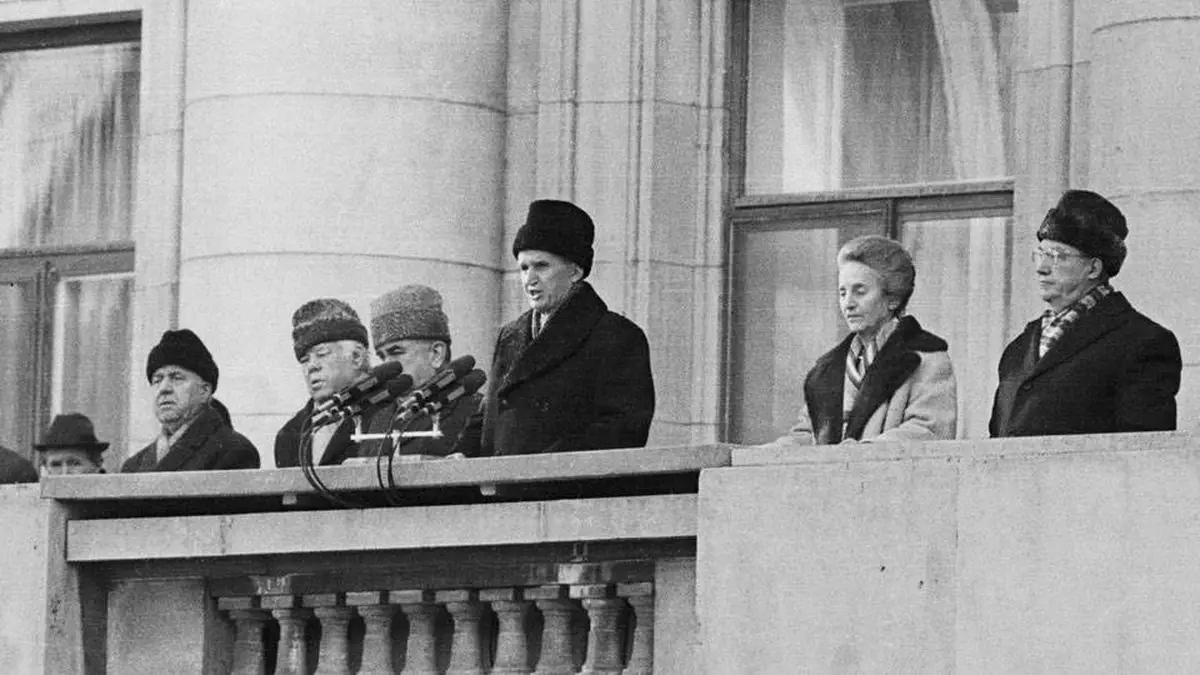
The profound bewilderment displayed by Ceaușescu during his final televised address on December 21, 1989, provides a chilling micro-historical moment of a totalitarian leader confronting objective reality for the first time. Standing on the balcony of the Central Committee building, addressing what he expected to be a controlled rally, Ceaușescu was met instead by spontaneous, hostile jeering and shouting. The shock etched on his face, transmitted live across the country, immediately signaled the regime’s fatal vulnerability.
The central analytical challenge lies in understanding the extraordinary disconnect between the dictator and the actual political environment. How could a leader who maintained one of Europe’s most repressive security apparatuses and a cult of personality intended to guarantee unquestioning adoration be so profoundly unprepared for the revolution unfolding beneath his feet? The evidence suggests that Ceaușescu’s shock was not merely a momentary emotional failure, but the inevitable consequence of a system meticulously engineered to insulate him. This self-constructed “reality bubble” was sustained by a confluence of hyper-inflated personality worship, strategic global and domestic isolation, and an intelligence network (the Securitate) incentivized to report loyalty and stability, not actual dissent.
II. The Architecture of Delusion: Totalitarian Isolation and the Information Funnel
Nicolae Ceaușescu’s decades-long reign was predicated on total information control, transforming the political landscape into a closed system where inconvenient facts simply ceased to exist for the supreme leader. This structural isolation ultimately became the system’s greatest weakness.
A. The Cult of Personality: Manufacturing Infallibility
Following the 1971 “July Theses,” Ceaușescu initiated a severe reversal of earlier liberalization, imposing a strict nationalist ideology and a return to Stalinist totalitarian practices. Central to this period was the development of an extreme cult of personality, inspired by models like North Korea’s Kim Il Sung. This cult centered on Nicolae, the “Genius of the Carpathians,” and by the early 1980s, included his wife, Elena Ceaușescu, who became Deputy Prime Minister and a significant political power in her own right.
The mass media and political apparatus were entirely subordinated to this image. The state broadcasting functioned purely for transmission and spectacle, systematically eliminating any capacity for genuine inquiry or critical feedback. Every public appearance, every state declaration, reinforced the myth of Ceaușescu’s infallible leadership and the boundless love of the Romanian people.
This systematic glorification established a form of cognitive capture for the dictator himself. Ceaușescu became the primary consumer, as well as the author, of his own propaganda. The constant assurance from the party, the military, and the media that he possessed unique political genius and widespread popular adoration made the possibility of authentic, spontaneous internal dissent literally incomprehensible within his political framework. From his perspective, any opposition had to be classified as foreign subversion or organized criminality. The personalization of power—where all success was attributed to him and all frustration was directed against him —guaranteed that when the myth failed, the entire regime collapsed instantly, without any institutional buffer.
B. Economic and Political Self-Isolation
Adding to the internal delusion was Romania’s strategic isolation from the wider world. Driven by an obsessive goal to repay the country’s entire foreign debt, Ceaușescu implemented crippling austerity measures throughout the 1980s. This resulted in severe public deprivation, manifested in constant heating and power shortages, yet the state proudly proclaimed its financial sovereignty.
This economic strategy of self-sufficiency mirrored a foreign policy of isolationism. Romania deliberately distanced itself from the Soviet Union and actively denounced Mikhail Gorbachev’s reform efforts (Perestroika and Glasnost) as “right-wing deviationism”. Romania’s international involvement was characterized by low-level engagement and “comprehensive exclusionist policies”.
While intended to maximize the dictator’s independence, this isolation eliminated crucial political safety valves. Unlike other Eastern Bloc states, which faced some degree of external pressure or maintained internal communist reform movements, Ceaușescu’s regime had no political safety net, no external protector to moderate its course, and no domestic faction capable of managing a smooth political transition. The resulting pervasive misery created deep, silent opposition that remained invisible to the isolated command structure, ensuring that when the public anger finally erupted, it did so with extreme violence and lacked any potential for negotiated settlement.
C. The Securitate’s Flawed Intelligence Model
The General Directorate for the Security of the People, or Securitate, was notorious for its reach and brutality, employing extensive surveillance networks that reportedly included child spies. However, while effective at enforcing localized repression, the Securitate apparatus was structurally incapable of providing neutral political analysis to Ceaușescu.
High-ranking officials within the military and intelligence services were incentivized to report success in crushing resistance and to reaffirm the myth of national stability. Ion Mihai Pacepa’s defection years earlier had already exposed the depth of corruption and affected Ceaușescu’s international credibility, suggesting significant internal problems within the network. Intelligence reports filtering up were therefore highly susceptible to confirmation bias, minimizing the scale of genuine domestic discontent and focusing instead on easily digested narratives of external interference or foreign destabilization. Documents that might have revealed deeper systemic problems were subject to destruction or disappearance.
This systematic filtration meant the security structure delivered exactly what the leader demanded: reassurance of perpetual popular support and immediate containment of any unrest. The security services were designed to manage spectacle and repression, not to assess the political health of the nation. The following table illustrates the key structural barriers to accurate information flow in the totalitarian state:
Totalitarian Information Flow Model: Structural Isolation
System Component
Role in Information Filtration
Effect on Leader’s Perception (Ceaușescu)
Cult of Personality (PCR)
Mandated unquestioning flattery; prohibited critical feedback; utilized staging/spectacle.
Fostered self-deification and the belief that public discontent was impossible or manufactured by foreign entities.
Securitate
Focused resources on internal repression and filtering dissent; incentivized to report swift suppression and state stability.
Provided sanitized, often falsified reports of public order, downplaying or reclassifying mass unrest as foreign conspiracy.
Inner Circle (Elena C.)
Concentrated power; enforced loyalty; served as a gatekeeper to Nicolae Ceaușescu.
Eliminated sources of contradictory information and amplified positive feedback, reinforcing the reality bubble.
Economic Policy (Debt Repayment)
Created systemic deprivation and pervasive resentment, fueling silent opposition (The Reality) that was invisible to the command structure.
The resulting misery was viewed by the leadership as temporary hardship necessary for national strength, not a prelude to revolution.
III. The Crumbling Walls: Timișoara and the Reality Distortion Field
The events in the city of Timișoara in mid-December 1989 provided the first irrefutable breach in the regime’s control, yet Ceaușescu’s information network ensured he received a fatally distorted picture of the crisis.
A. The Tőkés Catalyst and the Miscalculated Response
The revolution commenced on December 16, 1989, when security forces attempted to evict the ethnic Hungarian Protestant pastor, László Tőkés. Initially a small protest by parishioners, the resistance quickly grew, drawing hundreds, then thousands, of Romanians who joined in shouting anti-Ceaușescu slogans and tearing down regime symbols. Recognizing the immediate threat this localized unrest posed to the veneer of national unity, Ceaușescu ordered the military to open fire on December 17, resulting in many civilian casualties.
In a critical error of judgment that demonstrated his underestimation of the crisis, Ceaușescu departed for a planned official visit to Iran on December 18, returning only two days later, alarmed by the worsening situation. This absence created a void that local authorities and deputies scrambled to fill, ensuring that the reports Ceaușescu received upon his return were aggressively sanitized to mitigate their own culpability and to reinforce the idea that the situation was controllable.
B. The Cascade of Denial
While Romanian state media maintained an absolute silence about the violence and massacre in Timișoara, the public was fully informed of the revolt and the crackdown via Western broadcasters such as Radio Free Europe and Voice of America. This disparity meant that the populace knew the reality, while the dictator’s command structure insisted upon a false narrative of stability.
The core of the intelligence failure lay in the inability of high-level aides to communicate that the uprising was authentic, organic, and widespread. To do so would have meant admitting that the Cult of Personality—the very foundation of the regime’s legitimacy—was a catastrophic failure. Instead, officials were compelled to frame the rapidly escalating violence as a small, localized police action that was successfully contained. Reports may have implied that the situation was already under control or that the unrest was the work of “Arab terrorists” or foreign agents. The decision to stage a massive, choreographed rally in Bucharest on December 21 was the ultimate expression of this denial—a calculated attempt to use spectacle to overpower the inconvenient truth of Timișoara, assuming that one grand demonstration of loyalty could erase the memory of localized resistance.
IV. December 21, 1989: The Unscripted End and the Shock of Recognition
The rally held in Bucharest’s Piața Palatului (Palace Square, now Revolution Square) on December 21, 1989, was intended as the ultimate affirmation of Ceaușescu’s enduring popularity and the final, public condemnation of the events in Timișoara. Instead, it became the moment of terminal systemic failure.
A. The Staging of Loyalty
The spectacle was entirely controlled: approximately 100,000 workers were coercively assembled, often under threat of being fired, and provided with the standardized flags and placards bearing slogans like “Long live Ceauşescu”. Ceaușescu began his speech from the Central Committee balcony, adhering to the familiar ritual of power that had sustained his reign for decades.
B. The Sudden Collapse of Spectacle
Just over one minute into the address, as Ceaușescu spoke, the carefully managed atmosphere evaporated. A high-pitched scream was heard, quickly followed by widespread, unscripted shouting and organized jeering from the crowd. Crucially, spectators began chanting “Timișoara!”—the forbidden word, the physical manifestation of the reality the dictator had denied.
The live television broadcast captured the dictator’s extreme cognitive dissonance and consternation. Ceaușescu stopped speaking abruptly, visibly confused, raising his right hand in an attempt to command silence. His voice assumed a bewildered, paternalistic tone, attempting to silence the crowd as if scolding unruly children: “Halt! Hey, calm down,” or similar placating phrases. His political script offered no subroutine for spontaneous, widespread popular defiance. He was paralyzed, intellectually and emotionally, by the collision of his internalized myth of popular support with the objective, televised reality of mass rejection.
The panic extended beyond the dictator. The televised footage, which was raw and unfiltered until it was abruptly cut, also captured the alarmed reactions of his entourage on the balcony, who were heard asking frantically: “Who is shooting? Someone is shooting?” and “An earthquake?”. This confirms that the internal circle was so thoroughly invested in the stability narrative that they could not conceive of the chaos as organic popular revolt; they immediately sought an external, violent cause (shooting) or a natural disaster (earthquake) to explain the instantaneous collapse of the controlled environment.
The televised shock served a dual function: it revealed the dictator’s catastrophic failure to himself, and, simultaneously, it provided the psychological tipping point for the entire nation. Citizens watching the spectacle saw the myth of infallibility shattered in real time, realizing that the dictator was not powerful, but fundamentally vulnerable. The immediate interruption of the live broadcast only confirmed the truth of the chaos, spurring further open revolt nationwide.
The rapidity of the events demonstrates the fragility of power maintained solely by illusion and repression:

Chronology of Collapse: The Final Week (December 16-25, 1989)
Dec 16
Event Location : Timișoara
Impact on Ceaușescu’s Control:
Initial spontaneous protest; violence ordered on Dec 17.
Key Data Point:
Protest escalates despite Ceaușescu’s order to open fire.
Dec 18–20
Event Location : Iran / Romania
Impact on Ceaușescu’s Control:
Failure of subordinates to contain the crisis; public receives accurate RFE/VOA information.
Key Data Point:
Ceaușescu is abroad, receiving distorted reports of the situation upon his return.
Dec 21, Noon
Event Location : Bucharest (Palace Square)
Impact on Ceaușescu’s Control:
The Moment of Shock: Staged rally fails, turning into spontaneous revolution on live television.
Key Data Point:
Ceaușescu’s televised reaction confirms the regime’s psychological failure and vulnerability.
Dec 22, Morning
Event Location : Bucharest
Impact on Ceaușescu’s Control:
Complete institutional failure; loss of coercive monopoly.
Key Data Point:
Army defects (led by Stănculescu); Ceaușescu and Elena flee by helicopter from the Central Committee.
Dec 25
Event Location : Târgoviște
Impact on Ceaușescu’s Control:
Violent culmination and definitive closure of the totalitarian era.
Key Data Point:
Execution after drumhead trial for genocide.
V. The Terminal Collapse: Defection and the Swift End
The events of December 21, 1989, immediately escalated into a full-scale revolution. Once the psychological barrier of the leader’s infallibility was broken, the institutional loyalties quickly dissolved, proving that Ceaușescu’s control system lacked any mechanism for resilience.
A. The Military’s Defection and Institutional Failure
By the morning of December 22, the revolution was irreversible. The Romanian Army, the country’s main coercive force, switched its allegiance from supporting the dictator to backing the protesting population. This defection proved to be the decisive factor in the revolution’s success.
General Victor Stănculescu, the commander of the military, played a critical, central role. He refused to escalate the repression or carry out Ceaușescu’s final orders, thereby leading the army’s pivotal turn against the regime. Stănculescu later admitted he faced the prospect of execution from both Ceaușescu’s loyalists and the revolutionaries. His decision marked the irreversible collapse of the regime’s coercive monopoly. While the Securitate loyalists continued fighting in the streets, they were ultimately defeated by the revolutionary Romanian Army, which had the superior organization and strength.
B. Flight, Capture, and Symbolic Justice
Following the army’s defection, Nicolae Ceaușescu and Elena Ceaușescu fled the Central Committee building by helicopter on December 22nd. They were quickly captured within hours.
The swift end was punctuated by a predetermined act of revolutionary justice. On Christmas Day, December 25, 1989, the couple underwent a rapid, predetermined military trial—a drumhead court-martial—organized by the newly formed National Salvation Front. They were convicted of charges including genocide (responsible for the deaths of thousands, potentially 60,000 victims throughout the regime) and subversion of state power. The execution was carried out immediately, General Stănculescu having already selected the firing squad and execution location prior to the judicial proceedings.
The immediate and televised execution was a calculated political maneuver. It definitively severed any lingering institutional or political legitimacy of the old regime, providing instant, revolutionary credibility to the new government, which was largely composed of former Communist Party members. By guaranteeing the physical end of the Ceaușescu dynasty, the violence prevented any loyalist counter-coup by Securitate forces, ensuring the permanence of the transition, unlike the managed, negotiated transitions seen elsewhere that often left former communist elites in influential positions.
VI. Conclusion: The Legacy of Systemic Isolation
The profound shock witnessed on Nicolae Ceaușescu’s face during his final speech on December 21, 1989, was the direct, terminal consequence of a sophisticated feedback loop failure. The system, designed over two decades to maximize personal glorification and minimize internal dissent, successfully starved its leader of the accurate political intelligence necessary for self-preservation.
The combination of the extreme Cult of Personality and deliberate self-isolation guaranteed that when opposition finally materialized—fueled by severe economic deprivation—it was viewed not as a political failure, but as a manageable external threat. The Securitate, serving the spectacle rather than objective analysis, compounded this informational void by reporting successful repression and downplaying genuine popular anger.
This architecture of delusion led directly to the unique character of the Romanian Revolution: its suddenness and its violence. Unlike regimes that allowed for a degree of liberalization or possessed a mechanism for internal communist reform, Romania’s totalitarian isolation eliminated all middle ground. When the fabricated spectacle of loyalty collapsed on live television, the system had no institutional resilience left, necessitating a swift and brutal end to the dictatorship. The moment on the balcony remains a profound historical document, capturing the instant demise of a totalitarian apparatus built entirely on an illusion that failed to withstand the shock of reality.
Summary: These sources cover Romania’s December 1989 revolution from multiple angles. Overviews and timelines show how Nicolae and Elena Ceaușescu’s rigid, personalized dictatorship unraveled in days—accelerated by a disastrously backfiring “last speech,” mass protests, and a rapid collapse of regime control. Materials on the Securitate (secret police) and the army explore contested questions about who shot at whom and how loyalties shifted. Primary footage, archives, and contemporary reporting capture the pace and chaos of events, while scholarship traces Romania’s post-1989 foreign-policy pivot, debates “Romanian exceptionalism,” and critiques the uneven transition. Cultural and literary pieces illuminate the regime’s propaganda, the cult of personality, and how writers and journalists interpreted the revolution during and after the fall.
Overviews & Timelines
- Romanian revolution – Wikipedia
- The Romanian Revolution – ENRS
- Romanian government falls | December 22, 1989 – History.com
- The 1989 Romanian Revolution and the Fall of Ceaușescu – ADST
- 30 years after the Romanian revolution – Warsaw Institute
- The Fall of Romanian Communism, Part I (background) – CommunistCrimes.org
Key Figures
Cult of Personality
Securitate & Internal Security
- Inside the Securitate Archives – Wilson Center
- The Enemy Within: The Romanian Intelligence Service in Transition – FAS
- Ceausescu regime used children as police spies – The Guardian
The “Last Speech”: Analysis & Footage
- Video of Ceaușescu’s Last Speech (Dec 1989) – World History Commons
- Maria Bucur: What is important about Ceaușescu’s last speech? – Making the History of 1989
- Maria Bucur on the last speech – YouTube
- Romanian Revolution—Dramatic news footage – YouTube
Trial, Execution & Immediate Aftermath
- Trial and execution of Nicolae and Elena Ceaușescu – Wikipedia
- The fall of communism in Romania (1989 archive) – The Guardian
International Context & Post-1989 Transition
- Romanian Foreign Policy Change: From Isolation to Dependence (1989–1994) – LSE
- The revolution of 1989 – Romanian exceptionalism? – New Eastern Europe
- Romania: A Kidnapped Revolution and the History of a Pseudo-Transition – Monash University
- Romanian army vs. Securitate during 1989 – Medium (analysis)
Literature, Culture & Journalism
- The Last Hundred Days – The Booker Prizes
- Echoes from the Balcony: Media & Culture under Ceaușescu – Hungarian Conservative
- On the Road to Timișoara – Christopher Hitchens, Granta


