

Structural Shock
Tariffs, Debt, and the Permanent Rise of BRICS’ New World Order

Overview
The global economic order is undergoing a profound structural realignment, accelerated by two major systemic forces: the imposition of escalating protectionist tariffs by the United States and acute sovereign debt distress across the Global South. These pressures are serving as powerful catalysts, driving emerging and developing economies toward the expanded BRICS+ coalition. This shift is translating into durable, non-reversible changes in global supply chains, financial architecture, and geopolitical alignment, fundamentally challenging the dominance of Western-led institutions.
Section 1: The Geoeconomic Stressors Accelerating Multipolarity
The current geopolitical climate is defined by economic policies that produce systemic shocks, forcing a fundamental restructuring of trade relationships formed under decades of globalization.
1.1. The U.S. Tariff Regime as a Systemic Shock
The trade policies enacted by the United States have functioned as an unanticipated shock to the global economy, directly undermining the foundational assumptions upon which global supply chains (GSCs) were established. GSCs are typically formed in anticipation of free trade and rely on stable, predictable commercial environments.
The Quantitative Impact of Tariff Escalation
The quantitative impact of recent tariff escalations is severe. The effective US tariff rate is projected to climb sharply to about 17% in 2025, representing a massive increase from the rate of 2.3% recorded in 2024. This surge represents a radical change in the cost structure for businesses that rely on imported inputs. Unanticipated input tariffs, especially on intermediate goods—which comprise as much as two-thirds of world trade—act as a major disruptive force. When these tariffs are imposed, firms must engage in costly renegotiation with existing suppliers or undertake an expensive search for replacement partners.
Macroeconomic Consequences in the U.S.
The resulting disruption has consequences even within the tariff-imposing country. The tariffs are directly contributing to persistent inflation pressures in the United States, keeping core inflation sticky near 3%. This tariff-driven inflation complicates the Federal Reserve’s easing path and limits its ability to respond effectively as the labor market softens. The overall US economy is showing signs of fading momentum, with GDP growth projected to slow to 1.9% in 2025 from 2.8% in 2024. This evidence challenges the narrative that trade policy aimed at decoupling or reshoring can be enacted without substantial economic cost to the consumer and the broader economy.
1.2. Global South Financial Vulnerability: The Debt Crisis Catalyst
Simultaneously, much of the Global South is grappling with a severe and intensifying sovereign debt crisis, creating systemic instability and a desperate need for alternative, less conditional financing.
Scope of Global South Distress
What was once referred to as a “silent” debt crisis is now highly visible. Analysis indicates that 55% of the 152 countries surveyed in the Global South are critically or very critically indebted, a sharp rise compared to 37% before the COVID-19 pandemic. This scale of indebtedness creates a profound vulnerability and an urgent requirement for capital injection and debt relief.
The Opportunity Cost of Debt Servicing
The financial distress has direct and dire consequences for sustainable development. Countries in the Global South are facing a negative record in 2024, collectively obligated to make more debt service payments to external creditors than ever before. For 45 countries, over 15% of government revenue flows into servicing this debt. This massive financial outflow eliminates the necessary fiscal leeway for critical future investments in climate protection, social services, and long-term development, further compounding systemic instability.
Creditor Predicaments and Multilateral Constraints
The existing multilateral financial system has proven inadequate in swiftly and equitably resolving this crisis. Private creditors are reducing their exposure, leading to negative net credit flows to the entire Global South, compelling multilateral creditors to fill the resulting funding gaps. However, complex debt restructuring processes, such as those under the G20 Common Framework, are notoriously slow and costly. The initial debt restructuring outcomes show that creditors are granting minimal debt relief, often prioritizing their own interests over the long-term recovery and stability of the indebted nations. This inadequacy creates a wide strategic opening for an alternative financial institution that operates outside the Western creditor-centric framework.
Section 2: The Expanding Architecture of BRICS+ and its Strategic Mandate
The confluence of trade disruption and sovereign debt vulnerability has significantly enhanced the attractiveness of the BRICS bloc, which has responded by expanding its membership and operationalizing competitive financial mechanisms.
2.1. BRICS: From Acronym to Global Governance Challenger
The BRICS grouping, originally comprising Brazil, Russia, India, China, and South Africa, has transformed into a globally representative economic and political bloc.
Expansion and Membership Status
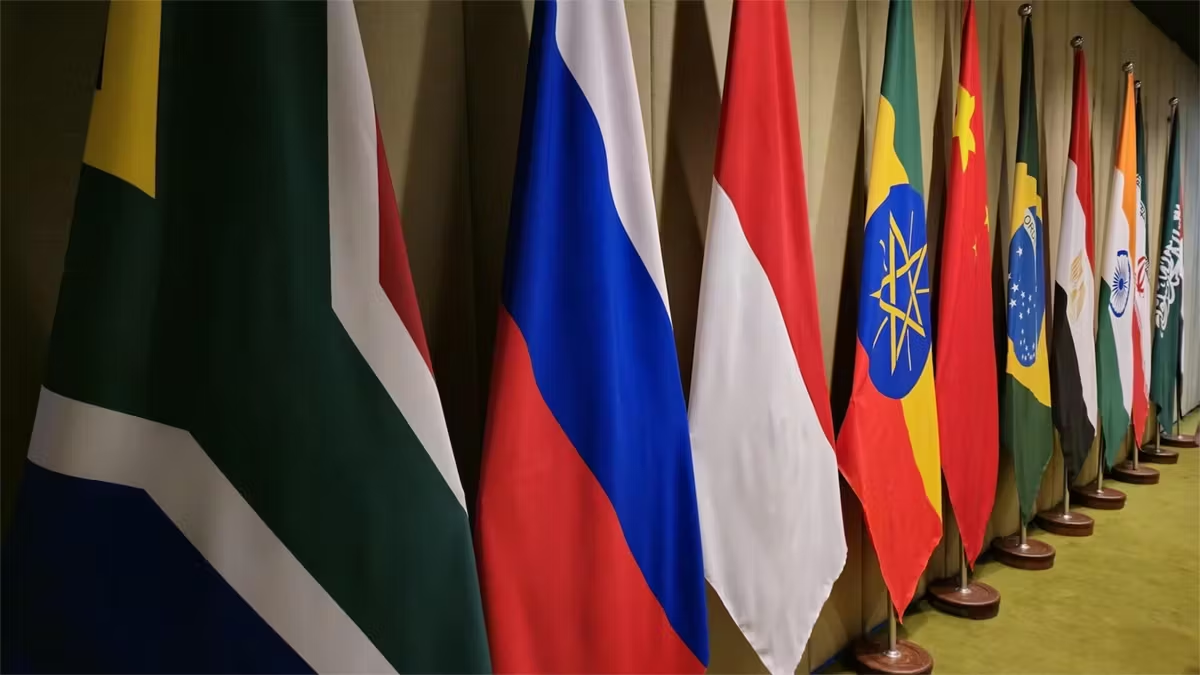
The expansion, implemented between 2024 and 2025, has resulted in the BRICS-11: the five original members plus six new full members: Saudi Arabia, Egypt, United Arab Emirates, Ethiopia, Iran, and Indonesia. This expansion was formalized following the Johannesburg Declaration in August 2023. Furthermore, the group is engaging a broader sphere of influence, having invited an additional 13 countries, including Algeria, Thailand, Turkey, Vietnam, and Uzbekistan, to participate as “partner countries” to benefit from BRICS initiatives.
Strategic Rationale for BRICS+
The primary strategic rationale behind the expansion is to advance the priorities of the developing world and reform global governance. The expanded BRICS+ platform provides a vehicle for emerging and middle powers to advance their frequently overlapping interests and “tinker” with the rules and institutions of the multilateral system. The emergence of BRICS is fundamentally analyzed using hegemony and balance of power theories, positioning the bloc as an influential counterbalancing alternative to existing dominance, thereby fostering multipolarity in the global order. By inviting a wide range of partners and new members, BRICS strategically positions itself as committed to dialogue and avoiding further global fragmentation, instead opting to shape the system from within by reflecting the growing economic weight of developing countries.
2.2. The New Development Bank (NDB) as an Alternative Financial Pillar
The New Development Bank (NDB), established in 2014 by the founding BRICS nations, serves as the economic and financial counterweight to the Bretton Woods institutions (the IMF and World Bank).
NDB Mandate and Capital Structure
The NDB’s core mandate is mobilizing resources for infrastructure and sustainable development projects specifically in emerging markets and developing countries (EMDCs). Its initial authorized capital was set at US$100 billion, equally distributed among the five founding members. Critically, its governance structure dictates that each founding member possesses one vote, and no single member has veto power. This structure is a deliberate contrast to the governance models of the World Bank and Asian Development Bank, which have historically been criticized for underrepresenting later-developing countries and allowing the dominance of established Western powers.
NDB’s Competitive Advantage: Non-Conditional Lending
The NDB’s most significant competitive advantage in attracting new partners and members is its flexible lending model, which directly contrasts with the strict policy conditionalities of the IMF and World Bank.
The appeal to Global South nations, particularly those navigating the current sovereign debt crisis, is substantial. NDB loans come with fewer economic conditionalities compared to the IMF and World Bank, which often require strict adherence to macroeconomic reforms such as fiscal consolidation or austerity. The NDB focuses instead on growth and development, aiming to maintain positive economic momentum without enforcing economic contractions through austerity measures.
The NDB’s operational distinction offers profound political advantages. Western multilateral development banks (MDBs) impose austerity measures—reducing public spending and increasing taxes—which can lead to significant social and political unrest, potentially harming the policy autonomy and stability of fragile governments. By guaranteeing fewer conditionalities and focusing on policy flexibility, the NDB provides a mechanism for nations like Cambodia (cited as an example seeking NDB financing) to direct funds toward priority sectors without external ideological pressure or the political burden of imposing harsh domestic reforms. This competitive edge transcends simple interest rates; it becomes a fundamental attractor for governments prioritizing internal political stability and policy sovereignty over stringent Western financial approval.
Table 1 summarizes this key structural difference:
Table 1: NDB vs. Western Multilateral Development Banks (MDBs) Lending Models
Criteria
New Development Bank (NDB)
World Bank (WB) / IMF
Significance for Global South
Primary Focus
Infrastructure and Sustainable Development
Fiscal Management, Structural Reforms, Balance of Payments
Aligns with core development needs
Primary Focus
Infrastructure and Sustainable Development
Fiscal Management, Structural Reforms, Balance of Payments
Aligns with core development needs
Austerity Risk
Low; growth-focused lending model; No austerity-induced contractions
High; often requires public spending cuts and tax increases
Maintains domestic political stability by avoiding harsh reforms.
Voter Representation
Equal voting rights for founding members; no veto power
Criticism for underrepresenting later-developing countries; dominance of established Western powers
Reflects multipolarity and shared ownership.
Section 3: De-dollarization Efforts: Finance as a Tool for Resilience
A central tenet of the BRICS strategy is to reduce financial dependence on the US dollar, which is perceived as a vulnerability due to its use as a tool for sanctions and control over global financial flows.
3.1. Shifting Away from USD Dominance: Bilateral Currency Arrangements
While the perception that BRICS is rapidly moving toward a complete break from the dollar-dominated monetary order is prevalent, a full de-dollarization, particularly the creation of a unified BRICS currency, remains a distant prospect. This is primarily due to major internal differences, including competing national interests, lack of institutional framework to produce safe assets, and significant currency convertibility issues (notably with the Chinese Yuan and Indian Rupee).
Instead, the practical strategy is focused on encouraging bilateral trade settlement in local currencies. This tactical shift aims not at replacing the dollar as the world’s primary reserve currency, but rather at eroding its function as a transactional transit and settlement currency within specific trade networks.
A key example is the official announcement by Brazil and China in April 2025 to use their local currencies (the Real and the Yuan) for bilateral trade transactions. This initiative directly reflects the bloc’s aspiration to play a more prominent role in reshaping global financial development. Supporting this movement, China’s central bank has established bilateral swap agreements with nearly all BRICS+ countries, specifically to facilitate local currency usage in trade. This system acts as financial rerouting, building resilient infrastructure that bypasses US jurisdiction for routine trade flows, thereby reducing the dollar’s transactional utility.
3.2. Alternative Payment Systems and Financial Insulation
The drive to insulate BRICS members from geopolitical risk, particularly Western sanctions (as demonstrated by the exclusion of Russian banks from SWIFT), necessitates the development of parallel payment systems.
The Rise of CIPS and SPFS
China’s Cross-Border Interbank Payment System (CIPS) and Russia’s System for Transfer of Financial Messages (SPFS) serve as the primary alternatives to the Western-controlled SWIFT network. CIPS is actively being leveraged by Beijing to internationalize the Yuan and expand its reach. In 2024, transactions processed through CIPS reached 175 trillion yuan (approximately US$24.4 trillion), marking a significant 43% increase over the previous year.
CIPS is strategically expanding its global footprint, notably adding African financial institutions, such as the African Export-Import Bank, as direct participants. Although CIPS offers superior transaction speed—sometimes clearing payments in seconds, compared to the multiple days often required for SWIFT transfers—its overall scale remains modest compared to Western systems like SWIFT and CHIPS. For instance, CHIPS processes roughly 40 times the daily volume of CIPS. Nevertheless, the increasing participation in CIPS serves as a critical contingency plan for financial insulation, ensuring an operational, albeit limited, alternative should Western systems restrict access. This tactical expansion is crucial for ensuring that as bilateral trade increases, more of that trade is denominated and settled in Yuan, thus linking growing economic ties directly to China’s financial infrastructure.
Section 4: The Construction of Counter-Hegemonic Supply Corridors
The economic shift away from traditional Western financial structures is mirrored by the physical construction of new, non-Western-aligned logistical and infrastructural corridors.
4.1. BRICS Initiatives for Supply Chain Facilitation
BRICS members are actively building new infrastructure and establishing internal trade frameworks to mitigate reliance on Western trade architecture. The BRICS Trade and Investment Facilitation Initiative is designed to streamline trade policies, enhance customs cooperation, and reduce non-tariff barriers within member economies. This framework works in tandem with the NDB, which funds the necessary infrastructure projects to secure these new trade routes. This focus on resilient, alternative routes is driven by the recognition that existing global supply chains are heavily burdened by political risk, unstable trade relationships, and geopolitical strain.
4.2. Geopolitical Infrastructure: The International North-South Transport Corridor (INSTC)
A prime example of a counter-hegemonic logistical project is the International North-South Transport Corridor (INSTC).
INSTC Structure and Function
The INSTC is a 7,200-km long multi-mode network involving ship, rail, and road, designed to move freight between countries including India, Iran, Russia, and Azerbaijan. Its primary objective is to significantly increase trade connectivity between major cities such as Mumbai, Moscow, and Tehran. The launch of the Mumbai–Vladivostok container service in 2024 further emphasizes this strategic collaboration.
Strategic Advantage
From a geopolitical standpoint, the INSTC provides a strategic counterbalance to Western influence and regional competitors. By establishing routes connecting the Persian Gulf, Central Asia, and Russia, the corridor cuts the transport distance between India and Russia by more than half compared to the traditional sea route via the Suez Canal. This drastically reduces transportation time and costs, with trials demonstrating savings of approximately $2,500 per 15 tons of cargo. This dedicated physical infrastructure acts as a geopolitical insurance policy, reducing reliance on traditional Western-controlled chokepoints and mitigating risks associated with potential disruptions along the Suez Canal route.
4.3. Political Economy of BRICS Partnerships: The China-Africa Model
The expansion of influence is also manifested through bilateral infrastructure deals that align partners with BRICS member interests, often leveraging a distinct foreign policy philosophy.
Case Study: China and Burkina Faso
Burkina Faso, navigating geopolitical challenges following its 2022 military coup, is deepening its partnership with China. This collaboration includes exploring the creation of a joint shipping company to enhance trade relations and Chinese commitment to infrastructure development, such as funding for a solar power plant at the Donsin Airport. Other African nations, including Mali and Nigeria, are involved in similar partnerships.
The Non-Interference Principle
The attractiveness of China’s cooperation model lies not only in the capital provided but also in its adherence to the Five Principles of Peaceful Coexistence, specifically the principle of non-interference in each other’s internal affairs. This principle, China’s established modus operandi in its economic interactions, stands in stark contrast to Western aid, which often imposes political or ideological conditionalities. By coupling the NDB’s lack of austerity measures with its own non-interference policy, China provides developing nations with the ability to maintain complete political autonomy over domestic governance and policy choices, even when facing international scrutiny or internal instability.
These dedicated infrastructural investments—whether the INSTC or the joint shipping company model—represent massive sunk capital expenditures. Once these new logistical networks are established, they create enduring economic dependency, efficiency, and trade volume that reinforce the financial and political ties of BRICS members. This physical “lock-in” effect makes it highly cost-prohibitive and strategically inefficient to reverse the shift back to Western-dominated corridors.
Section 5: The Economics of Supply Chain Stickiness and Reversibility
The user’s query highlights a critical principle in international trade: once supply chains change, they are exceptionally difficult to change back. This difficulty stems from the fundamental economic concept of sunk costs, which ensures that geopolitical shocks result in permanent structural change rather than temporary disruption.
5.1. Sunk Costs and the Durability of New Relationships
Global supply chains are characterized by durable relationships due to the non-trivial and sunk costs required to establish them. These sunk costs include the expense of searching for compatible new suppliers, customizing production processes, and negotiating bilateral prices and contracts.
When the US imposed unanticipated tariffs on intermediate goods, firms were forced to bear these costs to restructure their sourcing. Economic models calibrated to reflect the US tariffs imposed on China estimate a measurable overall welfare loss (0.12 percent of GDP), with a substantial portion of this loss attributed directly to changes in input sourcing and the high search costs incurred by firms.
The result is tangible trade diversion data. For example, China’s share of US apparel imports dropped from 40% in 2017 to 26% in 2023, while the collective share of alternative hubs—Vietnam, Bangladesh, Indonesia, and India (many of which are now BRICS members or partners)—rose from 30% to 38%. This redirection is not a simple paperwork adjustment; it involves significant Chinese outbound Foreign Direct Investment (FDI) into these new locations (e.g., Egypt, Cambodia, Vietnam), building new facilities, and retooling infrastructure.
5.2. Operational and Financial Barriers to Reversal
The permanence of these shifts is reinforced by operational and financial barriers that inhibit quick reversal. The complexity involved in undoing or re-re-routing supply chains is substantial. Supply chain experts recognize that while rerouting flexibility is crucial for resilience against geopolitical or environmental disruptions, this flexibility comes at the cost of increased complexity and can slow down the overall distribution system. The initial pain of setting up these diversified and complex routes is a justification for enhanced resilience, but this complexity subsequently acts as a powerful deterrent to switching back later.
For companies to reverse course and re-shore or re-route back to the original supplier, the original cost efficiency must significantly outweigh the massive sunk costs already incurred in the new locations. The core implication is that tariffs, intended as a targeted short-term measure, functioned instead as a costly, blunt instrument that permanently restructured global trade networks. Once new supply networks are established, the economic imperative to maintain them—justified by the initial sunk costs and the new premium placed on political resilience—means that lifting the tariffs will not automatically bring production back. This confirms that the current fragmentation of global supply chains is structural, not cyclical, and permanently benefits the substitute countries, many of which are aligning within the BRICS orbit. The era of prioritizing sheer cost efficiency above all else is being replaced by a necessary strategic focus on supply chain resilience against geopolitical risk.
Section 6: Strategic Implications and Future Trajectories
The analysis confirms that the interaction between Western trade policy shock and Global South financial instability has created a self-reinforcing dynamic, ensuring the durability of the shifts toward a BRICS-aligned multipolar economic system.
6.1. BRICS as a Multilateral Counterbalance: Effectiveness and Challenges
The BRICS-11 has cemented its status as an influential group capable of advancing Global South priorities and shaping the multilateral system. The development of parallel institutions provides tangible mechanisms for reducing dependence on the West: the NDB offers non-conditional infrastructure financing, and CIPS offers insulation from sanctions risk.
However, the path to sustained BRICS hegemony is not frictionless. The bloc faces inherent challenges stemming from diverse national interests, competing economic models, and fundamental differences regarding de-dollarization and currency convertibility. These internal divisions suggest that while BRICS will continue to chip away at Western financial and trade dominance, the emerging global system is likely to be highly fragmented and multipolar rather than unified under a single, non-Western hegemon.
6.2. Policy Recommendations
The structural nature of these shifts demands a reassessment of current policy and investment strategies.
For Western Policy Makers
Western countries must recognize that punitive measures like tariffs often lead to permanent network reallocation rather than temporary concessions. To mitigate further structural fragmentation, Western partners should seek to address the “legitimate complaints and advance the reasonable aspirations” of emerging powers. Increased engagement and constructive dialogue within existing global governance forums, such as the G20, offer a critical opportunity to manage multipolarity and prevent further economic polarization. Moreover, the West must acknowledge that the core competitive appeal of BRICS institutions is not simply capital but the guarantee of policy autonomy for borrowing nations, requiring a reevaluation of conditional lending practices.
For Global Corporations and Investors
The era of a single, optimized global supply chain is definitively over. Corporations and investors must fully price geopolitical risk and supply chain resilience into their decision-making, prioritizing diversification over short-term efficiency gains. The structural shifts detailed—the logistical lock-in of new corridors like the INSTC, the rise of CIPS as a payment alternative, and the high sunk costs associated with relocation—confirm that diversification into BRICS-aligned or neutral hubs (such as Indonesia or Vietnam) is now a permanent strategic necessity.
6.3. Conclusion: The Enduring Structural Shift
The cumulative effect of US tariffs, the sovereign debt crisis, and the availability of flexible BRICS financial and infrastructural alternatives has irrevocably altered the landscape of global trade and finance. By forcing firms to incur substantial sunk costs to restructure supply relationships, the tariffs have created new, durable economic linkages outside of traditional Western influence. The resulting network, reinforced by non-conditional lending and alternative payment systems, ensures that the shift toward BRICS-centric logistical and financial structures is highly durable and difficult to reverse, locking in the multipolar structure of the global economic system for the foreseeable future.
1. Global Supply Chains and Trade Disruption
- When Tariffs Disrupt Global Supply Chains – Harvard University
- When Tariffs Disrupt Global Supply Chains – Princeton University
- Navigating Supply Chain Resilience Amid Rising Geopolitical Risk – S&P Global
- China and the Future of Global Supply Chains – Rhodium Group
- Adapting to Disruptions: Managing Supply Chain Resilience through Product Rerouting – PMC
- US Q4 2025 Outlook – Equiti
2. Global Debt and Financial Reform
- Confronting the Debt Crisis: 11 Actions to Unlock Sustainable Financing – United Nations
- Global Sovereign Debt Monitor 2024 – Misereor
3. BRICS and Global Economic Governance
- BRICS – Wikipedia
- About the BRICS – Official BRICS Portal
- Brazil Announces Indonesia as Full Member of BRICS – Planalto
- BRICS Expansion, the G20, and the Future of World Order – Carnegie Endowment
- BRICS as an Alternative to Western Dominance in Global Governance – Asian Institute of Research
- Expansion of BRICS: A Quest for Greater Global Influence? – European Parliament
- As Emerging-Market Stocks Rally: Why It’s Worth Watching BRICS+ – Morningstar Global
4. The New Development Bank and Financial Alternatives
- About NDB – New Development Bank
- New Development Bank – Wikipedia
- Designing the New Development Bank – Baker Institute
- Cambodia’s Debt and Strategic Borrowing: New Development Bank – Khmer Times
- The BRICS and De-Dollarisation – CADTM
- How to Counter BRICS and Preserve Global Dollar Dominance – Hudson Institute
5. Currency and Payment System Developments
- Brazil and China Use Local Currencies for Bilateral Trade – Fundación Andrés Bello
- Yuan Payments System Makes Inroads in Africa – NTU Singapore
- Sanctions, SWIFT, and China’s Cross-Border Interbank Payments System – CSIS
- BRICS Making Progress on Payment System – GIS Reports
- Navigating Trade Wars: BRICS’ Response to Sanctions and Protectionism – BRICS Today
6. Infrastructure Corridors and Trade Routes
- International North–South Transport Corridor – Wikipedia
- Rivalry Between the Suez Canal and the North–South Corridor – ResearchGate
- BRICS Maritime-Urban Connectivity – ORF Online
- The Battle of the Corridors – American University of Beirut
7. China–Africa Relations and Regional Integration
- Country: Burkina Faso – The China–Global South Project
- Burkina Faso and China to Deepen Ties with Joint Shipping Company – WADR
- China, Africa, and the International Aid Architecture – African Development Bank
- China’s Non-Interference Policy and Growing African Concerns – African Arguments
- Principles of China’s Foreign Policy – Columbia University


