


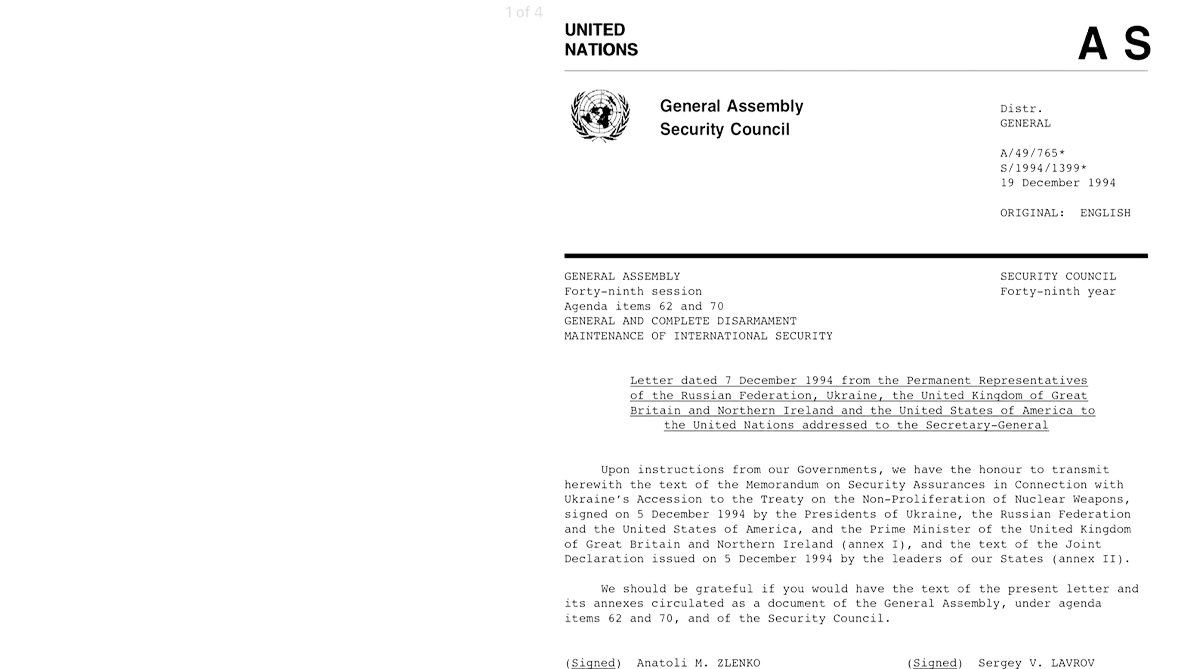

The Budapest Memorandum
A Foundational Analysis of Treaty Failure, Geopolitical Stakes, and the Crisis of Non-Proliferation

I. Introduction: The Budapest Memorandum as the Cornerstone of Post-Soviet Security
The 1994 Budapest Memorandum on Security Assurances stands as one of the most significant, and ultimately tragic, diplomatic achievements of the post-Cold War era. Signed on December 5, 1994, at the Conference on Security and Co-operation in Europe (CSCE) summit in Budapest, the Memorandum formalized high-level political commitments provided to Ukraine, Belarus, and Kazakhstan in connection with their accession to the Treaty on the Non-Proliferation of Nuclear Weapons (NPT) as non-nuclear-weapons states. For Ukraine, this agreement concluded arduous negotiations requiring it to relinquish the world’s third-largest nuclear arsenal, which the newly independent nation inherited from the collapsed Soviet Union.
The fundamental mandate of the agreement was simple: Ukraine would dismantle its strategic nuclear arsenal and transfer all warheads to the Russian Federation for elimination. In exchange, the three principal nuclear signatories—Russia, the United States, and the United Kingdom—pledged security assurances to Kyiv. The international community, especially the U.S., prioritized the removal of these weapons from non-Russian territories as an urgent non-proliferation goal, making the Memorandum a crucial success for global arms control at the time.
The eventual failure of this agreement, definitively marked by Russia’s military aggression beginning in 2014 and escalating with the full-scale invasion in 2022, exposes a profound crisis in international security. The collapse of the Budapest Memorandum, resulting from its inherent structural weaknesses and Russia’s calculated rejection of international law, created the fundamental security vacuum that directly enabled the current war. This transformed a political promise, intended to secure global nuclear order, into a catastrophic geopolitical precedent that has significantly undermined the global NPT regime. The analysis that follows rigorously deconstructs the legal, political, and strategic dynamics of the Memorandum and its essential role in framing the current conflict.
The negotiation leading to the BM suffered from a fundamental asymmetry. While the nuclear-weapons states (NWS), particularly the U.S. and Russia, prioritized the swift and successful outcome of non-proliferation—getting Ukraine to disarm and join the NPT—the quality and enforceability of the security assurances were secondary considerations. Ukraine, recognizing its strategic leverage in delaying disarmament , attempted to secure robust guarantees. However, because the BM achieved the primary non-proliferation goal without establishing immediate military enforcement mechanisms, it was deemed a success by international observers in 1994, even as it failed Ukraine’s long-term security needs from the start.
Moreover, the risk of non-compliance was fatally masked by the diplomatic environment prevailing in the early post-Cold War era. In 1994, the political atmosphere was characterized by a temporary perception of “goodwill,” and Russia was not widely regarded as an immediate aggressor state by the major Western powers. The assurance mechanism was suitable only for agreements between established allies. When one of the guarantors, Russia, became a revisionist power, the framework proved utterly ineffective, demonstrating a critical lack of geopolitical foresight in the design of the document.
II. The Genesis of the Deal: Ukraine’s Reluctant Denuclearization (1991–1994)
A. Ukraine’s Initial Claim and the Search for Leverage
Following the dissolution of the Soviet Union in 1991, Ukraine found itself in possession of massive stocks of Soviet strategic nuclear weapons and their delivery systems. While Ukraine’s pre-independence movement had supported joining the NPT as a non-nuclear state, soon after gaining independence, Kyiv adopted a more cautious approach, concerned that Russia would use its nuclear monopoly in the post-Soviet space to re-establish dominance. Ukraine consequently claimed legal succession to the Soviet Union on par with Russia, including ownership of all former Soviet military assets on its territory, which were then estimated to be the world’s third-largest nuclear arsenal.
This cautious approach quickly translated into specific demands for security guarantees. Ukrainian members of parliament, such as Y. Kostenko and V. Tolubko, explicitly argued in 1992 that accession to the NPT would only be possible if the U.S. and all other nuclear powers provided additional security guarantees for Ukraine. They emphasized that such guarantees could not be obtained within the framework of the Russia-dominated Commonwealth of Independent States (CIS) without compromising Ukraine’s neutral status. They characterized the acquisition of non-nuclear status as an “extremely complex and long-term process,” necessitating the “creation of a new mechanism for ensuring Ukraine’s national security”. Crucially, they argued for the “retention of its status as a ‘temporary nuclear power’” for a “foreseeable historical perspective,” justifying the preservation of the weapons to increase Kyiv’s influence in international affairs and make the West “more susceptible” to requests for economic aid. This pre-emptive concern about security and leverage frames the entire negotiation, highlighting that Kyiv fully understood the strategic price of disarmament.
B. Strategic and Technical Impetus for Transfer
Despite the political rhetoric regarding status retention, the reality of the arsenal provided a strong technical and strategic impetus for its transfer. Military critics often inaccurately describe the inherited warheads as a viable, independent “nuclear deterrent” against Russia. In reality, these weapons were designed during the Cold War to target the U.S. and were highly dependent on Russian technical infrastructure. They could not be safely maintained or independently utilized by Ukraine. The warheads themselves had a limited warranty period and required facilities located solely in Russia for servicing, maintenance, and ultimate dismantlement. Russia was aware of this liability; one leading Russian expert advised President Boris Yeltsin in 1994 against offering significant inducements to the Ukrainians, predicting that Ukraine would soon “be asking us” to take the warheads, which were already “rotting”.
The fact that Ukraine’s nuclear arsenal was a technical liability and not a sustainable deterrent validates the ultimate decision to relinquish the weapons. This reality, however, simultaneously elevates the importance of the compensatory security assurances, demonstrating that Ukraine received no actual, reliable strategic benefit from retaining the arsenal. The U.S. and Russia effectively used the deteriorating technical state of the arsenal as strategic leverage against Ukraine’s political demands for explicit, robust guarantees. This great power calculus minimized the security inducements necessary to complete the deal.
C. The Trilateral Statement and the Exchange of Assets for Promises
The complexity of the disarmament process led the U.S. government to engage in a trilateral process with Ukraine and Russia after bilateral negotiations between Kyiv and Moscow broke down in late 1993. This negotiation resulted in the Trilateral Statement, signed in January 1994, under which Ukraine agreed to transfer the nuclear warheads to Russia for elimination.
The exchange was fundamentally transactional, combining financial and material compensation with political assurances. In return for disarming, Ukraine received compensation for the commercial value of the highly-enriched uranium (HEU) contained in the warheads, which could be blended down into low-enriched uranium (LEU) for use in nuclear power reactors. This economic benefit was lubricated by American funding under the Nunn-Lugar Cooperative Threat Reduction program, with Ukraine receiving at least $175 million in assistance for dismantling the missiles and nuclear infrastructure.
The security assurances agreed upon in the Trilateral Statement were later formalized in the Budapest Memorandum. Ukraine fully met its commitments under the deal. The last nuclear warheads were transferred out of Ukraine in 1996, and the destruction of the last missile launch facility for intercontinental missiles was completed near Pervomaysk in 2001. The Ukrainian commitment was fulfilled completely, while the compensatory security commitment proved fatally weak. Ukraine prioritized the immediate, measurable benefits—money, reactor fuel, and safety services—but the intangible security guarantees proved unenforceable, reflecting a miscalculation regarding Russia’s long-term revisionist intentions.
III. Legal Status and Structural Weakness of the Budapest Memorandum
A. Deconstructing the Terminology: Assurances versus Guarantees
The core legal and political failure of the Budapest Memorandum is rooted in the crucial distinction between “security assurances” and “security guarantees” in international law. The key text signed in Budapest was titled “Memorandum on Security Assurances” in the English version. Security assurances are generally understood as high-level political commitments, requiring the signatories to abide by existing obligations, such as those laid out in the UN Charter. They lack the built-in, mandatory military commitment characteristic of collective defense treaties.
However, the authentic translation in both the Russian and Ukrainian versions of the document was titled “Memorandum on security guarantees”. Security guarantees typically imply a formal, legally binding treaty commitment, often requiring automatic military action or collective self-defense mechanisms, such as those found in NATO’s Article 5.
This linguistic compromise was accepted by Ukraine in 1994, a decision many analysts have since identified as a long-term diplomatic mistake. This legal ambiguity served the immediate denuclearization goal but fundamentally undermined the security outcome. The linguistic compromise allowed Ukraine to claim internally that it had received “guarantees” while simultaneously freeing the NWS signatories (especially Russia) from treaty-level, enforcement-heavy obligations under international law.
B. Analysis of the Binding Nature
The Budapest Memorandum is categorized as a diplomatic memorandum, not a formal treaty of guarantee that requires ratification as an instrument of mutual defense and codifies immediate punitive measures for violation. The document committed the signatories to several crucial principles: respecting Ukraine’s sovereignty, respecting the inviolability of its borders, and refraining from the threat or use of military force or economic coercion.
However, the assurances outlined in the BM did not extend beyond commitments already contained in the foundational texts of international security, specifically the UN Charter (Article 2(4)) and the Helsinki Final Act. Therefore, the sole utility of the BM was symbolic, linking Ukraine’s NPT accession to a high-level political gesture, which failed to add any genuine depth or enforceability to Ukraine’s security posture.
The memorandum suffered from a profound structural flaw: it failed to deter Russian aggression because it imposed “no immediate cost for its violation”. Its political assurances rested solely on the “goodwill and self-restraint of the guarantors”. This structure proved viable only if relations remained cooperative, but it provided no defense mechanism when a guarantor adopted a revisionist posture.
The primary signatories were the US, UK, and Russia. France and China also provided individual, separate security assurances. China’s commitment, reiterated in 2013, included both “negative security assurances” (not to use or threaten to use nuclear weapons against Ukraine) and “positive security assurances” (promises to help Ukraine in the event of aggression using nuclear weapons).
The agreement’s minimal enforcement structure was codified in Article 6, which merely stated that the parties “will consult in the event a situation arises which raises a question concerning these commitments”. This reliance on consultation, rather than automatic military defense, proved to be the Achilles’ heel of the entire framework.
The distinctions between the expectations surrounding the security framework and the reality of the Memorandum’s legal status are summarized in the following table:
Table 1: Key Differences: Security Assurances vs. Security Guarantees (BM Context)
Feature
Security Assurance (Budapest Memorandum)
Security Assurance (Budapest Memorandum)
Legal Status
Political commitment; Non-legally binding document (in English version).
Formal, legally binding treaty obligation (e.g., UN Charter Article 51/NATO Article 5).
Mechanism of Action
Consultation (Article 6); Requires consensus and goodwill of signatories.
Immediate military response (collective self-defense) or automatic triggering of defined actions.
Enforcement
Relies on adherence to other international law (UN Charter, Helsinki Final Act).
Built-in enforcement mechanisms, often codified military planning and resource allocation.
IV. The Failure Mechanism: From Initial Strain to Definitive Breach (2003–2014)
A. Precursor Failure: The Ineffective Invocation of Article 6
The structural flaws of the Memorandum were exposed long before Russia’s 2014 aggression. The Article 6 consultation mechanism, the sole diplomatic tool enshrined in the document, was tested unsuccessfully in 2003 during the Tuzla Island conflict between Russia and Ukraine.
During the crisis, an attempt by Ukraine to implement the sixth paragraph of the Memorandum was unsuccessful, as the nuclear guarantor states “generally refused to hold consultations”. This episode demonstrated that Ukraine, as the weaker party, lacked the necessary “political weight even to start the process of consultations,” confirming that the mechanism was contradictory and non-functional. The failure in 2003 provided an early, critical warning that the Memorandum was essentially worthless in the face of aggression from a guarantor state, especially Russia.
B. The Definitive Breach: Russia’s Annexation of Crimea (2014)
Russia delivered the definitive blow to the Budapest Memorandum framework by seizing and illegally annexing Ukraine’s Crimean peninsula in 2014, coupled with initiating aggression in eastern Ukraine. This action represented a clear and categorical violation of Russia’s central commitments under the BM: respecting Ukraine’s territorial integrity, respecting the inviolability of its borders, and refraining from the use or threat of military force.
In response to the mounting crisis, Ukraine formally invoked Article 6 of the Memorandum for the first time two decades after its signing. The parties were meant to consult on the situation which jeopardized the commitments made in 1994.
C. Breakdown of Consultation and the UN Veto
The attempt to invoke the consultation mechanism failed immediately and entirely. Following the Crimea annexation, Russian Foreign Minister Sergei Lavrov “declined to participate in the Paris meeting” attended by the other signatories (the US, UK, and Ukraine). Russia thus unilaterally utilized the inherent non-binding nature of the Memorandum to achieve diplomatic impunity, refusing to honor the procedural requirement for consultation.
Furthermore, Russia used its position as a permanent member of the United Nations Security Council (UNSC) to neutralize multilateral enforcement. Russia “predictably vetoed the UN Security Council resolution denouncing the March 16 Crimean referendum,” which had been conducted under the coercive presence of the Russian military.
Russia’s actions exploited the procedural limitations of international institutions layered over the BM’s structural weakness. The refusal to consult made the diplomatic channel useless, and the subsequent UNSC veto rendered the multilateral enforcement route impossible, allowing Moscow to neutralize the only two mechanisms for international recourse available to Ukraine.
D. The Response of Co-Signatories: The Limits of Assurance
The response of the other principal signatories, the United States and the United Kingdom, confirmed the non-binding nature of the assurances. While both nations recognized the clear breach, they limited their practical reaction to providing financial and military assistance to Ukraine and imposing economic sanctions on Russia. Crucially, both powers explicitly “ruled out ‘any direct interventions to avoid a direct confrontation with Russia’”.
This measured response, while supporting Ukraine, adhered strictly to the non-binding character of the assurance. It confirmed unequivocally that the Budapest Memorandum offered diplomatic support but lacked any pre-agreed mechanism for collective military defense. This decision solidified the Memorandum’s failure as a credible deterrent against aggression from a guarantor state.
V. The Foundational Rationale of the Current War
A. The Direct Link to the 2022 Aggression
The Russian Federation’s full-scale invasion of Ukraine in February 2022 is an “even more serious violation” of the Budapest Memorandum, effectively burying the assurances Russia once gave. The war is not merely a regional conflict but a systemic assault on the fundamental principles of post-Cold War stability and the legal order enshrined in instruments like the Helsinki Final Act and the UN Charter. The invasion represents an act of aggression in clear violation of Article 2(4) of the UN Charter, despite Russia’s legally dubious attempts to invoke Article 51 (self-defense) based on threats against itself.
The BM provides the essential historical and moral context: Russia’s aggression was directed not against a random non-aligned state, but against a sovereign nation that had dramatically altered its strategic security posture—relinquishing its nuclear deterrent—specifically in exchange for Russia’s explicit, high-level promise not to attack.
B. Strategic Consequence: The Loss of Deterrence
The strategic consequence of the BM’s failure was the creation of a profound security deficit. Prior to the disarmament, Ukraine’s parliamentary figures had recognized the strategic benefit of nuclear arms for conferring “certain security benefits”. Post-2014, the analytical consensus solidified that giving up one’s nuclear weapons for security promises, especially those found in the BM, was “foolhardy”. The Memorandum’s failure made Ukraine strategically vulnerable and an “easy target” for revisionism, as the initial concerns about Russia’s regional domination proved entirely justified.
Had Ukraine, even with the technical challenges, retained or developed a rudimentary, sovereign nuclear deterrent capability, the threshold for Russian aggression would have been significantly elevated. The collapse of the BM created the crucial permissive condition for the 2022 full-scale invasion.
C. The Russian Revisionist Narrative
Russia’s doctrinal and diplomatic language surrounding the war demonstrates a complete disregard for the 1994 commitments. Russia has attempted to frame its actions by referencing perceived security threats, including the possibility that Ukraine could develop nuclear weapons (based on recent comments by President Zelenskyy). Furthermore, Moscow frames its own nuclear policy as purely defensive, relying on the “classical logic of deterrence” , implicitly attempting to justify the use of nuclear threats against non-nuclear Ukraine as necessary for its own security.
Russia views the post-1994 security architecture as subject to unilateral revision, prioritizing its perceived threats from NATO expansion and internal Ukrainian political changes over its foundational treaty commitments. The documents show that the signing of the BM occurred simultaneously with increasing tensions over NATO expansion, forming a “biggest train wreck” in U.S.-Russia relations. Russia may have viewed the BM not as a perpetual obligation, but as a temporary arrangement that dissolved as the U.S. pursued NATO expansion. The subsequent war is an attempt by Moscow to enforce a strategic re-hypothecation of Ukraine’s status, aiming to dismantle the legal basis for sovereign independence recognized in 1994 and pull Ukraine back into a security framework Kyiv had explicitly rejected prior to the BM’s signing.
VI. Global Ramifications and the Crisis of Non-Proliferation
A. Erosion of Confidence in the NPT Grand Bargain
The violation of the Budapest Memorandum by a nuclear weapons state (NWS) poses a direct and existential threat to the global non-proliferation norm. The NPT regime operates on a grand bargain: non-nuclear weapon states (NNWS) agree to forgo nuclear weapons in exchange for access to peaceful nuclear technology and security assurances from the NWS.
The BM failure catastrophically shattered the second part of this bargain, demonstrating that NNWS “cannot rely on security guarantees by nuclear weapons states (NWS)”. The failure has set a dangerous precedent that has “undermined confidence in the very idea of nuclear disarmament”. This damage is systemic, extending far beyond Eastern Europe to affect the stability and legitimacy of the NPT framework globally.
B. Incentivizing Nuclear Proliferation
The tragic fate of Ukraine sends a clear signal to states operating under serious external security threats: retaining or developing nuclear weapons appears necessary for national survival. This lesson has led to a “catastrophic increase in security threats” around the world.
Security analysts point to the BM failure as evidence that proliferation will accelerate in regions where trust in NWS protection is low. For instance, many in South Korea specifically reference the failure to implement the Budapest Memorandum as evidence that they cannot rely exclusively on the United States for protection against adversaries. The breach provides a rhetorical justification for proliferators in the Indo-Pacific region and the Middle East to lobby actively for the expansion of their nuclear arsenals.
C. Accountability and the Veto Problem
The failure of the BM exposed a profound systemic flaw in the global enforcement architecture: the inability to hold a Permanent Member of the UN Security Council (P5) accountable when it acts as the aggressor. By wielding its veto power and refusing to consult, Russia demonstrated that the existing legal framework offers insufficient recourse when the aggressor is one of the designated international custodians of peace and security.
This outcome validates the argument made by potential proliferators that NWS will demand adherence to non-proliferation norms from NNWS, but will not uphold their corresponding security obligations if doing so risks confrontation with a peer NWS. The response of the US and UK (sanctions and aid, but no direct military intervention) , while politically justifiable, reinforces the perception that NWS will ultimately prioritize their own national interests over those of a disarmed NNWS.
VII. New Security Frameworks: Learning from the Budapest Failure
A. The Shift from Assurances to Enforceable Guarantees
In the wake of Russia’s 2014 aggression, Ukraine’s security policy underwent a fundamental transformation. Kyiv concluded that reliance on diplomatic assurances and non-binding memoranda was untenable, leading to a demand for concrete security partnerships and legally enforceable guarantees. This political evolution represents a complete shift in approach, focusing on tangible military commitments rather than the ineffective diplomatic assurances that proved worthless during the 2014 annexation and the 2022 invasion.
B. Detailed Analysis of the Kyiv Security Compact (2022)
The most comprehensive proposal for a new security architecture is the Kyiv Security Compact (KSC), prepared in 2022. The KSC is explicitly designed as a remedy for the structural deficiencies of the Budapest Memorandum, aiming to establish enforceable mechanisms that would provide genuine deterrence.
The KSC proposes the establishment of a core group of allied countries (including the US, UK, Canada, Poland, Germany, France, and others) which would enter into binding bilateral agreements, coordinated under a joint strategic partnership document. These agreements would require significant, long-term commitments regarding Ukraine’s self-defense capabilities, including ongoing military development, intelligence sharing, and support for Ukraine’s eventual EU and NATO membership.
A key difference from the BM is the integration of automatic punitive measures. The KSC proposes defined “snapback sanctions” that would be triggered automatically upon a well-defined event under international law, such as an “armed attack” or “act of aggression”. Furthermore, the KSC proposes measures to seize the aggressor’s sovereign assets and funds to direct them toward war reparations.
C. Comparison with NATO’s Article 5 and the BM’s Article 6
Proponents view the KSC as a fundamentally new international document that abandons the principles of the Budapest Memorandum. The KSC aims to establish collective defense criteria that are practically identical to the security guarantees found in NATO’s Article 5.
The entire KSC framework is a direct policy response to the specific failures of the BM. The KSC mandates binding bilateral agreements to counter the BM’s non-binding status; it demands permanent monitoring and automatic response mechanisms to remedy the BM’s failure to compel consultation; and it stipulates pre-defined punitive sanctions to impose costs that the BM conspicuously lacked. The KSC thus pragmatically recognizes that deterrence must be built upon tangible national commitments and military components, not diplomatic idealism.
The following table summarizes the operational differences between the BM and the proposed KSC:
Table 1: Key Differences: Security Assurances vs. Security Guarantees (BM Context)
Security Provision
Budapest Memorandum (BM)
Security AssKyiv Security Compact (KSC) (Proposed)urance (Budapest Memorandum)
Nature of Obligation
Political assurances, non-binding.
Binding bilateral agreements under a multilateral strategic partnership.
Response Mechanism
Consultations only (Article 6); Failed in 2003 and 2014.
Immediate, automatic military, financial, and intelligence assistance in case of attack.
Deterrence Strategy
Diplomatic reliance on NPT norms and UN Charter.
Concrete, pre-defined defense investments and robust self-defense capabilities.
Sanctions Provision
None specified.
Detailed “snapback sanctions” mechanism designed to trigger automatically upon aggression, allowing asset seizure.
VIII. Conclusion and Policy Recommendations
The Budapest Memorandum successfully facilitated the denuclearization of Ukraine, a crucial objective for global security in 1994, but it failed catastrophically as an instrument of national security for Ukraine. The Memorandum collapsed under the structural contradiction of installing an inherently aggressive power, Russia, as a security guarantor. Its fatal weakness was not a lack of moral clarity, but the deliberate absence of legal enforceability and automatic punitive mechanisms, summarized by the distinction between unenforceable political “assurances” and robust legal “guarantees.” The failure of the BM created the strategic vacuum that enabled Russia’s aggression in 2014 and the full-scale invasion of 2022.Policy Recommendations
- Reaffirmation through Enforcement: The United States and the United Kingdom, as signatories to the BM and depositaries of the NPT, must use their robust, long-term support for Ukraine to mitigate the systemic damage done to the non-proliferation regime. This support should prioritize the implementation of Kyiv Security Compact-style guarantees, ensuring they transition from proposed frameworks to ratified, binding bilateral defense treaties.
- Elevating Future Assurances: Any future security assurances offered to non-nuclear weapons states must be elevated from political memoranda to formal treaties with clear, military-grade enforcement criteria, including pre-agreed triggers for intervention, sanctions, and resource allocation. The international community must acknowledge that political goodwill is an insufficient basis for national security in volatile regions.
Ultimately, the current war demonstrates a tragic reality: Ukraine traded a perceived deterrent for an empty promise, and its future security depends on the successful implementation of new, binding guarantees (such as the KSC) that build a defense capability robust enough to provide sovereign deterrence, irrespective of Russia’s adherence to international law. The foundational rationale of the current conflict lies in Russia’s effective annihilation of the 1994 agreement, forcing Ukraine to fight for the credible security architecture it had previously negotiated away.
Budapest Memorandum and Ukraine’s Nuclear Disarmament
1. Foundational Agreements and Primary Documents
- Memorandum on Security Assurances in Connection with Ukraine’s Accession to the NPT – United Nations Treaty Collection
- January 14 Trilateral Statement (1994) – National Security Archive
- The Lisbon Protocol at a Glance – Arms Control Association
- Nuclear Disarmament of Ukraine – National Security Archive
2. Historical Context and Scholarly Analysis
- Budapest Memorandum – Wikipedia
- Budapest Memorandum at 25: Between Past and Future – Harvard Kennedy School
- The Trilateral Process: The U.S., Ukraine, Russia, and Nuclear Weapons – Brookings Institution
- Ukraine, Nuclear Weapons, and the Trilateral Statement 25 Years Later – Stanford University
- The Budapest Memorandum 30 Years Later: Non-Proliferation Lessons – National Security Archive
- Russian Foreign Ministry Memo to Duma on Ukrainian Statements (1992) – National Security Archive
3. Contemporary Commentary and Policy Perspectives
- From Budapest Memorandum to Ukraine Compact: A Conundrum of Guarantees – RUSI
- The Breach: Ukraine’s Territorial Integrity and the Budapest Memorandum – Wilson Center
- Field Test of the Budapest Memorandum and Ukraine’s Non-Nuclear Status – UAtom.org
- In Hindsight: Ukraine and the Tools of the UN – Security Council Report
- Why a Stalling NPT Is a Wake-Up Call for Global Security – Chatham House
4. Global and Diplomatic Reactions
- China’s Broken Promise to Ukraine – Union of Concerned Scientists
- Comment by Maria Zakharova on the 30th Anniversary of the Budapest Memorandum – Ministry of Foreign Affairs (Russia)
- The Impact of Russia’s War on Ukraine on the Future of Arms Control – National Institute for Public Policy
- Vilnius NATO Summit and Security Guarantees for Ukraine – Geneva Centre for Security Policy
- Ukraine Begins Work on Military Security Guarantees – Discovery Alert


